
Quick Summary
To choose high quality jewelry wire, first decide what the wire must do: hold a shape, flex, or show. Then check that the listing names the exact metal and construction, such as 925 sterling silver or 14/20 gold-filled, and confirm the gauge and temper. Vague labels like gold tone are a red flag.
- Decide first whether the wire must hold a shape, flex, or stay visible.
- Confirm sterling silver wire is marked 925, meaning 92.5 percent silver.
- Choose gold-filled over gold plated for longer wear; the gold layer is thicker.
- Use half-hard or full-hard wire for rings and frames that must keep their shape.
- Measure gauge with digital calipers at several points to check consistency.
Table of Contents
- Start With the Project: What the Wire Needs to Do
- Precious Metal vs. Base Metal: Choosing the Right Material
- Wire Hardness Explained: Dead Soft, Half-Hard, and Full-Hard
- Jewelry Wire Gauge Chart: Matching Thickness to Your Design
- Best Wire for Jewelry Making Beginners
- Jewelry Wire for Rings and Bracelets: Strength and Shape Retention
- Checking Wire Quality at Home and Before You Buy
- Reading Plating, Coatings, and Care Information
- Frequently Asked Questions
Start With the Project: What the Wire Needs to Do
Before you buy any jewelry wire, decide what the wire needs to do. A wire for wrapping a pendant has very different demands than one for a bracelet frame. Knowing the job makes every other choice easier.
Ask yourself three questions:
- Will it hold a shape? Wire for wrapped loops and frames needs to keep its form.
- Will it move or flex? Bracelets and necklaces need wire that bends without breaking.
- Will it show? Visible wire needs a clean finish, while hidden wire can be more practical.
Write these answers down. They become your shopping list.
Watch out: Buying the thinnest wire on sale often backfires. Fine wire looks delicate, but it kinks and weakens fast under stress.
Precious Metal vs. Base Metal: Choosing the Right Material
Jewelry wire falls into two broad families, but the label on the spool rarely tells you the whole story. Precious metals include sterling silver, fine silver, and gold. Base metals include copper, brass, and steel. Within both families, construction matters as much as the metal name.
Solid, plated, filled, and coated are four different products.
- Solid wire is the named metal all the way through. Sterling silver wire should be marked 925, meaning 92.5 percent silver. Fine silver is essentially pure silver and is softer than sterling.
- Plated wire has a very thin electroplated layer over a base core. The layer is measured in fractions of a micron and wears through with friction, sweat, and repeated bending.
- Gold-filled wire has a much thicker gold layer mechanically bonded to a base core. In the United States, gold-filled jewelry is commonly described by a ratio such as 14/20, meaning 14-karat gold at roughly 20 percent of the total weight. It outlasts plating by a wide margin but is not solid gold.
- Coated wire uses a lacquer or polymer film, often over copper or brass, to slow tarnish or block skin contact. The coating can chip at cut ends and tight bends.
| Material | Best For | Main Trade-Off |
|---|---|---|
| Sterling silver (925) | Wrapping, frames, visible work | Tarnishes; verify the 925 stamp |
| Fine silver | Soft, detailed bending | Too soft for sturdy frames |
| Gold-filled (e.g., 14/20) | Gold look with longer wear | Pricier than plated; not solid gold |
| Gold plated | Budget accent work | Thin layer wears through |
| Copper | Practice, budget pieces | Can turn skin green |
| Brass | Vintage looks, affordable pieces | Tarnishes; may cause reactions |
| Steel | Structural and practice work | Stiff; limited jewelry finishes |
Metal disclosure is the first quality test. A reputable listing names the exact alloy and construction: “925 sterling silver, dead soft, 22 gauge” or “14/20 gold-filled, half-hard.” Vague terms like “gold tone,” “silver-colored,” or “precious metal blend” are red flags. For pieces worn against skin, ask whether the wire contains nickel; nickel is a common contact allergen, and a seller who cannot answer is a seller to skip. If you or the wearer reacts to copper or brass, a coated wire or a precious-metal alternative is the safer choice.
Sterling silver and copper are commonly used by beginners. Confirm the 925 mark and the temper before you commit.
Wire Hardness Explained: Dead Soft, Half-Hard, and Full-Hard
Hardness, sometimes called temper, describes how stiff the wire is. Most suppliers label wire as dead soft, half-hard, or full-hard.
- Dead soft: Bends easily and holds any shape you give it. Good for intricate wrapping.
- Half-hard: A balance of flexibility and firmness. A strong all-around choice.
- Full-hard: Very stiff and springy. Best for structural frames and clasps.
A common mistake is buying dead soft wire for a frame that needs rigidity. The frame will sag over time. The reverse is also true: full-hard wire is very hard to wrap tightly.
Jewelry Wire Gauge Chart: Matching Thickness to Your Design
Gauge measures wire thickness. In the American system, a higher number means a thinner wire. Common sizes for jewelry include 20, 22, 24, and 26 gauge. For a deeper guide on choosing the right gauge for your project, read our full walkthrough.
Use this rough guide:
- 18-20 gauge: Sturdy frames, statement pieces, and clasps
- 22 gauge: A versatile middle size for most wrapped pendants
- 24-26 gauge: Delicate wrapping, chain-style work, and fine details
Match gauge to the bead or stone size too. A heavy wire can overpower a small bead, while a fine wire may not support a large stone.
Best Wire for Jewelry Making Beginners
Beginners need forgiving wire. Start with a dead soft or half-hard sterling silver or copper wire in 20 or 22 gauge. These sizes are easy to handle and hard to ruin.
Buy a small spool first. Practice a few loops and wraps before committing to a large amount. A starter kit can save you from buying loose pieces that don’t work together. You can compare a curated set of five sterling silver earring making kits that bundle suitable materials for beginners.
Our tip: keep your practice wire separate from your good wire. That way, you never waste your best material on a learning mistake.
Jewelry Wire for Rings and Bracelets: Strength and Shape Retention
Rings and bracelets face daily stress, so strength matters more here. A ring band made from soft wire can stretch out of shape within weeks. Choose half-hard or full-hard wire, and check that it resists bending when you squeeze it.
For bracelets, flexibility matters as much as strength. Wire that is too stiff will crack at the bends. For a nylon or cord-style bracelet, a durable thread gives you a flexible, knot-friendly alternative to metal.
Checking Wire Quality at Home and Before You Buy
Most guides tell you to bend the wire and look at it. That is a start, but “high quality” is really four measurable properties: dimensional accuracy, temper consistency, surface finish, and honest disclosure. Here is how to check each one, at home and before you spend money.
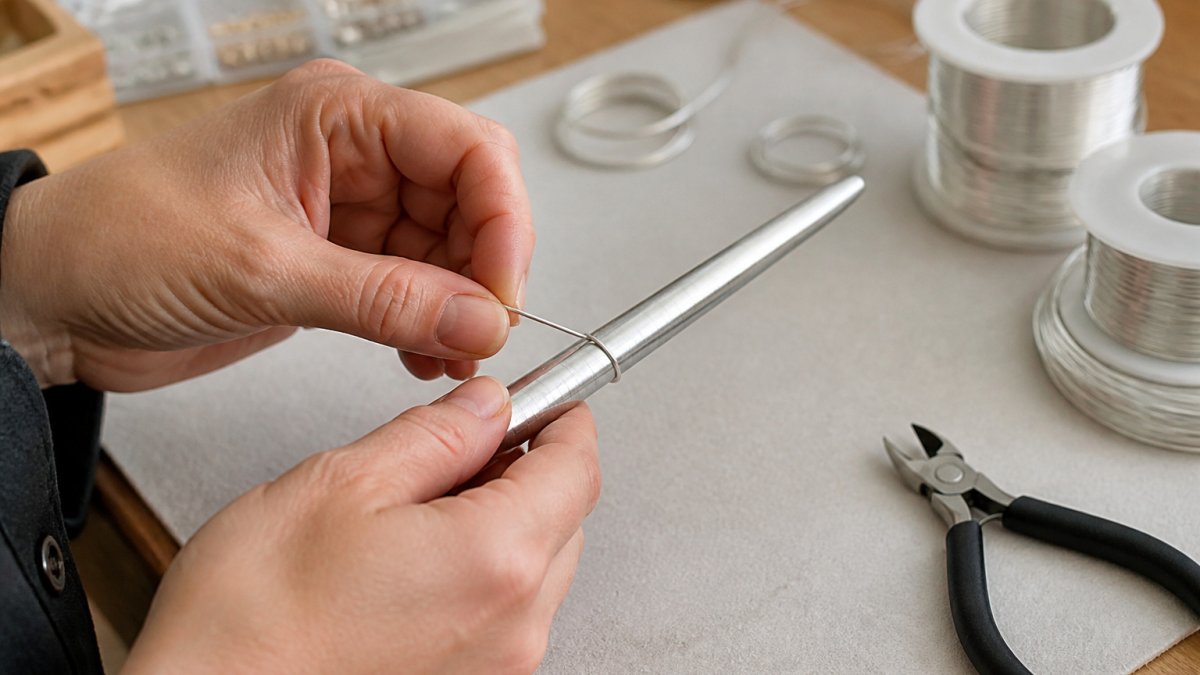
Dimensional accuracy. Gauge is nominal, not exact. Use digital calipers and measure the wire at several points along the spool to check for consistency. Also check that the wire is round rather than oval by measuring across two axes.
Temper consistency. Temper is the heat treatment that sets stiffness. Test it with a controlled bend, not a destructive one: bend a short length around a pencil or dowel and compare the springback against a known-good piece of the same gauge and temper. Wire that feels noticeably softer or springier than its label suggests is mislabeled or inconsistently processed.
Surface finish. Run the wire between your fingers and inspect under bright light. Look for longitudinal scratches, die lines, dull patches, flaking coating, or discoloration at the cut end. A clean, even surface draws smoothly and takes a polish; a rough surface snags on beads and weakens at bends.
Safe home tests, with caveats.
- Springback test: Bend a 2-inch length to 90 degrees, release, and note how far it springs back. Dead soft should stay close to the bend; half-hard springs back moderately; full-hard springs back sharply.
- Kink test: Deliberately kink a scrap piece. A clean fold that recovers suggests good ductility; a sharp crease or crack suggests brittleness.
- Break test: Bend a scrap back and forth until it breaks. A smooth, necked break is normal; a jagged, crystalline break or whitening before failure signals brittle metal.
- Magnet check: A strong magnet should not attract sterling silver, fine silver, copper, or brass. Attraction suggests a steel or nickel core under a plated finish.
Watch out: Every bend, kink, and break test is destructive. Cut a short scrap from the end of the spool and test that, never a length you plan to use. Do not test wire installed in a finished piece.
Supplier evaluation checklist. Before buying, confirm the listing states:
- Exact metal and construction (solid, plated, filled, coated), with alloy or karat where relevant
- Gauge, temper, and shape (round, half-round, square)
- Spool length or weight in feet or ounces, so you can compare price per foot
- Country of origin and any hallmark or stamp
- Return policy for unopened spools and a way to contact the seller with material questions
A seller who publishes full specs, answers nickel and alloy questions directly, and accepts returns on unopened wire is a safer bet than one offering only a photo and a price. Keep a small labeled sample of each spool so you can compare temper and finish the next time you buy.
Reading Plating, Coatings, and Care Information
Labels can be confusing. “Gold plated” and “gold filled” are not the same. Plating is a very thin layer that can wear off with friction. Gold filled has a thicker layer bonded to a base metal, so it lasts longer. For a direct side-by-side of sterling silver versus gold plated options, see our comparison.
Check for these details before buying:
- Metal disclosure: Does the listing name the exact metal, such as 925 sterling silver?
- Coating type: Is the finish plated, filled, or solid?
- Care notes: Does the seller explain how to prevent tarnish?
Sterling silver tarnishes over time. Some people have skin sensitivity to nickel or copper, so check materials if you or the wearer has reactions.
When you’re ready to shop, you can browse the Craft Living Artistry website for current jewelry-making supplies and pricing.
Frequently Asked Questions
What is the best quality wire for jewelry making?
There is no single best wire, because quality depends on the project. For most jewelry, solid metal wire in sterling silver, fine silver, or gold-filled or solid gold for higher-end pieces holds its color and shape well. Look for consistent diameter along the spool, clear metal disclosure on the label, and a stated hardness. Avoid wire that is labeled only as silver-toned or gilded without specifying the base metal, since its finish and durability will be hard to predict. Start with a quality copper or sterling silver wire to practice before investing in precious metals.
Should I use 12- or 14-gauge wire?
Choose 14-gauge wire when you want a lighter, more flexible structure for wrapping, delicate rings, or earwire. Choose 12-gauge when the piece needs more strength and shape retention, such as a sturdy bangle, a bold statement ring, or a pendant frame that must hold stones. Remember that a lower gauge number means thicker wire. For practice, 20 to 22 gauge is a common starting point because it is easy to bend and wrap, and it is inexpensive to experiment with.
How can you identify jewelry wire quality?
Check the spool or packaging for the metal type, gauge, and temper, and confirm whether the wire is solid or plated. Unroll a short length and look for even color, a smooth surface without scratches or flaking, and a round cross-section when you view it end-on. Bend it gently around a mandrel or a pen: good wire should bend cleanly without cracking or kinking. Wire that feels brittle, tarnishes quickly, or varies in thickness along its length is usually lower quality.
Which jewelry wire is best for rings and bracelets?
For rings, many makers prefer half-hard 14- to 18-gauge sterling silver or copper, because it holds a circular shape while still allowing fine adjustments. For bracelets, half-hard or full-hard wire in 12- to 16-gauge works well when you need the band to keep its form. Dead soft wire is easier to shape by hand but can stretch or deform with daily wear, so it is better for wrapped or decorative elements. Always test a sample by wearing or bending it before committing to a finished piece.
Choosing good wire comes down to matching the material, hardness, and gauge to the job. Start with the project, test what you buy, and keep notes on what works. Craft Living Artistry is here to help you find wire and supplies that fit your next design.




0 Comments