Last Updated: October 30, 2026
Quick Summary
The best craft kits for toddlers target a specific developmental skill, match their actual dexterity, and let them do most of the work themselves. Choose kits with pre-cut or peel-and-stick pieces, picture instructions of no more than three steps, and pieces too big to fit through a toilet paper tube.
- A toddler’s realistic attention window for a craft is ten to fifteen minutes.
- Around 24-30 months, look for kits that add a simple two-step sequence.
- Skip loose glitter, small beads, sequins, and thin string, which are choking hazards.
- Run the tube, pull, and tear tests at home to screen for choking hazards.
- Start with one well-matched kit rather than buying five at once.
Table of Contents
- What Makes a Craft Kit Actually Educational for Toddlers?
- Craft Supplies for 2-Year-Olds: What Belongs in the Box
- Toddler Crafts for Fine Motor Skills: What to Look For
- Easy Crafts for Toddlers: Signs a Kit Matches Their Skill Level
- Sensory Craft Kits for Toddlers: Texture, Mess, and Cleanup
- Safety, Choking Hazards, and What the Labels Tell You
- Comparing Popular Craft Kits for Toddlers
- Picking Your First Kit from Craft Living Artistry
- Frequently Asked Questions
What Makes a Craft Kit Actually Educational for Toddlers?
A craft kit is educational for toddlers when it targets a specific developmental skill, matches their actual dexterity, and lets them do most of the work themselves. For a deeper walkthrough, see our guide on how to choose educational craft kits for kids. That’s the whole test. Most kits sold as “educational” fail at least one of those three.
The difference between a kit a toddler completes and one that ends in tears usually comes down to how much of the project is pre-made.
The Skills Toddlers Build Through Crafting
Crafting builds fine motor control, color recognition, and early problem-solving. A toddler peeling a sticker and placing it inside a shape is practicing pincer grip and spatial reasoning at the same time.
The learning lives in the process, not the finished object. A lopsided clay blob your child squashed themselves teaches more than a perfect adult-made flower.
Craft Supplies for 2-Year-Olds: What Belongs in the Box
What belongs in a toddler craft box: chunky crayons, washable markers, large glue sticks, big stickers, soft dough, and paper in bright colors. Everything should be too big to swallow and easy for small hands to grip.
Size is the deciding factor. If a piece fits through a cardboard toilet paper tube, it’s too small for a two-year-old. That tube test is the fastest check you can do at home.
A good toddler kit also limits variety. Ten crayons and one pad beat forty tiny pieces. Fewer choices mean longer focus and less cleanup.
Materials to Skip Until Age Three
Skip anything with loose glitter, small beads, sequins, or thin string. These are choking hazards and they end up in carpet fibers for months.
Also skip kits that need scissors, hot glue, or adult assembly for most of the project. A kit your child watches you build isn’t their craft.
Toddler Crafts for Fine Motor Skills: What to Look For
Look for actions that repeat: peeling, pinching, pressing, threading, and squeezing. Repetition is what builds the hand strength behind fine motor skills.
Threading large beads onto a thick cord, pressing dough into shapes, and peeling stickers off a sheet all work the same muscles a child needs for holding a pencil later.
Watch out: kits labeled for “ages 3+” often assume scissor skills. For a two-year-old, choose tear-and-stick projects instead.
Easy Crafts for Toddlers: Signs a Kit Matches Their Skill Level
A kit matches your toddler when they can finish most steps alone and stay engaged for ten to fifteen minutes. If you need more ideas beyond kits, browse these screen-free activities for rainy days. That’s the realistic attention window at this age. But “matches” looks different at 18 months, 24 months, and 36 months, and most roundups flatten those stages into one “preschool” bucket. Use the stage-by-stage signs below instead.
Signs by Toddler Stage
Around 18-24 months: Look for kits where the main action is grasping, pressing, or peeling. A good sign is that the kit ships with chunky handles, large peel-and-stick pieces, or soft dough that a whole hand can squeeze. If the project requires lining up edges or holding a small tool between thumb and forefinger, it’s a stage too early.
Around 24-30 months: Look for kits that add a simple sequence: peel, place, press; or squeeze, stamp, lift. Two-step repetition is the sweet spot. A good sign is that the instructions show the sequence in two or three pictures with no text.
Around 30-36 months: Look for kits that introduce a choice, pick a color, choose where a sticker goes, decide how to arrange shapes. Choice is what keeps a nearly-three engaged past the ten-minute mark.
Three Signs It’s a Good Fit
- The pieces are pre-cut or peel-and-stick, so the child does the placing rather than the prep
- The instructions use pictures, not paragraphs, and show no more than three steps
- The project has a clear end point a child can see, a filled shape, a completed row, a finished stamp pattern
Three Signs It’s Too Advanced
- The kit assumes scissor skills or precise folding
- The pieces are smaller than the child’s palm grip
- The finished project requires adult assembly for more than a few seconds
A quick at-home test: hand your toddler the main piece and watch for thirty seconds. If they can pick it up, place it, and repeat without you repositioning their hand, the kit fits. If you’re guiding their fingers every step, save it for six months from now.
Sensory Craft Kits for Toddlers: Texture, Mess, and Cleanup
Sensory craft kits for toddlers focus on touch: dough, foam, water beads, textured paper, and washable finger paint. To understand what this play builds, read about the benefits of sensory play for toddler development. The mess is the point, so plan for it.
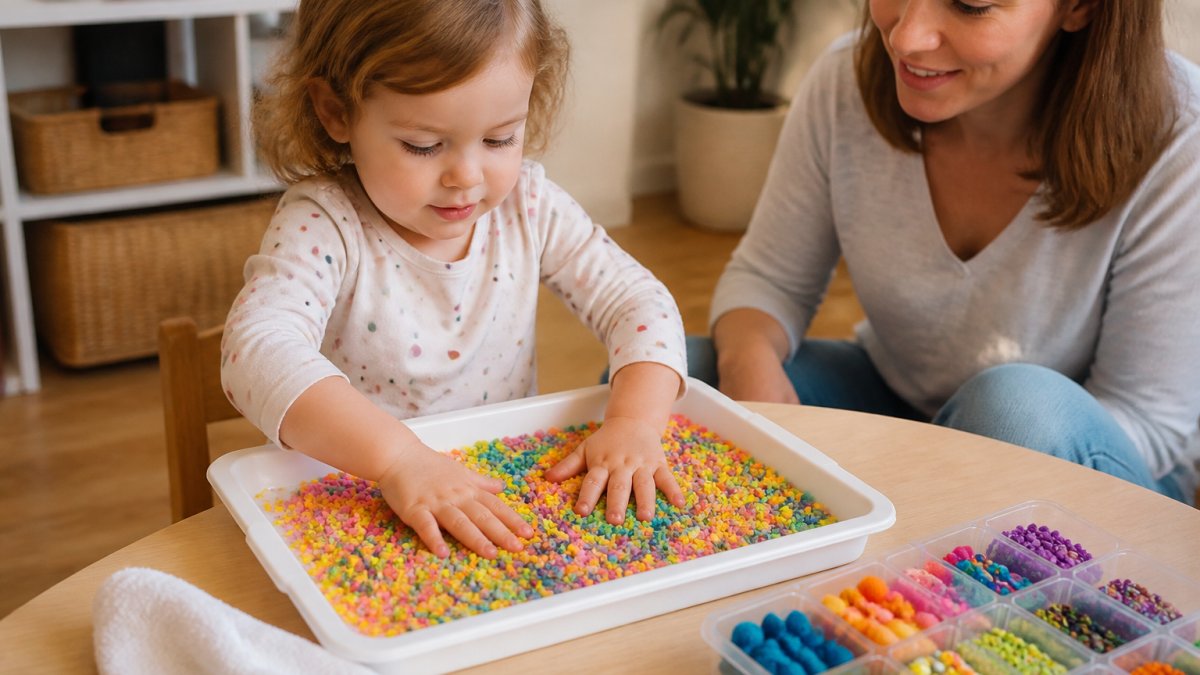
Set a vinyl tablecloth down first and keep a damp cloth within reach. Ten seconds of prep saves twenty minutes of scrubbing.
Safety, Choking Hazards, and What the Labels Tell You
Check three things on every label: the age recommendation, the choking hazard warning, and the material list. Toys intended for children under three are subject to federal small-parts requirements, and the Consumer Product Safety Commission publishes the rules that apply (Small Parts Ban and Choking Hazard Labeling). Check the Consumer Product Safety Commission’s current guidance for the exact test方法 before relying on it.
The At-Home Choking-Hazard Check
You don’t need lab equipment to screen a kit before you buy it. Run these three checks:
- The tube test. Any loose piece that slides through a toilet paper tube is too small for a toddler. This catches beads, sequins, small pom-poms, and tiny sticker backs.
- The pull test. Tug on attached parts, eyes, buttons, pom-poms glued to a base. If a piece comes off with a gentle pull, a toddler will find it and put it in their mouth.
- The tear test. Bend paper and thin plastic pieces. If they tear into small fragments easily, they’ll become choking hazards during normal play.
Materials to Look For and Avoid
Look for “non-toxic” and “washable” on the packaging. For paint and dough, water-based formulas rinse out of clothes and off hands. Avoid kits with loose glitter, small beads, sequins, or thin string, these are choking hazards and they end up in carpet fibers for months. Also skip kits that need scissors, hot glue, or adult assembly for most of the project.
A common mistake is buying up an age range. A kit marked 6+ isn’t a challenge for a toddler, it’s a hazard. The age label reflects the smallest parts and the skills assumed, not the child’s intelligence.
Supervision and Setup
Even a well-matched kit needs an adult within arm’s reach. Keep the kit’s small pieces in a shallow tray so they don’t scatter, and put the tray away when the session ends. For dough and paint, keep a damp cloth on the table and wipe hands before the child leaves the seat. If a kit includes a battery, check that the compartment is screwed shut, button batteries are a serious hazard if swallowed (Button Cell and Coin Batteries).
What the Labels Don’t Tell You
Labels cover the legal minimum, not the developmental fit. A kit can meet every federal requirement and still be wrong for a two-year-old because the project assumes scissor skills. Use the label as a floor, then apply the stage-by-stage fit signs above.
Comparing Popular Craft Kits for Toddlers
Here’s how the options stack up on the factors that matter for a two- or three-year-old.
| Kit | Stated Age | Activity Type | Best For |
|---|---|---|---|
| Craft Living Artistry kids’ craft kits | Varies by kit | Mixed supplies and themed kits | One-stop shopping with clear age sorting |
| KiwiCo Koala Crate | Preschool | Subscription craft box | Recurring projects delivered monthly |
| Craft Activity Kit (Learning Express) | 3-7 | General craft activity | A single low-cost project |
| DIY Fabric Flower Bouquet Kit | Not stated | Fabric flowers | Older kids with adult help |
| Arts & Crafts Kit, 40+ pieces | Not stated | Assorted craft supplies | Families wanting a stocked supply box |
Third-party kits vary in age range and contents, so check each listing’s stated age and included pieces before buying for a young toddler.
For a wider roundup, see our picks for the best kids craft kits for creativity.
Picking Your First Kit from Craft Living Artistry
Start with one kit, not five. A single well-matched project tells you more about your child’s interests than a shelf of unopened boxes.
We curate kids’ craft kits alongside our jewelry-making supplies, cords, beads, and maker tools, so you can find a toddler project and your own materials in one place.
Frequently Asked Questions
What craft supplies are appropriate for a 2-year-old?
Two-year-olds do best with large, chunky materials they can grip without frustration: thick crayons, washable finger paint, big glue sticks, and large stickers. Avoid anything small enough to swallow, including beads, sequins, and tiny pom-poms. Check the age label on every kit before buying, since a kit marked for ages 3 and up may still contain small parts. A good rule is that if a piece fits through a cardboard toilet paper tube, it is too small for a 2-year-old.
Which craft kits help toddlers develop fine motor skills?
Kits built around pinching, squeezing, peeling, and pressing do the most for fine motor skills. Look for sticker mosaics, peel-and-stick foam projects, chunky lacing cards, and dough or clay kits with simple shaping tools. These activities work the small muscles in the hands and fingers that later support pencil grip. Toddler crafts for fine motor skills work best when the kit has a clear finished product, so your child stays engaged long enough to repeat the motion.
How do I choose a safe craft kit for a toddler?
Start with the age range on the box and treat it as a minimum, not a suggestion. Look for washable, non-toxic materials and check whether small parts are included. Confirm the kit lists its contents so you are not surprised by loose beads or sharp tools. For sensory craft kits for toddlers, verify that any dough or slime is labeled non-toxic. Finally, plan to supervise: even a well-labeled kit for ages 3 and up needs an adult nearby for a younger toddler.
Are craft subscription boxes suitable for toddlers?
They can be, if the box is designed for the preschool age range rather than school-age kids. Subscription boxes deliver a new activity on a schedule, which suits toddlers who lose interest in the same kit after a few sessions. Before subscribing, check the stated age range and whether the box includes all materials or requires household supplies. Pricing varies by plan and billing cycle, so check the current rate on the seller’s site before committing.
The hardest part of toddler crafting isn’t finding supplies, it’s finding a kit your child can actually finish. We built our kids’ selection around that problem, with curated kits, complete materials, and age guidance you can check before you buy. Get started with Craft Living Artistry and pick a first kit your toddler can open, make, and feel proud of.




0 Comments