Table of Contents
- Start with the Child: Age-Appropriate Craft Activities for Children
- Why the Benefits of Arts and Crafts for Child Development Matter
- Safety First: Non-Toxic Materials and Safety Standards
- Craft Kits for STEM Learning: What to Look For
- The Educational Craft Kits Checklist: Supplies, Instructions, and Value
- What to Ignore and Common Mistakes When Buying Educational Craft Kits
- Frequently Asked Questions
Last Updated: October 3, 2026
Start with the Child: Age-Appropriate Craft Activities for Children
The best way to choose educational craft kits for kids is to match the kit to your child’s current developmental stage, not their age on the box.
This guide walks through the decisions that actually matter, from developmental stages to safety standards to the subscription-versus-one-time question. Below, we’ll show you exactly how to evaluate any kit before you buy it.
Developmental Stages and What They Mean for Kit Selection
Preschool crafts and early elementary projects look similar on a shelf, but they demand very different skills.
For ages six to eight, project complexity can rise. Multi-step kits with guided instructions and a clear picture of the end result keep attention longer.
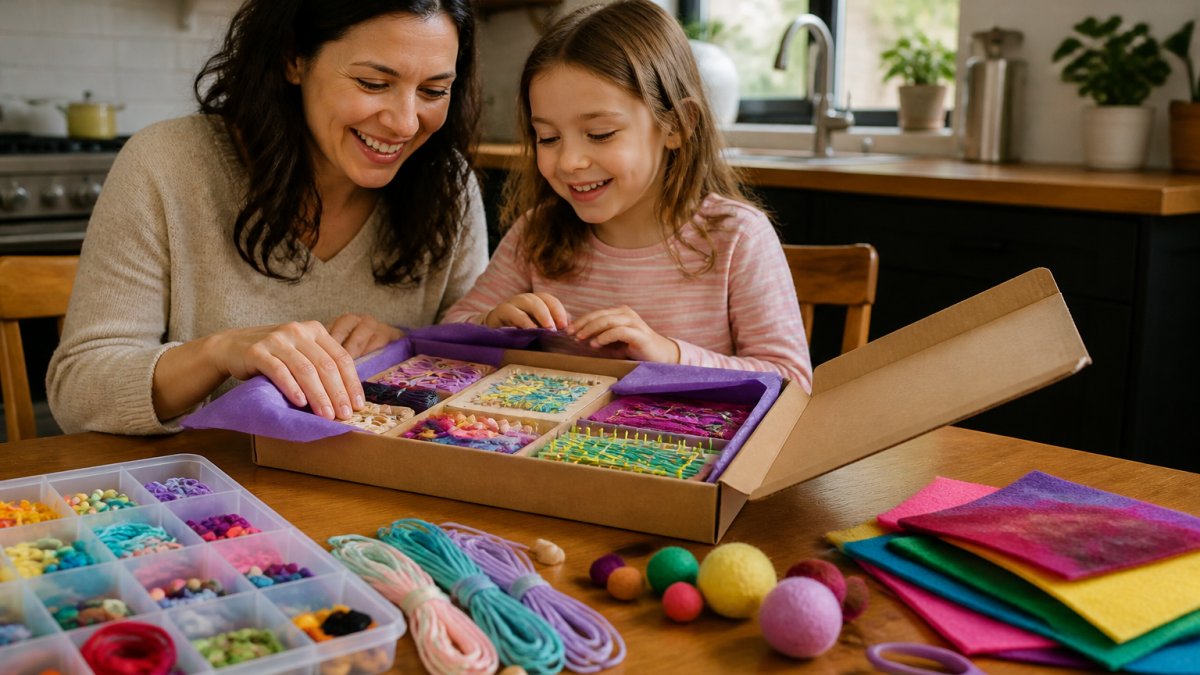
Check the box for a stated age range and a project time estimate. A kit that lists “45 minutes” for a six-year-old is usually telling you it assumes adult help. If you want independent play, look for kits marked as self-guided.
Why the Benefits of Arts and Crafts for Child Development Matter
The benefits of arts and crafts for child development go well beyond a finished object. Hands-on learning builds fine motor skills, supports cognitive development, and gives children a low-stakes space to practice creative problem solving.
Many parents find that screen-free activities become easier to protect once a child has a project they genuinely want to finish. The American Academy of Pediatrics guidance on creative play notes that unstructured creative time supports social, emotional, and cognitive growth in young children.
Fine Motor Skills, Cognitive Development, and Creative Problem Solving
Different craft types build different skills, and knowing which is which helps you pick with intent:
- Threading and beading: fine motor skills, hand-eye coordination, patience
- Clay and pottery: tactile learning, spatial reasoning, material handling
- Painting and drawing: creative expression, color mixing, artistic confidence
- Building and assembly kits: STEM integration, sequencing, structural thinking
Match the skill to the goal. If your child needs to build hand strength, threading beats painting. If you want creative expression, open-ended materials beat a template-driven kit.
Safety First: Non-Toxic Materials and Safety Standards
Non-toxic materials are the first thing to verify, especially for children under six who still put things in their mouths. In the United States, children’s art materials fall under the Federal Hazardous Substances Act, which the Consumer Product Safety Commission (CPSC) enforces. Reputable makers label their products to show compliance, and learning to read those labels takes about thirty seconds once you know what you’re looking at.
How to Read an Art-Material Safety Label
Three markings do most of the work:
- “Conforms to ASTM D-4236”: This is the labeling standard the CPSC requires for art materials under the Labeling of Hazardous Art Materials Act (LHAMA). It means a toxicologist has reviewed the product for chronic hazards and the maker has labeled any that apply. It is a baseline, not a guarantee of quality.
- The AP (Approved Product) seal: Issued by the ACMI (Art & Creative Materials Institute), an industry certification body. The AP seal means the material is certified non-toxic and safe for children when used as intended. The CL (Cautionary Labeling) seal means the product is not for children or requires adult supervision.
- Age and choking warnings: Required by CPSC rules for toys and small parts. A “3+” or “not for children under 3” warning reflects small-parts choking risk, not chemical risk, the two are separate.
If a kit’s packaging says nothing about safety, treat that silence as a warning sign. A maker confident in its materials will say so.
Physical Safety Beyond Chemistry
Chemistry is only half the picture. Check the physical build of the kit itself:
- Small parts: Anything that fits inside a toilet-paper tube is a choking hazard for children under three. Beads, buttons, and small magnets all qualify.
- Magnets and button batteries: High-powered small magnets and coin-cell batteries are among the most serious ingestion hazards in children’s products. If a kit includes either, confirm they are secured and not loose in the box.
- Sharp tools: Real scissors, awls, and craft knives need adult supervision. Look for blunt-tip or plastic-handled versions for younger children.
- Material durability: Flimsy scissors and thin cardboard frustrate small hands and shorten a kit’s useful life, which is a safety issue in its own right when tools break mid-project.
A “non-toxic” claim and an age warning solve different problems. A kit can be certified non-toxic and still be unsafe for a two-year-old because of small parts. Read both labels.
A Quick Pre-Purchase Safety Check
Before you buy, confirm four things on the listing or box: an ASTM D-4236 statement, an AP seal or equivalent non-toxic claim, an age range that matches your child, and a clear list of any tools or small parts that require supervision. If any of the four is missing, ask the maker or skip the kit.
Craft Kits for STEM Learning: What to Look For
Craft kits for STEM learning should ask the child to build, test, and adjust, not just assemble a model once. The best STEM-integrated kits include a variable the child can change, like a different gear ratio or a new structural shape, and a prompt to see what happens.
When you evaluate a STEM kit, ask three questions:
- Does the child make a prediction before building?
- Is there a way to test or measure the result?
- Can the project be rebuilt differently, or is it one-and-done?
A kit that answers yes to all three teaches the engineering mindset, not just the finished object. Kits that only produce a single display piece tend to sit on a shelf after the first build.
The Educational Craft Kits Checklist: Supplies, Instructions, and Value
Use this checklist before you buy any kit. It covers the things that separate a kit your child finishes from one that ends up in a drawer, plus two factors most buying guides skip entirely.
- Complete supplies: Does the kit include everything, or does it require items you have to buy separately?
- Instructional clarity: Are the instructions illustrated, sequenced, and written for the child’s reading level?
- Guided vs. unguided balance: Does it show the steps while leaving room for the child’s own choices?
- Project completion time: Is the time estimate realistic for your child’s attention span?
- Refill potential: Can you restock consumables, or is the kit disposable?
| Kit Type | Best For | Typical Time | Adult Help Needed |
|---|---|---|---|
| Preschool craft kit | Ages 3-5, skill-building | 15-30 min | High |
| STEM building kit | Ages 6-10, problem solving | 45-90 min | Medium |
| Open-ended art kit | Ages 8-12, creative autonomy | Varies | Low |
| Subscription box | Ongoing engagement | Monthly | Varies |
Subscription Box vs. One-Time Kit: Which Fits Your Family?
A subscription box suits families who want a steady stream of new projects and a built-in rotation of materials. A one-time kit suits a child with a specific interest, a gift occasion, or a family testing whether crafting will stick before committing to a recurring cost.
The honest trade-off: subscriptions can pile up unopened if the projects don’t match your child’s interests, and one-time kits can run out of supplies before the child is done exploring.
A common mistake is buying a subscription before you know your child’s preferred medium. If they love clay but you’ve signed up for a paper-craft box, the boxes stack up unopened. Test one kit first.
Neurodivergent-Friendly Craft Kits: What Most Guides Miss
Most buying guides treat every child as a neurotypical crafter. In practice, a large share of families are choosing kits for a child with ADHD, autism, or sensory processing differences, and the criteria shift.
For a child with ADHD, the biggest factor is often project length and structure.
For a child with autism or sensory sensitivities, the material matters as much as the project.
The practical move is to match the format to the child, not the trend.
Sustainability and Eco-Conscious Sourcing
Craft kits are often plastic-heavy: shrink-wrapped components, single-use molds, and packaging that outlives the project by years. If sustainability matters to your family, three questions cut through the greenwashing:
- What is the kit made of? Look for recycled paper and cardboard, FSC-certified wood, natural fibers, and plant-based or biodegradable clay. Avoid kits whose main components are single-use plastic.
- What happens after the project? A kit with reusable tools and refillable consumables produces less waste than a one-and-done box. Refill potential is both a value and a sustainability metric.
- Is the packaging recyclable? Curbside-recyclable cardboard and paper beat mixed-material plastic clamshells that most programs won’t accept.
A useful rule: the more a kit’s materials can be reused, refilled, or composted, the better it scores on both cost-per-hour and environmental impact. Those two goals usually point the same direction.
Skill Progression: Turning Kits into a Roadmap
Rather than buying random kits, plan a path. A workable progression looks like this: threading and beading first (fine motor foundation), then simple assembly kits (sequencing and following steps), then multi-step STEM projects (prediction and testing), then open-ended design (independent creative decisions). Each stage builds on the last, and your child’s confidence grows with the difficulty. When you evaluate a kit against this roadmap, ask which stage it serves, a kit that doesn’t advance the child is a kit that sits on a shelf.
What to Ignore and Common Mistakes When Buying Educational Craft Kits
The biggest mistake is buying for the finished object instead of the process.
Other patterns worth avoiding:
- Chasing the lowest price: Cheap kits often skimp on supplies, and a missing piece turns a gift into a chore.
- Ignoring the child’s interest: A kit that matches a hobby your child already loves gets used; a generic kit often doesn’t.
- Overlooking neurodivergent needs: Some children do better with clear step-by-step structure and low-sensory materials; others thrive with open-ended, tactile options. Match the format to the child, not the trend.
- Skipping the sustainability question: Eco-conscious sourcing matters to many families, so check whether a maker uses recycled or responsibly sourced materials when that’s a priority for you.
A skill progression roadmap helps here. Rather than buying random kits, plan a path: threading and beading first, then simple assembly, then multi-step STEM projects, then open-ended design.
At Craft Living Artistry, we curate kids’ craft kits so the supplies, instructions, and skill level line up in one box, which takes the guesswork out of that progression.
Frequently Asked Questions
What factors should you consider when buying craft kits for children?
Focus on the child’s age and developmental stage, material safety, and the kit’s educational value. Check for non-toxic materials and clear instructions. Consider whether the kit builds fine motor skills or creative problem solving. Also think about project completion time and whether the child can work independently or needs guided help. A good educational craft kit balances challenge with achievable success.
How do educational craft kits support child development?
Educational craft kits support cognitive development, fine motor skills, and creative expression. Hands-on learning through crafts helps children practice following steps, make decisions, and solve problems. For example, building a simple circuit or weaving a pattern teaches sequencing and patience. These activities also build artistic confidence and give kids a sense of ownership over their work.
What materials should I look for in high-quality kids’ craft kits?
Look for non-toxic, washable materials that meet safety standards. Check that supplies are durable enough to survive handling by small hands. Kits with pre-cut pieces and clear, illustrated instructions reduce frustration. Avoid kits with strong chemical smells or loose glitter that can be inhaled. For STEM kits, ensure components like wires or magnets are securely encased.
Are craft kits suitable for all age groups?
Craft kits work for a wide range of ages, but the complexity must match the child’s developmental milestones. Preschool crafts often focus on sensory play and simple assembly. Early elementary kits introduce guided projects with more steps. Older kids can handle open-ended creativity and STEM integration. Always check the manufacturer’s age recommendation and consider your child’s individual skills.
Choosing well comes down to one question: does this kit build a skill your child is ready to practice? Answer that, and the rest, from safety labels to subscription timing, falls into place. Craft Living Artistry curates a focused selection of kids’ craft kits with complete supplies, clear instructions, and age-appropriate projects, all in one convenient place. Explore our kids’ craft kits and find the project that fits your child’s next stage.




0 Comments