
Last Updated: November 20, 2026
Quick Summary
To choose beads, start with the finished piece: name what you’re making, match bead weight to the wearer, and set a cost-per-piece budget. Then check bead size in millimeters and hole diameter against your string before buying a full strand.
- Most beaded jewelry uses beads between 4mm and 12mm, measured by diameter, not hole size.
- Bracelets usually sit comfortably with 6mm to 8mm beads, while necklaces can go up to 12mm or more.
- Multiply string diameter by the number of passes and compare it to the hole diameter before stringing.
- Beginners do best with glass, wood, and metal beads in a few consistent sizes.
- Use one focal bead per piece, surrounded by smaller accent beads in a complementary color.
Table of Contents
- Start With the Project: A Bead-Selection Decision Tree
- Different Types of Beads and Their Names
- Bead Sizes for Jewelry Making: What the Numbers Mean
- How to Pick Beads and String for Beaded Jewelry
- Best Beads for Beginner Jewelry Making
- Balancing Focal and Accent Beads for Visual Interest
- Quality Checks, Wearability, and Material Care
- Build Your First Bead Palette With a Curated Kit
- Frequently Asked Questions
Start With the Project: A Bead-Selection Decision Tree
Learning how to choose beads for jewelry making gets easier once you stop shopping by color and start shopping by project. New makers often buy what looks pretty, get home, and discover the beads don’t fit their string or their clasp. The fix is a short decision tree you run before you spend a cent.
Step 1: Name the Finished Piece
Write down exactly what you’re making: a bracelet, a necklace, earrings, or a multi-strand piece. The finished piece sets your bead size range, your weight limit, and how many beads you need.
Step 2: Match Bead Weight to the Wearer
Heavy beads can drag on a neckline and stretch string over time. Light beads often suit earrings. Think about who wears it and for how long.
Step 3: Set a Cost-Per-Piece Budget
Divide your total bead budget by the number of pieces you plan to make. That number tells you whether you can afford gemstone beads or should start with glass and wood.
Different Types of Beads and Their Names
Beads fall into a handful of material families, and each one behaves differently on a finished piece. Here’s a short glossary for beginners:
- Seed beads: tiny glass beads, usually 2mm to 6mm, used for weaving and detail work
- Czech glass: pressed glass beads known for consistent shape and rich color
- Crystal beads: faceted glass with high sparkle, best as accents
- Gemstone beads and semi-precious stones: natural stone, heavier and often irregular
- Wood beads: light, warm, and budget-friendly, great for casual designs
- Metal beads: brass, copper, or silver-toned spacers and accents
- Bead findings: clasps, jump rings, and ear wires that hold the piece together
Bead Sizes for Jewelry Making: What the Numbers Mean
Bead size is measured in millimeters, and that number refers to the bead’s diameter, not its hole. Most beaded jewelry uses beads between 4mm and 12mm. Seed beads run smaller, from 2mm up.
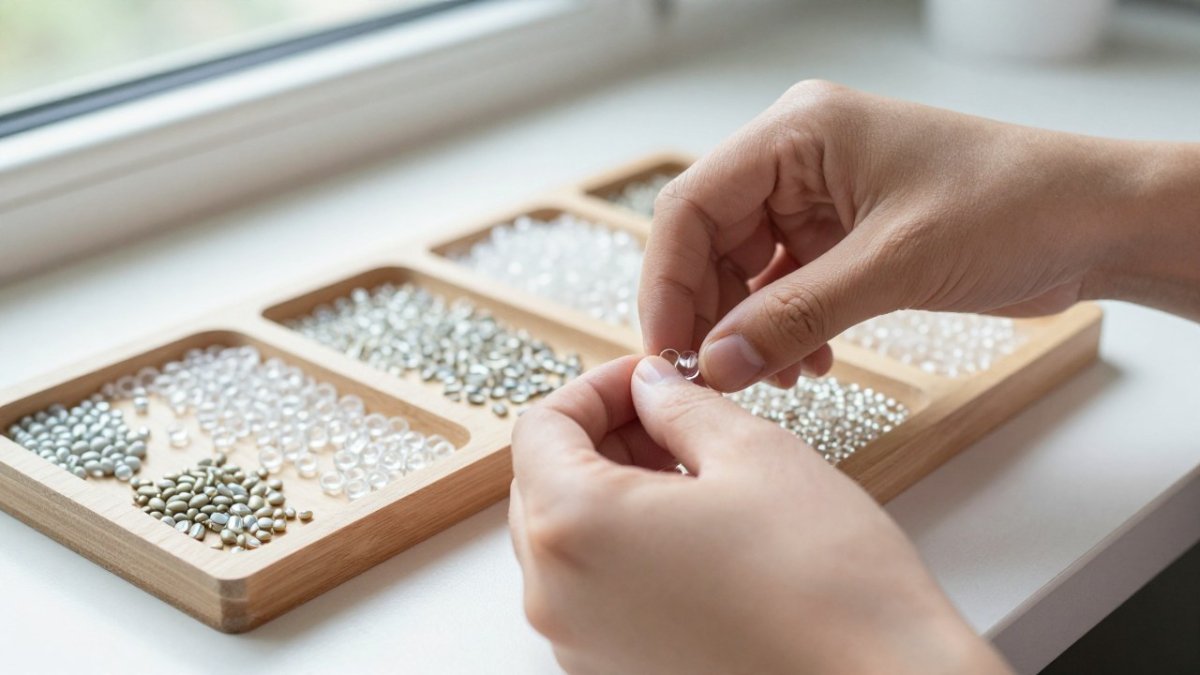
Bracelets usually sit comfortably with 6mm to 8mm beads. Necklaces can go larger, up to 12mm or more for a focal look. Earrings work best with light beads.
A common mistake is buying a mixed scoop without checking size consistency. Uneven beads make a lumpy strand.
Bead size is measured in millimeters as the bead’s diameter, and these ranges cover most beaded jewelry.
| Piece | Typical bead size | Note |
|---|---|---|
| Most beaded jewelry | 4mm to 12mm | Size refers to diameter, not hole |
| Seed beads | 2mm up | Run smaller than standard beads |
| Bracelets | 6mm to 8mm | Sits comfortably |
| Necklaces | Up to 12mm or more | Larger for a focal look |
| Earrings | Light beads | Best with light beads |
How to Pick Beads and String for Beaded Jewelry
The bead and the string have to agree with each other. A bead hole that’s too small won’t take your wire, and a hole that’s too large lets the bead slide and wobble. The practical rule is to work backward from the hole: measure the hole, then choose the thinnest stringing material that still holds the weight of the finished piece.
Bead-Hole Diameter and Stringing Compatibility
Bead hole diameter determines which stringing material will pass through. Most bead strands list a hole size in millimeters, and the number refers to the opening, not the bead’s outside diameter. A 6mm bead might have a 0.8mm hole or a 2mm hole depending on the material and manufacturer, so the outside size tells you nothing about what will fit.
Match your string to the hole using these working ranges:
- Beading wire: commonly sold in gauges from about 0.38mm (28-gauge, fine and flexible) up to about 0.51mm (24-gauge, stiffer and stronger). Best for gemstone and metal beads, holds shape well, and needs a hole of at least the wire diameter plus a little clearance.
- Thread: nylon or bonded thread for seed beads and weaving. Seed beads are sized so that a specific number of thread passes fit through the hole, a size 11 seed bead typically takes two to three passes of a fine beading thread, which is why weavers test before committing.
- Cord: leather, cotton, or elastic cord for wood and larger-hole beads. Cord compresses and frays, so choose a cord that fills roughly two-thirds of the hole to reduce wobble.
The Passes Rule
Every design has a hidden constraint: how many times the string must pass through a bead. A single-strand bracelet passes through each bead once. A multi-strand piece, a loop-back finish, or a bead woven into a pattern may pass through the same bead two, three, or four times. Multiply the string diameter by the number of passes and compare that to the hole diameter.
Watch out: a bead that accepts one pass of wire may not accept the second pass needed to loop back through a focal bead and hide the tail, test the return pass on a single bead before stringing the full strand.
Matching String to Bead Weight and Finish
Heavier beads need stronger string. Gemstone and metal beads put more load on the wire and on the clasp, so use a heavier beading wire and a clasp rated for the finished weight.
Always check hole size before you buy a full strand. A quick test with your wire saves a return, and a caliper or the manufacturer’s listed hole size is more reliable than eyeballing the opening.
Best Beads for Beginner Jewelry Making
Beginners do best with glass, wood, and metal beads in a few consistent sizes. These materials are affordable, easy to string, and forgiving when you’re learning tension.
Start with one bead size and two or three colors. Add accent beads once your first piece is done. For a deeper list of top options, see our guide to the 10 best beads for professional jewelry making.
Balancing Focal and Accent Beads for Visual Interest
A focal bead is the one your eye lands on first. Accent beads support it. Without that balance, a strand reads as noise.
Use one focal bead per necklace or bracelet, placed at the center or slightly off-center. Surround it with smaller accent beads in a complementary color. Contrast in size and finish creates visual interest without clutter.
Quality Checks, Wearability, and Material Care
Before you buy any strand, run a quick quality check. The goal is to catch problems while the beads are still returnable, because inconsistent sizing, chipped finishes, and irregular holes all show up after the piece is strung.
A Repeatable Pre-Purchase Checklist
Run these checks on every strand before you commit:
- Size consistency: measure five to ten beads with a caliper or compare them against a known-size bead. A strand sold as 6mm that varies by more than about 0.3mm will string lumpy.
- Hole consistency: look down the strand and check that holes sit centered. Off-center holes make beads tilt and can crack under tension.
- Finish integrity: inspect for chips, bubbles, and thin spots in coatings. On coated or plated beads, look at the hole edges, where finishes wear first.
- Color variation: natural stone and some glass vary from bead to bead. Decide whether the variation reads as character or as a mismatch before you buy a full strand.
- Roll test: roll a few beads on a flat surface. Inconsistent ones wobble, which signals irregular shape or size.
- String condition: check that the temporary string isn’t cutting into the beads or leaving residue in the holes.
Wearability, Allergies, and Skin Sensitivity
Wearability matters too. Some people react to certain metal findings, so choose ear wires and clasps with care if sensitive skin is a concern. Common options include surgical stainless steel, niobium, and sterling silver for sensitive ears, while many base-metal and plated findings contain nickel, a common trigger. For bracelets and necklaces that sit against the skin, coated or plated beads can wear through at contact points and expose the base metal underneath.
Weight is part of wearability. Heavy gemstone or metal beads pull on the earlobe and stretch string over time, so keep earrings light and reserve heavier beads for necklaces and bracelets where the load is spread across a longer strand.
Material Care by Bead Type
- Gemstone and glass: store away from direct sun, which can fade some stones and coatings, and keep strands separated so harder beads don’t scratch softer ones.
- Metal findings: keep dry, and wipe after wear to remove skin oils and moisture that speed tarnishing.
- Wood and porous beads: keep away from water and prolonged humidity, which can swell, crack, or warp them.
- Coated and plated beads: avoid prolonged water exposure and harsh cleaners, which break down coatings faster than normal wear.
Watch out: water exposure is the most common cause of premature failure, remove bracelets and necklaces before swimming, showering, or washing dishes, and dry metal findings immediately if they do get wet.
For a fuller breakdown of judging bead quality before you commit, read our guide on how to choose quality jewelry beads.
Build Your First Bead Palette With a Curated Kit
The fastest way to learn how to choose beads for jewelry making is to start with a kit that already matches sizes, holes, and findings.
A starter kit can remove some of the guesswork by putting your beads and supplies together in one place. When you’re ready for techniques to pair with it, our guide on how to start jewelry making with beginner-friendly techniques walks you through the basics.
If you want everything in one box, our jewelry making starter kit includes the essential tools and findings. Prefer to begin with seed beads? Our glass seed beads jewelry kit comes with labeled sizes so you can practice sizing as you string.
Choosing beads stops being overwhelming once you run the decision tree and check hole sizes before you buy. At Craft Living Artistry, we curate kits, cords, beads, and maker tools so every project starts with parts that fit together.
Frequently Asked Questions
What are the different types of beads and sizes available for jewelry making?
The main families are seed beads, Czech glass, crystal, gemstone and semi-precious stones, wood, and metal beads. Sizes range from tiny seed beads up to larger focal beads. Round beads are listed by diameter. Start with a mix of 4mm, 6mm, and 8mm rounds so you can build bracelets and necklaces without hunting for odd sizes.
How do I choose beads and string that actually work together?
Check the bead hole diameter against your stringing material before you buy. Beading wire comes in diameters measured in thousandths of an inch, and a good rule is to use the thickest wire that still passes through the hole twice. For heavy gemstone or metal beads, choose a thicker wire and add crimp beads at the ends. For lightweight seed bead work, a fine wire or strong thread works better. Always string a short test section first to confirm the beads slide freely.
Which beads are best for beginner jewelry making?
Glass and wood beads are often a beginner-friendly starting point because they are light, easy to string, and available in many colors. Avoid irregular gemstone chips and very small seed beads until you are comfortable with tension and finishing.
How can I combine bead colors and shapes without making a design look cluttered?
Limit yourself to one focal bead, two accent colors, and one neutral in a single piece. Pick a color palette from a photo or fabric you like, then repeat each color at least twice so the eye has something to follow. Mix shapes sparingly: pair round beads with one contrasting shape, such as a faceted rondelle or a coin bead, rather than three. Texture and finish, like matte versus shiny, add variety without adding visual noise.




0 Comments