
Table of Contents
- Why Proper Storage Matters for Resin Supplies
- Ideal Temperature and Climate for Resin Storage
- Choosing the Best Containers for Resin Storage
- Does Resin Expire? Shelf Life of Each Component
- How to Clean and Store Silicone Resin Molds
- Organizing Pigments, Mica Powders and Alcohol Inks
- Safety, Spill Containment and Inventory Tracking for Your Setup
- Set Up Your Resin Storage System Today
- Frequently Asked Questions
Why Proper Storage Matters for Resin Supplies
Last Updated: November 9, 2026
Resin supplies are not forgiving. Leave an open bottle of UV resin on a sunny windowsill, and you may find it thick and useless a few weeks later. Good storage protects your investment and keeps your work safe. A tidy setup helps crafters enjoy the hobby more and waste less material.
Learning how to store resin jewelry supplies correctly does three things at once:
- Protects material quality: Moisture, heat, and light break down resin and pigments over time.
- Keeps you safe: Clearly labeled chemicals stay away from kids and pets.
- Saves money: Fewer ruined bottles means fewer replacements.
Many crafters treat storage as an afterthought. A common mistake is buying supplies in bulk, then tossing them into a drawer with no labels and no lids checked. Within a few months, nobody remembers what is still good. Taking a few minutes to set up a proper system up front prevents that waste. Learn how to organize jewelry making beads into clear, labeled sections.
Ideal Temperature and Climate for Resin Storage
Resin does best in a cool, dry, stable room. Manufacturers generally recommend keeping resin away from direct sunlight and large temperature swings.
Temperature swings matter as much as the heat itself. Repeated warming and cooling can change how resin thickens and cures. Pick a spot where the temperature stays fairly steady through the day and across seasons.
Keep these basics in mind:
- Avoid direct sunlight: UV light can start curing or degrading resin in the bottle.
- Stay out of garages and sheds: They often get too hot in summer and too cold in winter.
- Watch humidity: Moisture can ruin pigments and contaminate open supplies.
- Keep supplies off the floor: Basements tend to hold dampness.
Check the manufacturer’s label for the storage range on each product. Those instructions beat any general rule, because formulas vary.
Storage conditions change how long resin lasts, so the article recommends a few basic climate rules.
| Condition | Recommendation | Why it matters |
|---|---|---|
| Sunlight | Avoid direct sunlight | UV light can start curing or degrading resin |
| Temperature | Stable, cool room | Swings change how resin thickens and cures |
| Humidity | Keep dry | Moisture ruins pigments and contaminates supplies |
| Garages and sheds | Avoid | Too hot in summer, too cold in winter |
| Floor storage | Keep off floor | Basements tend to hold dampness |
Choosing the Best Containers for Resin Storage
Your containers do most of the protecting, but the wrong container can do real damage. Resin, hardeners, and solvents can soften, cloud, or even dissolve some plastics, and a failed container means a leak, a ruined shelf, and a safety hazard. Choose containers by what is going inside them, not by what is on sale.
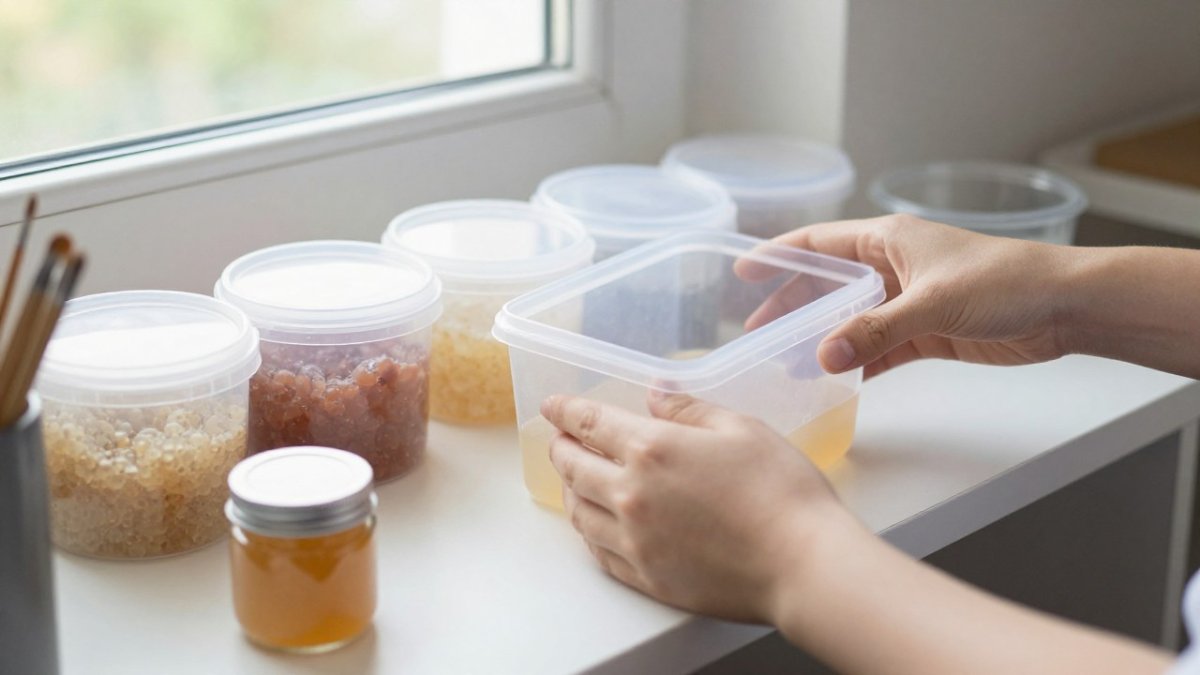
Start with these baseline features for any resin supply container:
- Airtight seals: Stop air and moisture from getting in and keep volatile solvents from escaping.
- Opaque or tinted sides: Block light for UV-sensitive products.
- Clear labeling areas: Write the product name, open date, and batch number.
- Upright shape: Tall, narrow bottles stand straight and waste less space.
Upright storage works well for bottles of resin and pigments, since it keeps liquids from leaking into lids. Horizontal storage suits flat items like silicone molds and resin sheets. Store each product the way its label recommends.
Plastic vs. Glass: Chemical Compatibility
Glass is non-porous, does not absorb odors or residue, and resists most solvents. It is the safest default for alcohol inks, acetone, and any solvent-based product. The trade-offs are weight, breakage risk, and cost.
Plastic is lighter, cheaper, and easier to stack, but not all plastics are equal around craft chemicals. Two resin codes matter most:
- PP (polypropylene, recycling code 5): Resists most solvents and is the usual material for chemical-resistant trays, measuring cups, and storage bins. It is a good choice for secondary containment and for short-term storage of mixed or wiped-down tools.
- HDPE (high-density polyethylene, recycling code 2): Resists many chemicals and moisture well, making it suitable for pigment and powder storage. It is less resistant to strong solvents than PP over long contact.
- PET (code 1) and PS (code 6): Common for food and retail packaging but can cloud, craze, or soften when exposed to solvents like acetone or some alcohol ink carriers. Avoid these for solvent storage.
- LDPE (code 4): Flexible and fine for dry goods and secondary bags, but not a barrier against solvent vapors over time.
Before you transfer any chemical into a plastic container, check the container’s own label and the resin or solvent supplier’s chemical compatibility chart.
Watch out: Never store chemicals in food containers or drink bottles. Anyone could mistake them for something safe to consume, and the container itself may not resist the chemical.
Keep your containers in good shape. Replace lids that no longer seal, and clean up any spills right away so residue does not dry around the openings.
Does Resin Expire? Shelf Life of Each Component
Yes, most resin products have a limited shelf life. Epoxy resin and its curing agent each degrade at their own rate, so check both. Once the two are mixed, they begin to cure, and you cannot store the mixture.
General patterns to watch for:
- Epoxy resin: Often stable for about a year when unopened and stored properly.
- Curing agent or hardener: Can lose strength over time, sometimes sooner than the resin.
- UV resin: Usually shorter shelf life and very sensitive to light.
- Pigments and mica powders: Generally last longer, but moisture can cause clumping.
- Alcohol inks: Can thicken or evaporate if the cap is left loose.
Write the date you opened each product on the bottle or lid. Manufacturers’ printed expiration dates are the best guide. If a product looks cloudy, lumpy, or has an odd smell, it is safer to replace it than to risk a bad piece.
How to Clean and Store Silicone Resin Molds
Silicone molds last a long time when you clean and store them correctly. Wash each mold with mild soap and warm water after use, then dry it fully before putting it away. Troubleshoot sticky UV resin jewelry after curing. Leftover resin residue can attract dust and affect future pieces.
Storage tips for silicone molds:
- Store flat or loosely rolled: Avoid creases that can warp the shape.
- Keep them away from heat: High temperatures can soften or distort silicone.
- Do not stack heavy items on top: Weight can deform thin molds.
- Dust-free bags or bins: Protect the surfaces from debris.
Handle molds gently when you remove cured pieces. Tearing or stretching a mold early shortens its life. Store them separately from sharp tools that could scratch the surface.
Organizing Pigments, Mica Powders and Alcohol Inks
Pigments, mica powders, and alcohol inks look similar on a shelf, so labeling matters. Group them by type and color family, then store each group in its own container. Small divided organizers help keep powders from mixing.
A simple organization method:
- Sort by product type: Keep pigments, mica, and inks in separate sections.
- Use clear divided trays: Compartments stop powders from spilling into each other.
- Label each slot: Include the color name and the date you opened it.
- Store inks upright and sealed: This prevents leaks and evaporation.
Keep powders dry. Even a little moisture can turn fine mica into clumps. Keep a small packet of desiccant in the bin if your room tends to feel damp.
Divided storage boxes with small compartments can hold pigments, flakes, and small tools in one place. Just remember to store the bottles upright and tightly capped.
Safety, Spill Containment and Inventory Tracking for Your Setup
Resin chemicals deserve respect. Read the safety data sheet (SDS) for each product and follow its storage and handling rules. The Occupational Safety and Health Administration (OSHA) and the Environmental Protection Agency (EPA) publish guidance on chemical storage and disposal that is useful for home studios too.
Safety habits to build in:
- Store chemicals up high or locked: Keep them out of reach of children and pets.
- Keep a spill kit nearby: Absorbent pads, nitrile gloves, a sealable waste bag, and a small PP or metal tray work well.
- Use a catch tray: A plastic or metal tray under your bottles catches drips.
- Ventilate the workspace: Good airflow reduces fumes while you work.
- Store gloves and masks close by: Keep protective gear in its own bin near your workbench.
Spill Containment Supplies to Keep on Hand
A spill kit does not need to be elaborate, but it should be complete enough to handle a tipped bottle without a scramble. A practical home-studio kit includes:
- Nitrile gloves (not latex, which some solvents degrade)
- Absorbent pads or paper towels
- A sealable plastic bag or lidded container for used absorbents
- A small PP or metal tray to contain the spill area
- A labeled container for solvent-soaked cleanup rags
Watch out: Solvent-soaked rags and paper towels can self-heat or ignite if piled together. Spread them flat to dry in a ventilated area away from heat, or place them in a sealed metal container, and follow your local hazardous waste rules for disposal.
A Simple Inventory Tracking System
Inventory tracking saves money and prevents waste, and it is the step most hobbyists skip. Discover how supply kits and bulk buying reduce the hassle of managing stock. A notebook works, but a spreadsheet makes it easier to sort and review. Set up columns for:
- Product name and color
- Date opened
- Batch or lot number
- Estimated amount left
- Expiration or review date
A simple method is to assign each product a review date when you open it, then sort the sheet by that date. Check the list every few months. Use up older products first, and mark anything that has passed its date for disposal. Dispose of expired resin and solvent through your local hazardous waste program. Never pour resin down the drain or throw liquids in the trash.
If you have a small space, stackable bins and wall-mounted rails keep supplies organized without taking up floor room. Apartment crafters often do well with a single rolling cart that holds everything in one place.
Set Up Your Resin Storage System Today
A good storage setup takes an afternoon. Start by clearing one shelf or cabinet that stays cool and dry.
For most crafters, a good system includes:
- A cool, dry, dark storage spot
- Airtight, labeled containers
- Separate sections for pigments, inks, and molds
- A spill kit and protective gear within reach
- A running inventory list with open dates
Start small and build as you go. Once your system is in place, you will spend less time searching and more time creating.
Watch out: Do not store curing agents or resin near heat sources or in direct sun, since this can shorten their useful life.
Ready to get organized? Browse our 15-grid organizer storage box and our 24-color resin pigment set to start building a storage setup that fits your studio.
Frequently Asked Questions
Does unused resin go bad?
Yes, unused resin has a limited shelf life. Epoxy resin and its hardener are sensitive to moisture, heat and air, which can thicken the resin or slow its cure. Keep both parts tightly sealed in their original containers, store them upright in a cool, dry spot, and check the manufacturer’s label for the expiration date. Resin that has become cloudy, clumpy or unusually thick should be tested on a small sample before you use it on a finished piece.
How long does epoxy resin jewelry last if stored properly?
Cured epoxy resin jewelry is durable and can last for years when it is kept out of direct sunlight, away from heat and stored in a soft pouch or padded box. Prolonged UV exposure can cause yellowing, so display pieces away from windows. Keep finished jewelry separate from raw supplies to avoid scratches, and wipe off dust with a soft cloth before storing.
How do people store their resin molds to prevent warping?
Store silicone molds flat or hanging rather than stacked under heavy items, since pressure over time can distort the shape. Make sure molds are fully dry and free of cured resin residue before putting them away. Keeping them out of hot spaces such as attics or cars also helps them hold their shape for future projects.
Can I store resin supplies in a garage or shed?
A garage or shed is usually not ideal because temperatures swing widely and humidity can be high. If you have no other option, use airtight containers, add silica gel packets to absorb moisture, and check supplies regularly. Keep resin away from freezing temperatures and very hot days, and store chemicals in a location away from sparks, open flames and food.




0 Comments