
Last Updated: November 14, 2026
Quick Summary
Source high-quality jewelry findings from suppliers who can answer three questions in writing: the base metal, the plating thickness in microns, and whether the item is nickel-free by alloy or by test. Buy sterling or gold-filled for parts that touch skin and bear load, and plated base metal for decorative pieces. Test a small batch before committing to wholesale.
- Build a jewelry findings chart and buy only against that list.
- Stock two or three sizes of each component rather than one bulk bag.
- Use sterling or gold-filled for ear wires, clasps, and bracelet jump rings.
- Buy in bulk only when per-unit savings exceed cash and storage costs.
- Test a small batch and measure ten pieces before a large wholesale order.
Table of Contents
- Start With a Jewelry Findings Chart to Know What You Need
- Precious Metals vs. Base Metal: What Holds Up Over Time
- How to Identify High-Quality Jewelry Findings
- Jewelry Findings Wholesale: When Bulk Supply Pays Off
- Choosing Jewelry Findings for Pendants
- Testing Quality at Home and Troubleshooting Common Failures
- Ethical Sourcing and Supply Chain Transparency
- Build Your Findings Inventory With Craft Living Artistry
- Frequently Asked Questions
Start With a Jewelry Findings Chart to Know What You Need
A jewelry findings chart is a reference list of the small metal components that hold a piece together, and building one before you shop is the fastest way to avoid overpaying for parts you will never use.
Most beginners buy findings by the bag and end up with a drawer full of mismatched sizes. A chart fixes that. Write down each component, the metal you want, and the size in millimeters, then buy only against that list.
Core Components Every Studio Should Stock
Start with the parts that appear in nearly every design. Jump rings connect components and come in wire gauges measured in millimeters. Clasps close a piece, with lobster claws for necklaces and spring rings for bracelets. Headpins and eye pins hold beads in place, while bails let a pendant hang from a chain. Crimp beads secure beading wire, and ear wires finish any earring project.
Stock two or three sizes of each rather than one bulk bag. A studio with 4mm and 6mm jump rings handles most designs; a single 8mm bag handles very few.
Precious Metals vs. Base Metal: What Holds Up Over Time
Metal choice decides whether a piece survives a year of wear or tarnishes in a drawer. Precious metals cost more upfront and last longer. Base metals cost less and demand more care. The difference is not just price; it is how the metal behaves under repeated stress, skin contact, and cleaning.
Sterling Silver, Gold-Filled, and Vermeil Compared
Sterling silver contains 92.5 percent silver alloyed with copper, and it tarnishes but polishes back to a bright finish. The copper is what makes sterling harder than fine silver, but it is also why sterling darkens when exposed to sulfur compounds in air, wool, and some papers. Store sterling in tarnish-resistant bags with a sulfur-absorbing strip, and polish with a soft cloth rather than abrasive dips that strip the surface.
Gold-filled metal is a layered product with a gold layer bonded over a base metal core.
Vermeil is sterling silver coated in a layer of gold.
For a deeper comparison of these options before you commit, our guide to sterling silver vs gold plated jewelry making breaks down the trade-offs.
Base Metals, Plating Thickness, and Nickel Release
Base metal findings with electroplating sit at the bottom of the durability scale. Plating thickness decides how long the finish lasts, and thin plating wears through at clasp edges first.
Nickel is the metal most likely to cause contact dermatitis, and it is common in inexpensive base-metal alloys and in some platings. If a customer has metal sensitivities, look for nickel-free and hypoallergenic labeling rather than assuming.
How to Verify What a Listing Claims
Metal content claims are regulated in the United States. The Federal Trade Commission’s jewelry guides set the rules for how metal content and claims like “gold,” “silver,” and “gold-filled” must be described in advertising, which makes them a useful benchmark when a listing’s wording looks loose.
Ask the supplier three questions before you buy: what is the base metal, what is the plating thickness in microns, and is the item nickel-free by alloy or by test. A supplier who can answer all three in writing is selling a product they understand. A supplier who answers only with adjectives is selling a finish, not a specification.
Matching Metal to the Part
Not every finding needs the same metal. Use sterling or gold-filled for the parts that touch skin and bear load: ear wires, clasps, and jump rings on bracelets. Use plated base metal for decorative connectors, bead caps, and spacers that see less friction. This split keeps cost down without putting weak metal where a piece will fail. A bracelet clasp in thin plating will wear through at the spring before the chain shows any wear, which is why clasp metal is the first place to upgrade.
How to Identify High-Quality Jewelry Findings
Quality shows up in three places: weight, finish, and the cut of the wire ends. A well-made finding feels heavier than its size suggests, has no rough edges, and closes with a clean snap.
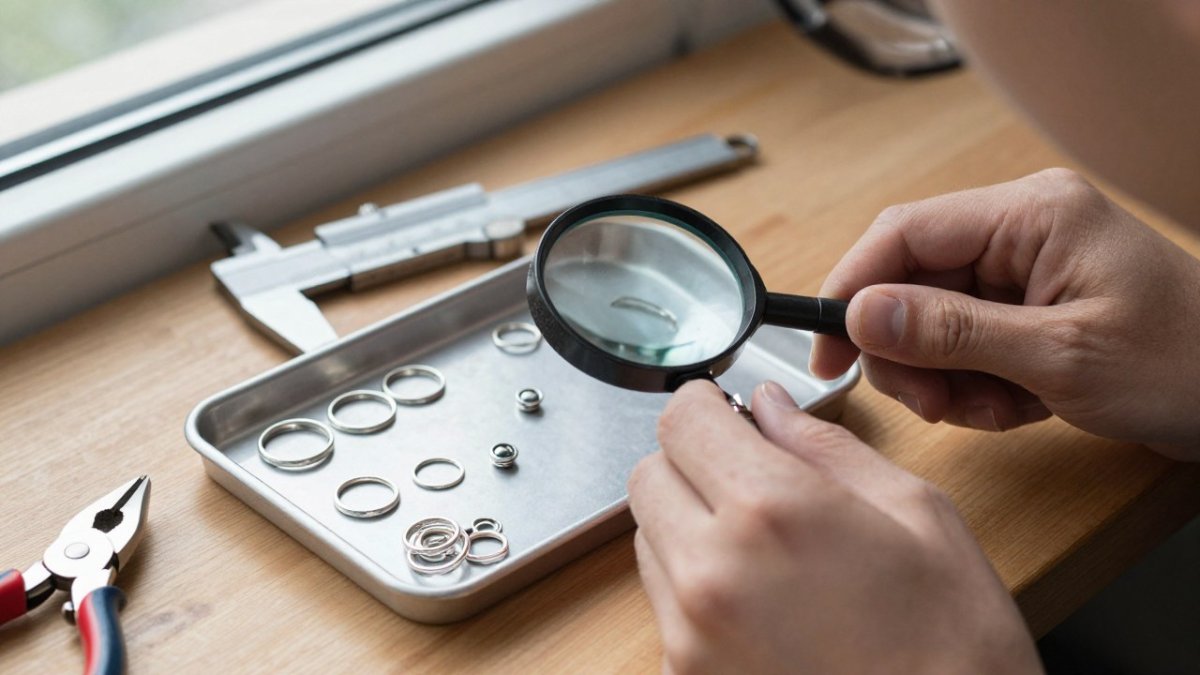
Run a fingernail along the inside of a jump ring. If it catches, the cut was rushed and the ring will snag thread or wear through a cord.
For a broader method of judging materials before you buy, our guide on how to find quality crafting materials covers durability testing and sourcing in more depth.
Jewelry Findings Wholesale: When Bulk Supply Pays Off
Wholesale pricing starts to make sense once your monthly usage is predictable. Below that point, bulk bags sit unused and tie up money you could spend on beads. The decision is not about the discount percentage; it is about whether the per-unit savings exceed the cost of capital and storage sitting in your drawer.
The Break-Even Math
The break-even question is simple. If you use a component every week, buy it in bulk. If you use it twice a year, buy retail. Put numbers to it: divide the bulk price by the number of pieces to get the per-unit cost, then compare that with the retail per-unit cost. Multiply the per-piece savings by your annual usage to see whether the savings justify the cash tied up.
Minimum Order Quantities and Mixed Lots
Wholesale suppliers often set a minimum order quantity (MOQ) per SKU, so read the MOQ before you commit to a price.
Watch out: bulk orders from unfamiliar sellers often mix gauges or ship thinner plating than the sample suggested, so order a small test batch before committing to a large one. Open the test batch, measure ten pieces with a caliper, and compare the wire gauge and plating color against the sample.
Vetting a Wholesale Supplier
Ask for the supplier’s business license or resale certificate process, their return policy on mixed or defective lots, and whether they manufacture or resell.
Factor shipping and any import costs, not just unit price, into the comparison.
When you are ready to move up, our guide to finding reliable jewelry craft suppliers explains how to vet a supplier before your first large order.
When to Stay Retail
Stay retail for components you use in small quantities, for trend-driven designs that may not repeat, and for any finding you have not yet tested in a finished piece. A wholesale bag of a clasp you end up disliking is a sunk cost. Test the component in three finished pieces before you commit to a bulk order, and keep a written record of the supplier, lot number, and test result so you can reorder the same quality later.
Choosing Jewelry Findings for Pendants
Pendant work hinges on the bail, and the wrong bail ruins an otherwise good piece. The bail must match the chain’s thickness and the pendant’s weight.
A glued bail works for flat, lightweight pieces. A pinch bail grips a drilled hole and holds heavier stones. For a pendant above roughly 20 grams, use a soldered bail or a drilled setting rather than glue.
Testing Quality at Home and Troubleshooting Common Failures
Three quick tests catch most bad findings before they reach a customer. First, drop a finding in a small dish of water with a drop of dish soap and leave it overnight; heavy tarnish or a dull gray film signals thin plating. Second, bend a jump ring open and closed five times with pliers; a quality ring holds its shape. Third, rub the piece with a white cloth; gold color that transfers to the cloth is plating, not gold fill.
Common failures trace back to a few causes:
- Jump rings that pull open under weight, fixed by using a thicker wire gauge
- Clasps that fail at the spring, fixed by sizing up one clasp weight class
- Crimp beads that slip, fixed by switching to a crimp tube and crimping tool
If finished pieces look cheaper than the materials suggest, the problem is usually the findings and the finishing rather than the beads. Our guide on why your jewelry projects look cheap covers the fixes in detail.
Three quick at-home tests catch most bad findings, and the most common failures trace back to a handful of causes.
| Test or problem | What to do or cause | Fix |
|---|---|---|
| Soapy water overnight | Heavy tarnish or dull gray film signals thin plating | Reject the finding |
| Bend jump ring five times | Quality ring holds its shape | Reject the finding |
| Rub with white cloth | Gold color transferring means plating, not gold fill | Reject the finding |
| Jump rings pull open under weight | Wire gauge too thin | Use a thicker wire gauge |
| Clasps fail at the spring | Clasp weight class too light | Size up one clasp weight class |
| Crimp beads slip | Crimp bead not holding | Switch to a crimp tube and crimping tool |
| Ear wires irritate skin | Nickel in the alloy or plating | Specify nickel-free or surgical steel |
Ethical Sourcing and Supply Chain Transparency
Ask suppliers where their metal comes from, and treat a vague answer as a warning. Reputable suppliers can name their refineries and describe their recycled-metal content.
Transparency goes further than a certificate. Look for suppliers who publish their sourcing policy, state whether their silver is recycled, and name the countries where their metal is refined. A supplier who cannot answer basic sourcing questions will not answer them later, either.
Build Your Findings Inventory With Craft Living Artistry
A working findings inventory is a small, deliberate set of parts you restock on a schedule, not a warehouse of impulse buys.
Craft Living Artistry curates kits, cords, beads, and maker tools in one place, so a beginner can start with a complete set and a working crafter can restock specific components without hunting across five stores. Our selection is focused rather than endless, which means fewer wrong turns and less time comparing listings. If you want to skip the piecemeal shopping entirely, our jewelry findings repair set gives you the core components, including lobster clasps and open jump rings, in one kit.
Get started with Craft Living Artistry and build a findings inventory that holds up on real projects.
Sourcing quality findings comes down to knowing your components, testing before you trust, and buying from suppliers who answer hard questions.
Frequently Asked Questions
Where can I buy high-quality jewelry findings?
Specialty craft retailers that curate their inventory are a reliable starting point, along with wholesale suppliers that publish metal purity and plating thickness details. Look for listings that name the alloy (for example, sterling silver or 14k gold-filled) rather than vague terms like ‘silver-tone.’ Craft Living Artistry curates a focused selection of kits, cords, beads, and maker tools in one convenient place.
What should I look for when buying jewelry findings?
Check four things: the stated metal and purity, plating thickness if the piece is plated, the finish quality on edges and joints, and whether the supplier lists nickel content. A jewelry findings chart from the supplier should map each component to its material. Pieces labeled hypoallergenic and nickel-free are the safer choice for ear wires and anything worn against skin. Ask for bulk supply terms only after you have tested a small batch.
How can I tell whether jewelry findings are made from quality materials?
Start with a magnet: sterling silver and gold-filled findings will not stick, while many cheap base metal pieces will. Check for a hallmark stamp such as 925 or 14/20 on precious metal components. Flex a jump ring once and see whether it springs back or stays bent, and inspect clasps for smooth edges that will not snag thread or skin. Tarnish resistance after a few weeks of wear is the clearest long-term signal.
Is it cheaper to buy jewelry findings wholesale?
Wholesale pricing usually beats retail per-piece cost once you are buying in quantity, but only if you will actually use the stock. Findings inventory ties up money and can tarnish in storage, so buy bulk only for components you replace constantly, like jump rings and ear wires. For accent pieces or one-off designs, retail quantities from a curated supplier keep waste down and let you test quality before committing to a larger order.





0 Comments