Last Updated: November 18, 2026
Quick Summary
Crafting benefits for older adults include possible gains in mood, memory, hand strength, and social connection, though many studies are small. Crafting engages focus, movement, and small decisions at once, and the best craft is one matched to the person’s abilities and interests.
- Crafting asks for focus, movement, and small decisions, which few hobbies do all three of.
- Most crafts combine a sustained grip, a precision pinch, and controlled release tied to visual feedback.
- Start with a project the person can finish in one sitting, then increase one variable at a time.
- In nursing homes, aim for sessions of thirty to forty-five minutes with a clear finish line.
- Take breaks every fifteen minutes when crafting with arthritis and stop if a joint aches.
Table of Contents
- Why Crafting Benefits Older Adults More Than Most Hobbies
- Mood, Stress Relief, and Emotional Well-Being
- Memory, Brain Stimulation, and Cognitive Function
- Fine Motor Skills, Dexterity, and Hand-Eye Coordination
- Social Connection and a Sense of Purpose
- Simple Crafts for Seniors: Matching the Activity to the Person
- Safety, Materials, and Supervision: What Caregivers Should Check
- What the Research Really Says About Crafting Benefits
- Frequently Asked Questions
Why Crafting Benefits Older Adults More Than Most Hobbies
Crafting benefits for older adults go well beyond filling an afternoon. Research points to possible gains in mood, memory, hand strength, and social connection, though many studies are small.
Crafting can engage several systems at once. It asks for focus, movement, and small decisions. Few hobbies do all three.
This guide breaks down seven real crafting benefits, then shows you how to match the right project to the right person.
Mood, Stress Relief, and Emotional Well-Being
The emotional payoff shows up fast. Many people describe a settled, focused feeling once they start a familiar project.
Crafting gives the mind a single, concrete task. That quiet focus pushes anxious thoughts to the background. The hands move, the mind settles.
Finishing a piece adds a second layer. There’s a finished object to hold up and show. That small win builds confidence and a brighter mood.
For a closer look at the emotional side, read our guide on the benefits of completing craft projects for mental health.
Memory, Brain Stimulation, and Cognitive Function
Crafting can engage the brain. Counting stitches, matching colors, and following patterns all ask for memory and attention.
These tasks use working memory, the mental scratchpad we use to hold information. Repeating a pattern strengthens that skill over time.
Fine Motor Skills, Dexterity, and Hand-Eye Coordination
Gripping, pinching, threading, and turning can get harder with age, and crafting offers a low-stakes way to practice those motions.
The mechanism is straightforward.
Different crafts load different skills, so the match matters more than the project’s popularity:
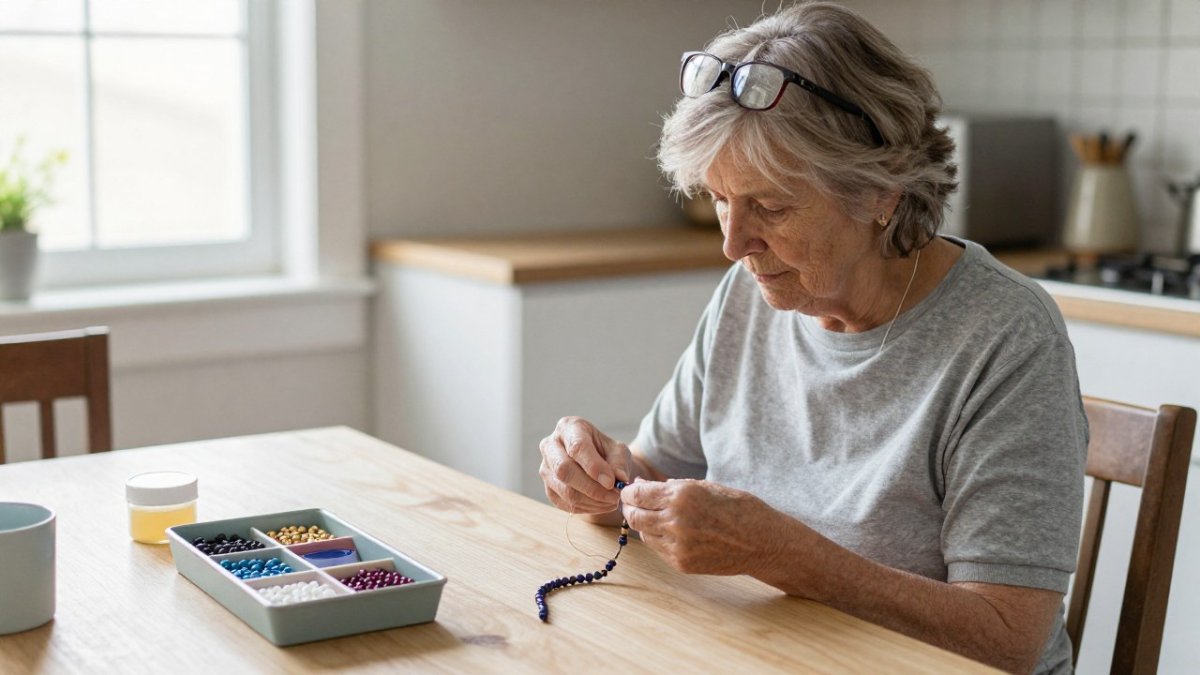
- Bead stringing and jewelry making build a pincer grip and controlled release. Larger beads and a stiff cord lower the difficulty; seed beads and fine wire raise it.
- Knitting and crochet work the fingers and wrists through repeated tension and release, and they build stamina for sustained grip.
- Cutting, folding, and paper crafts train hand-eye coordination and two-handed coordination, since one hand steadies while the other acts.
- Air-dry clay and pottery load the larger hand and forearm muscles and give immediate resistance feedback, which many people find easier to gauge than fine work.
- Coloring and drawing build graded control, pressing lightly versus firmly, which transfers to handwriting and utensil use.
The payoff reaches daily life.
A practical progression helps. Start with a project the person can finish in one sitting, then increase one variable at a time, smaller beads, a finer hook, a longer session, rather than changing everything at once.
Here are some adaptations that can help when grip, vision, or steadiness is limited:
- Grip aids: foam tubing over tool handles, ergonomic crochet hooks, and spring-loaded scissors reduce the force needed to hold and squeeze.
- Stabilizers: a clamp, a non-slip mat, or a lap tray holds the work steady so the hands can focus on the motion rather than on keeping the project in place.
- Vision supports: bright, even task lighting, high-contrast materials, and magnifiers make fine placement easier without straining.
- Needle and thread workarounds: self-threading needles, needle threaders, and larger-eye needles remove the most frustrating step for many people.
- Session design: shorter sessions with a clear stopping point prevent fatigue from turning a good experience into a painful one.
For guidance on sourcing safe supplies, see our guide on finding quality crafting materials.
Social Connection and a Sense of Purpose
Crafting is easy to share. A weekly group, a class, or a table at the community center turns a solo hobby into a social one.
Talking while working lowers pressure. People open up when their hands are busy. New connections form without anyone forcing conversation.
Purpose matters just as much. A project gives the week a shape. A gift for a grandchild or a piece for a charity sale gives the work meaning.
Simple Crafts for Seniors: Matching the Activity to the Person
The best craft is the one the person can actually do and enjoy. Match the project to ability, interest, and setting, and then scale it so the person stays in control of the outcome rather than watching someone else finish the work.
A Simple Selection Framework
Rather than starting from a craft name, start from four questions. This is the step most activity lists skip, and it is the one that prevents frustration.
- What can the hands do today? Check grip strength, pinch control, and steadiness. If fine pinch is difficult, start with larger materials and tools with built-up handles.
- What can the eyes track? Check whether the person can see fine detail, distinguish colors, and work without glare. High-contrast materials and bright task lighting can move a project from frustrating to feasible.
- How long can the person focus? Match session length to attention span, not to the project’s ideal finish time. A project that can be paused and resumed is better than one that must be completed in one sitting.
- What does the person want to make? Interest drives persistence. A project tied to a gift, a holiday, or a personal preference will hold attention longer than a generic kit.
Once those answers are clear, scale the project along three dials: material size (larger to smaller), tool demand (built-up grips to standard tools), and session length (short and frequent to longer and less frequent). Change one dial at a time so the person can feel progress rather than a sudden jump in difficulty.
Simple Crafts for Seniors With Limited Mobility
Seated, low-mess projects work best here. Think bead stringing, paper crafts, or coloring with fine pens.
Keep supplies within easy reach. A lap tray or a small caddy cuts down on bending and twisting, and a non-slip mat keeps the work from sliding. Position the project at a comfortable height so the person is not reaching up or hunching over.
If jewelry making is on the table, our look at whether easy jewelry making projects are worth trying as a beginner can help you decide.
Crafts for Seniors With Arthritis
Gentle, low-resistance projects protect sore joints. Air-dry clay and large-grip tools are good starting points, and foam tubing over handles can make existing tools usable again.
Warm up hands before starting. Take breaks every fifteen minutes. Stop if a joint aches. A common pattern is to alternate a fine-motor task with a larger-motion task so the same joints are not worked continuously.
If you’re weighing clay as an option, our take on whether air-dry clay is worth it for beginners covers the trade-offs.
Easy Crafts for Seniors in Nursing Homes
Group settings call for simple, safe, and short projects. Paper crafts, felt ornaments, and no-mess kits fit well because they have a clear finish line and limited cleanup.
Keep sessions short. Aim for thirty to forty-five minutes, with a clear finish line. Offer two or three choices rather than an open-ended menu, since too many options can stall decision-making.
For ready-made options, browse our craft kits for creative stress relief to find beginner-friendly picks.
Caregiver Facilitation: Help Without Taking Over
The most common failure in shared crafting is well-meaning over-help. When a caregiver finishes the hard parts, the person loses the sense of accomplishment that makes the activity worth doing.
A few habits help:
- Offer choices, not instructions. Ask which color or which project, and let the person commit.
- Demonstrate once, then step back. Show the motion, then let the person try before correcting.
- Praise effort and decisions, not just the finished piece. Notice the choice of color or the careful placement.
- Watch for fatigue signals. Slowing pace, rubbing hands, squinting, or going quiet are cues to pause rather than push.
- Set up, then hand over. Prepare materials and workspace, but leave the making to the person.
Measuring engagement is simpler than it sounds. Note whether the person returns to the project without prompting, whether sessions are getting longer, and whether they talk about the work afterward.
Match the project to the person’s needs with these starting points.
| Situation | Suggested crafts | Key adaptation |
|---|---|---|
| Limited mobility | Bead stringing, paper crafts, coloring with fine pens | Lap tray, caddy, non-slip mat |
| Arthritis | Air-dry clay, large-grip tools | Warm up hands, breaks every fifteen minutes |
| Nursing homes | Paper crafts, felt ornaments, no-mess kits | Sessions of thirty to forty-five minutes |
| Fine pinch difficult | Larger materials | Tools with built-up handles |
| Low vision | High-contrast materials | Bright task lighting and magnifiers |
| Needle threading hard | Self-threading needles, needle threaders | Larger-eye needles |
Safety, Materials, and Supervision: What Caregivers Should Check
Safety comes down to a few simple checks. Most craft injuries are easy to prevent.
- Sharp tools: Keep blades, needles, and awls out of reach unless supervised.
- Small parts: Watch for choking risks with beads and buttons around anyone with swallowing issues.
- Toxins: Choose non-toxic, low-odor glues and finishes.
- Ventilation: Work near a window when using sprays or strong adhesives.
- Lighting: Bright, even light reduces eye strain and mistakes.
For guidance on sourcing safe supplies, see our guide on finding quality crafting materials.
What the Research Really Says About Crafting Benefits
Here’s where honesty matters. Much of the evidence on crafting is encouraging but early.
That doesn’t mean the benefits are imaginary. It means the claims deserve a level head.
The National Institute on Aging’s guidance on healthy aging supports staying mentally and socially active.
The CDC’s resources on social connection and health also point to engagement as a key part of well-being.
Start small, pick a project that fits the person, and let the benefits build over time.
Our curated kits, cords, beads, and maker tools are designed to make it easier to get started.
Frequently Asked Questions
What are the benefits of crafts for seniors?
Crafting supports several areas at once. It gives the hands steady work that keeps fine motor skills and hand-eye coordination in use, it engages memory and planning as you follow a pattern or design, and it offers stress relief through focused, repetitive motion. Group crafting adds social connection, which matters for mood and sense of purpose. The practical result is a low-pressure activity that can be adjusted to almost any ability level, from a simple beading project to a full pottery session.
What crafts are easy for older adults with limited mobility?
Look for projects that need no standing, no reaching, and no heavy lifting. Bead stringing, yarn-wrapped wreaths, paper quilling, stamping, and air-dry clay shaping all work well at a table. Choose kits with pre-cut pieces and larger components so hands do not have to do fine work for long stretches. A lap tray or a raised work surface keeps supplies within easy reach,
How can arts and crafts support healthy aging?
Arts and crafts keep several systems active at once: hands, memory, attention, and often conversation. That combination is what makes crafting a useful part of a healthy aging routine rather than just a way to pass time. The key is regular participation at a level the person finds comfortable, not a demanding project that causes strain. Start short, keep sessions enjoyable, and adjust the difficulty as skills and confidence grow.
What crafts can older adults with arthritis do?
Choose projects that use larger tools and softer materials. Chunky-handled crochet hooks, thick yarn, foam stamps, and pre-cut fabric reduce the grip strength needed. Air-dry clay is easier to shape than stiff polymer clay, and bead stringing with large-hole beads is gentler on fingers than tiny seed beads. Work in short sessions with breaks, and keep a warm compress nearby. Compression gloves can help some people, but anyone with significant joint pain should check with their doctor first.



0 Comments