Table of Contents
- Why Finishing Matters: The Mental Health Payoff of Completed Craft Projects
- Crafting for Stress Relief: How Hands-On Work Calms the Nervous System
- Crafting and Mindfulness: Staying Present One Stitch at a Time
- Easy Crafts for Adults: Low-Pressure Projects That Still Deliver
- Craft Projects for Beginners: A Step-by-Step Guide to Your First Finish
- Accessible Adaptations: Making Craft Projects Work for Every Body
- Building a Sustainable Crafting Routine Without Perfectionism
- When Crafting Isn’t Enough: Knowing the Limits and Seeking Support
- Frequently Asked Questions
Last Updated: October 20, 2026
Why Finishing Matters: The Mental Health Payoff of Completed Craft Projects
The benefits of completing craft projects for mental health start with a simple truth: finishing feels good, and that feeling is not trivial. A finished object gives you proof of effort. It sits on your shelf and says, “You did this.” At Craft Living Artistry, we see how that small moment of pride can shift a rough day.
Most craft advice focuses on starting. That misses the point. The payoff lives in the finish.
Here is what a completed project actually delivers:
- A tangible outcome you can see and touch
- A sense of achievement that builds self-esteem
- A clear endpoint that calms the mind
- A reason to keep going next time
The mental well-being boost comes from closure, not from collecting supplies. Many crafters find that unfinished projects create quiet guilt. A pile of half-done kits can feel like a to-do list that never ends. Finishing one small thing clears that weight.
Pick projects you can finish in one or two sittings. Completion, not complexity, is what lifts mood and confidence.
Crafting for Stress Relief: How Hands-On Work Calms the Nervous System
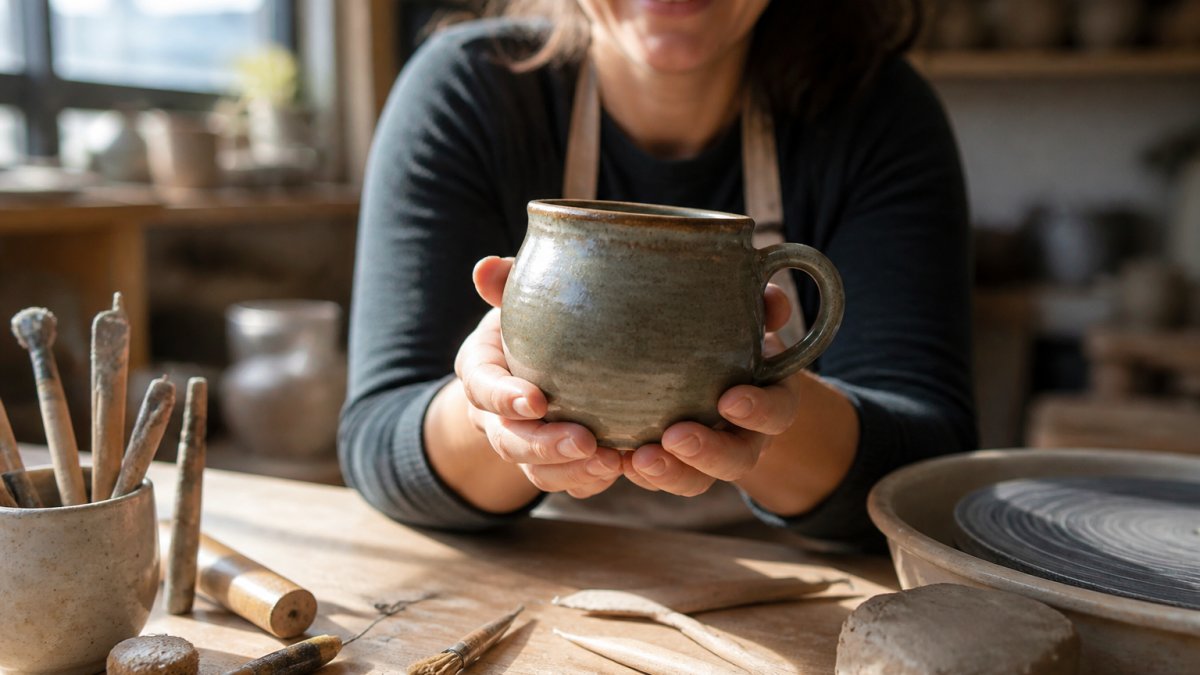
Crafting for stress relief works because busy hands quiet a busy mind, but the mechanism is more specific than that.
The key is the body. Repetitive motion, like stitching, beading, or shaping clay, gives your nervous system a steady cadence. There is no screen, no notification, no rush. Just your hands and the material.
A common approach is to keep a small project near your chair. When stress spikes, you pick it up for ten minutes. That short break can reset your mood better than scrolling, because scrolling feeds the same alert system you are trying to quiet.
Here is a concrete ten-minute reset that works with almost any craft:
- Set a timer for ten minutes. A hard stop prevents the session from becoming another task to manage.
- Choose one repetitive action. Stitch a row, string five beads, or roll a coil of clay. Repetition is the point, not progress.
- Match your breath to the motion. Inhale as you draw the needle through, exhale as you pull. This pairing is what turns motion into a calming rhythm.
- Keep the result out of it. Do not judge the row or the bead pattern. The ten minutes are the deliverable.
- Stop when the timer rings, even if you feel like continuing. Leaving a little momentum makes the next session easier to start.
A few practical trade-offs are worth knowing. Fine motor work like tiny beads or detailed embroidery can sharpen focus but may raise tension in the hands and neck, so alternate with a looser craft.
Craft-based interventions are used in many settings as a form of self-care. They are not a cure, but they are a low-cost way to add calm to your day.
If ten minutes feels like too much on a hard day, cut it to three. A single row or one bracelet segment still counts, and the habit of returning matters more than the duration.
Crafting and Mindfulness: Staying Present One Stitch at a Time
Crafting and mindfulness fit together naturally. Mindfulness means keeping your attention in the present moment. A craft project asks for exactly that.
When you count beads or match thread colors, your mind has one job. That single focus is present-moment awareness in action. Worries about tomorrow fade because your hands are busy now.
This is why so many people reach a flow state while crafting. Time slips by. The inner critic goes quiet. You are fully engaged in the task.
Try this simple routine:
- Put your phone in another room
- Set out only the supplies for one step
- Notice the texture, color, and weight of the material
- Work slowly for 15 minutes
The goal is not a perfect result. The goal is your full attention on the task. That focus is the whole point.
If your mind wanders, name what your hands are doing out loud. “I am threading the needle.” This tiny habit pulls you back to the present fast.
Easy Crafts for Adults: Low-Pressure Projects That Still Deliver
Easy crafts for adults remove the biggest barrier: the fear of failing. A low-pressure project has few steps, forgiving materials, and a clear finish line. You get the mood boost without the stress.
Here are strong options that deliver real satisfaction:
| Craft | Time to Finish | Skill Level | What You Need |
|---|---|---|---|
| Beaded bracelet | 30-45 minutes | Beginner | Cord, beads, clasp |
| Simple pottery mug | 1-2 sessions | Beginner | Clay, basic tools |
| Stamped gift cards | 20 minutes | Beginner | Paper, stamps, ink |
| Knit scarf | A few evenings | Beginner | Yarn, needles |
| Painted wooden box | 1 hour | Beginner | Box, paint, brush |
The best pick is the one you will actually finish. Skip anything with a long supply list or fussy steps for now. You can grow into harder projects later.
For parents, kids’ craft kits offer the same benefit. A complete kit means no last-minute store runs. It also means the project is designed to work from start to finish.
Craft Projects for Beginners: A Step-by-Step Guide to Your First Finish
Craft projects for beginners succeed when you plan for the finish, not the fantasy. Most first-timers quit because they bought too much or picked something too hard.
Step 1: Pick by energy, time, and budget together. Match the project to your real week, not your ideal one. Use this filter:
- Low energy, under 30 minutes: stamped cards, a beaded bracelet, a painted wooden box.
- Moderate energy, one to two evenings: a knit scarf, a simple pottery mug, a small cross-stitch piece.
- Higher energy, weekend project: a sewn tote, a macrame plant hanger, a beginner quilt block.
Set a budget before you shop.
Step 2: Read the full instructions before you buy. If a step confuses you on paper, it will confuse you in practice.
Step 3: Set up a small, permanent workspace. A tray and good light are enough. Keep it ready so starting is easy and cleanup is fast.
Step 4: Break the project into milestones. Every finished step is a win. Write the steps on a card and mark them off.
Step 5: Finish before you start the next one. This single rule protects your confidence and your shelf space.
Step 6: Plan a small reward for the finish. Show the object to someone, use it, or photograph it.
Here is a realistic first-project example. A beaded bracelet takes 30 to 45 minutes, needs only cord, beads, and a clasp, and has a clear finish line.
Buying three projects at once is the most common beginner mistake. The supplies pile up, guilt builds, and nothing gets finished. Start with one, finish it, and let the confidence carry you into the next.
For parents, kids’ craft kits offer the same benefit. A complete kit means no last-minute store runs and a project designed to work from start to finish, which is exactly the structure a first finish needs.
Accessible Adaptations: Making Craft Projects Work for Every Body
Crafting should not depend on perfect hands or endless energy. Accessible adaptations let people with disability, chronic illness, or limited dexterity take part and finish. The goal is the same: a completed project and the lift that comes with it.
Practical changes that help:
- Use larger grips on tools for easier holding
- Try spring-loaded scissors to reduce hand strain
- Work with pre-cut kits that skip fiddly prep
- Sit at a table at the right height with good lighting
- Split a project across several short sessions
- Use a lap tray if standing is hard
For chronic illness, pacing matters more than speed. Ten minutes a day still counts. Many crafters find that gentle, repetitive tasks are easier on the body than long sessions.
Adaptive tools are not a compromise. They are how more people get to enjoy creative activities and the sense of accomplishment that follows.
Building a Sustainable Crafting Routine Without Perfectionism
A sustainable crafting routine beats a burst of enthusiasm every time. The crafters who stick with it are not the most talented. They are the ones who made it easy to show up.
Perfectionism is the enemy here. It tells you the project is not good enough to finish. That voice kills more projects than any missing supply.
Try these habits:
- Keep a small, ready-to-go project on your table
- Schedule short sessions, not marathons
- Accept “done” over “perfect”
- Track finished projects in a simple list
- Share your work with someone who cheers you on
Social connection matters too (the CDC). Craft groups, online or in person, reduce loneliness and add accountability. A weekly check-in with a friend can keep you moving.
Craft Living Artistry supports this by keeping supplies focused and complete. Fewer decisions mean more time making. That is how a hobby becomes a steady part of your wellness routine.
Anyone who starts strong but stalls halfway. Short sessions plus one project at a time keep momentum alive.
When Crafting Isn’t Enough: Knowing the Limits and Seeking Support
Crafting is a helpful tool, not a treatment. It can lift mood and ease stress, but it cannot replace professional care. Knowing the limits keeps you safe.
Talk to a doctor or mental health professional if you notice:
- Sadness or anxiety that lasts for weeks
- Loss of interest in things you used to enjoy
- Trouble sleeping or eating
- Thoughts of harming yourself
Crafting can support your well-being alongside professional help. It should never be the only thing you rely on. If a project feels like pressure instead of relief, step back. The point is care, not a checklist.
For many people, a balanced approach works best: professional support when needed, plus small creative activities that add joy and focus to daily life.
Crafting can give you calm, confidence, and a finished object to be proud of. But the hardest part is often just starting with the right project. At Craft Living Artistry, we make that easier with curated kits, cords, beads, and maker tools in one place, so you always have what you need to finish. Our focused selection supports beginners and experienced makers alike, whether you are beading a bracelet or shaping clay.
Frequently Asked Questions
What does crafting do to your brain?
Crafting engages multiple brain regions at once: fine motor control, visual-spatial reasoning, and memory. The repetitive motions of knitting, beading, or clay work can trigger a flow state, where you’re fully absorbed and lose track of time. This state reduces activity in the brain’s default mode network, which is linked to rumination and worry. The result is a calmer, more focused mind, and the sense of accomplishment when you finish a craft project reinforces positive reward pathways.
Can crafting help reduce stress and anxiety?
Yes, many people find that crafting for stress relief works because it redirects attention away from anxious thoughts and into a concrete, manageable task. The rhythmic, repetitive motions of crafts like knitting or hand-building with clay can lower heart rate and promote relaxation. Focusing on the project at hand also interrupts the cycle of worry. While crafting isn’t a replacement for professional treatment, it’s a practical self-care tool that can be part of a broader stress-management routine.
How do you choose a craft project that is not too difficult?
Start by matching the project to your current energy, skill level, time, and budget. For a first project, pick something that takes one to two hours and uses materials you already have or can buy in a single kit. Look for beginner-friendly options like a simple beaded bracelet, a small pottery pinch pot, or a pre-cut felt ornament. Avoid projects with complex patterns or many steps. The goal is to finish, not to impress, so choose something you can complete in one or two sittings.
How often should you craft to support your well-being?
There’s no fixed rule, but consistency matters more than duration. Many people benefit from a short, regular session, such as 20 to 30 minutes a few times a week, rather than one long marathon. A sustainable routine might be a weekly craft night or a few minutes of handwork after dinner. Pay attention to how you feel before and after. If crafting starts to feel like another chore, scale back. The point is to create a reliable, low-pressure outlet, not another obligation.



0 Comments