
Quick Summary
Mindful hobbies are hands-on activities such as coloring, knitting, journaling, gardening and breathwork that pull attention back to the present moment. Repeated, simple tasks give a racing mind something to focus on, which can calm both body and thoughts. They support anxiety relief but do not replace professional care.
- Mindful hobbies give a racing mind one simple thing to focus on in the present.
- Adult coloring and journaling can start with a $5-$25 setup and 10-30 minute sessions.
- Match your hobby to your pattern: repetitive crafts for racing thoughts, walking or gardening for restlessness.
- Start small, such as one hook and one skein, and commit to two weeks of regular practice before buying more.
- Breathwork is free and can be done in 5-10 minutes, inhaling for four counts and exhaling for six.
Table of Contents
- Why Mindful Hobbies Help With Anxiety
- Quick Comparison: Cost, Time and Difficulty of Each Hobby
- Creative Arts: Drawing, Painting and Coloring for Stress Relief
- Repetitive Crafts: Knitting, Crocheting and Beading
- Writing, Journaling and Gardening: Calm Through Routine and Nature
- Gentle Movement, Breathwork and Baking as Mindful Practices
- Picking the Mindful Hobby That Fits Your Anxiety and Start Your Practice at Home
- Frequently Asked Questions
Why Mindful Hobbies Help With Anxiety
Mindful hobbies work because they give a racing mind one simple thing to attend to. Anxiety pulls attention toward worst-case scenarios and “what if” loops. A hobby that asks for your hands and your focus pulls attention back to the present moment, and that shift can calm the body as well as the mind.
Many people describe this as a break from overthinking. Knitting a row, shaping clay or sketching a shape asks for small, repeated decisions. Those decisions are easy to make, so the brain has less room to replay worries.
Creative activity is not a cure for an anxiety disorder, and it does not replace professional care. Think of it as one practical tool you can use between bigger steps. The National Institute of Mental Health’s anxiety disorders overview is a good place to learn more about when symptoms need professional attention.
Mindful hobbies are useful because they are repeatable. You can return to them on a hard afternoon, after work or before bed.
Quick Comparison: Cost, Time and Difficulty of Each Hobby
Most of the hobbies in this guide start with a modest setup, but ‘modest’ means different things to different budgets. The table below gives a rough sense of what each one asks for in supplies, session length, and learning curve. Costs vary by brand, retailer and the materials you choose, so treat them as general planning considerations rather than prices.
| Hobby | Typical Startup Cost (USD) | Time Per Session | Difficulty | Best For |
|---|---|---|---|---|
| Adult coloring | $10-$25 (book plus colored pencils or markers) | 15-30 minutes | Beginner | Racing thoughts, perfectionism |
| Drawing and painting | $15-$60 (sketchbook, pencils, or a small acrylic set) | 20-60 minutes | Beginner | Mind wandering, need for free expression |
| Knitting or crocheting | $15-$40 (yarn plus one hook or needle set) | 15-45 minutes | Beginner to intermediate | Restlessness, need for rhythm |
| Beading | $15-$35 (beads, wire, and pliers) | 20-45 minutes | Beginner | Sorting and color focus |
| Journaling | $5-$15 (notebook and pen) | 10-20 minutes | Beginner | Overthinking, worry loops |
| Gardening | $20-$50 (pots, soil, and starter herbs) | 20-60 minutes | Beginner | Grounding, outdoor time |
| Gentle yoga or walking | $0-$30 (mat optional) | 10-30 minutes | Beginner | Physical restlessness |
| Breathwork | $0 | 5-10 minutes | Beginner | Acute anxiety, bedtime wind-down |
| Baking | $15-$40 (basic pantry plus a loaf pan) | 30-90 minutes | Beginner to intermediate | Need for clear process |
Time Per Session
Pick one or two options that match your budget and schedule. A short session you will actually repeat beats a long one you dread. If you are choosing between a calming hobby and an active one, match it to your anxiety pattern: repetitive crafts and breathwork suit a racing mind, while walking and gardening suit physical restlessness. For a low-mobility or sensory-sensitive option, coloring, journaling, and breathwork can all be done seated and indoors with minimal equipment.
Watch out: buying a full kit before you have tested the hobby often leads to unused supplies. Start with the smallest viable setup, one hook and one skein, one notebook and one pen, and upgrade only after two weeks of regular practice.
Creative Arts: Drawing, Painting and Coloring for Stress Relief
Drawing, painting and coloring are among the most accessible mindful hobbies. If you are curious about hands-on, slow-paced making, learn how to hand build pottery with beginner techniques. You do not need talent, and no result is wrong. The goal is to notice color, line and texture as you work.
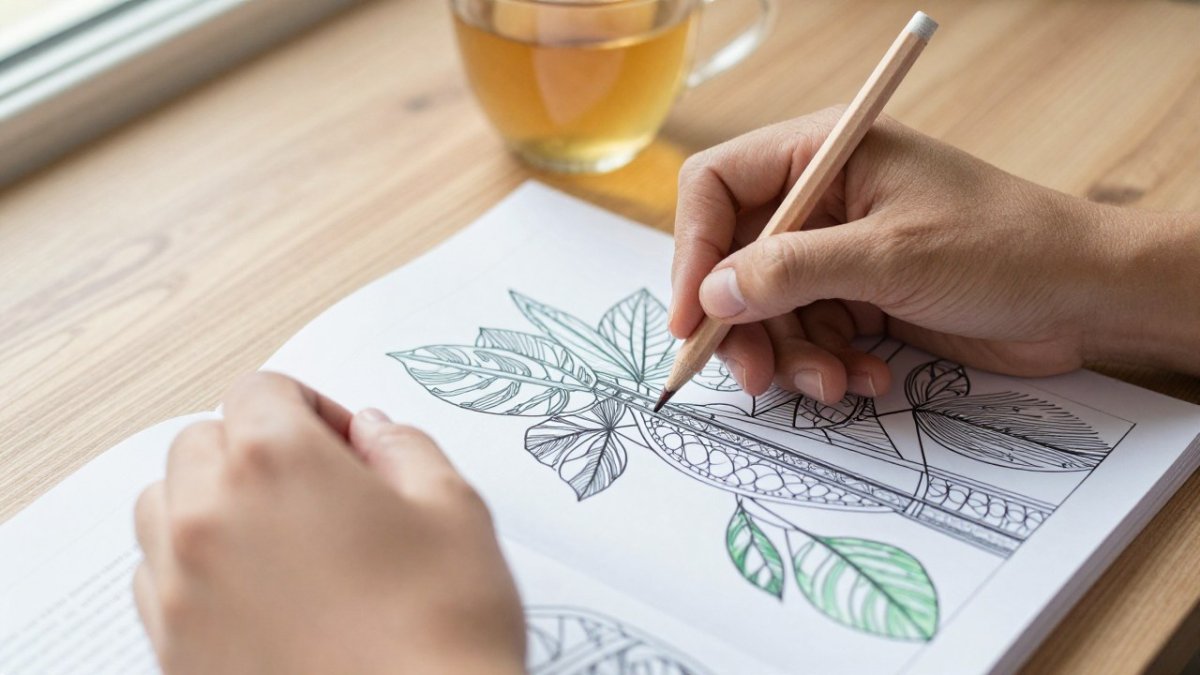
Start with a single sheet and one medium. Adult coloring books give structure, so you do not have to invent a composition. Watercolor or acrylic painting offers more freedom once you feel comfortable. Set a timer for 20 minutes and focus only on the marks you are making.
Watch out: pushing for a finished, impressive piece turns relaxation into performance. If you notice frustration rising, shift to loose shapes or simple color blocks.
Repetitive Crafts: Knitting, Crocheting and Beading
Repetitive crafts build calm through rhythm. Each stitch or bead looks much like the last, and the motion becomes predictable. Many people find that predictability settles a restless mind.
Begin with a simple beginner crochet set. A complete crochet hooks set gives you several hook sizes and accessories to try different yarns. A basic set with a hook and yarn lets you practice a chain stitch and single crochet without guessing what to buy. Knitting works in a similar way, with one stitch repeated across a row. For a ready-made start, try a beginner crochet starter kit that includes everything needed to practice the repeated stitches. Beading suits people who like sorting, color choices and small, precise movements.
Keep projects small at first. A dishcloth, a coaster or a short bracelet finishes quickly and gives a satisfying sense of progress. Set a practice habit of 15 minutes, three or four days a week.
Writing, Journaling and Gardening: Calm Through Routine and Nature
Writing and gardening both ask you to slow down and notice what is in front of you, but they work through different mechanisms. Journaling externalizes worry so it is easier to examine; gardening anchors attention in soil, weather, and slow plant changes. Practicing either one mindfully means deliberately returning your attention to sensory details whenever it drifts.
Mindful journaling
Journaling moves worries from your head onto the page, where they are easier to look at. A simple prompt works better than a blank page: write what you are worried about for five minutes, then write what is within your control for five minutes. Keep the session to 10 minutes and avoid rereading old entries to judge them.
To make it mindful, notice the pen in your hand, the texture of the paper, and the pace of your writing. When your mind wanders into rehearsal of the day, return to the physical act of forming letters. A common pattern is that the first two minutes feel restless and the next eight feel calmer; if restlessness persists, switch to a gratitude list or a sensory description of the room.
Watch out: journaling can become rumination if you only write about worries. Balance each worry entry with one line about what you can control or one thing you noticed with your senses.
Mindful gardening
Gardening puts your hands in soil and your attention on plants, weather, and small changes over days. A few pots of herbs on a windowsill or balcony are enough to start. Watering and pruning give a steady task with visible results, and time outdoors, even briefly, helps many people feel more grounded.
To practice mindfully, focus on the smell of soil, the weight of the watering can, and the temperature of the air. Check one plant at a time rather than scanning the whole garden. If you have limited mobility, a raised planter or a tabletop herb kit lets you garden seated. If sensory sensitivity is an issue, wear gloves and start with a single pot.
Watch out: beginning with a large garden or a long daily journal often leads to burnout. Start with one pot and one 10-minute journal session, and build the habit gradually over two weeks before adding more.
Gentle Movement, Breathwork and Baking as Mindful Practices
Gentle movement, breathwork and baking each give the body a focused task. Walking, gentle stretching and easy yoga keep attention on breath and balance. Breathwork, such as slow breathing with a longer exhale, is free and can be done anywhere in five minutes. Baking connects you to measuring, timing and the smell and feel of dough.
To practice mindful walking, pay attention to your feet touching the ground and the sounds around you. For breathwork, inhale for a count of four and exhale for a count of six. Repeat for a few minutes.
Baking works well for people who like a clear process. Choose a simple recipe, such as quick bread or cookies, and focus on each step. Measuring by weight, not volume, also makes the task feel more precise, and measuring tools are inexpensive.
Consistency matters more than intensity. Ten quiet minutes of movement or breathing most days can be more useful than one long session a month.
Picking the Mindful Hobby That Fits Your Anxiety and Start Your Practice at Home
Choosing a hobby is easier when you match it to what your anxiety looks like. If racing thoughts keep you up, try a repetitive craft or breathwork before bed. If you feel restless and need to move, try gentle walking or gardening. If your mind wanders into worry, journaling or drawing gives it a clear focus.
Start with one option and commit to it for two weeks. Set a specific time, keep a small supply station ready and pick a project you can finish. Notice how your body feels before and after each session, and adjust as you learn what works.
Craft Living Artistry offers everything needed for crafting in one convenient place, which can make that first step easier so you can spend your energy on the practice.
If you are unsure where to begin, read our guide to best craft kits for creative stress relief. It lists beginner-friendly options that suit a range of budgets and skill levels.
Frequently Asked Questions
What is the best hobby for anxiety?
There is no single best hobby for everyone, but activities that are repetitive, absorbing and low-pressure tend to work well for many people with anxiety. Drawing, coloring, knitting, journaling and gardening all keep attention on the task at hand rather than on worries. The best choice is usually the one you will actually return to several times a week. Start with something that costs little and takes 15 to 20 minutes, then adjust based on how you feel afterward. If anxiety is severe or persistent, pair any hobby with support from a licensed mental health professional.
What are some mindful hobbies that can help with anxiety?
Mindful hobbies are activities you do with full attention to the present moment. Good examples include coloring, knitting or crocheting, gardening, slow walking, journaling and simple breathwork while cooking or baking. To make any hobby mindful, notice textures, colors and sounds, and gently return your attention when your thoughts drift. Research on these activities is still developing, so treat them as supportive habits rather than treatments. Many people find that combining a hobby with regular rest and professional care gives the most consistent relief.
What are the best anxiety-relief hobbies to do at home?
Several hobbies work well at home with little setup. Coloring and drawing need only paper and pencils, while knitting and crocheting require yarn and a hook or needles. Journaling needs a notebook and a few quiet minutes each day. Baking, jigsaw puzzles and home gardening with a few pots also suit a calm routine. Start with one activity for two weeks, set a consistent time of day, and keep materials within easy reach so the habit is simple to maintain.
What is the 3 hobby rule?
The 3 hobby rule is a common suggestion that you keep three hobbies going at once: one that challenges you, one that is purely relaxing and one that is social or physical. The idea is that variety protects against burnout and gives you different outlets depending on your mood. It is a guideline rather than a clinical standard, so adjust it to your time and budget. Even one hobby practiced regularly can reduce stress, and you can add others as your schedule allows.



0 Comments