
Table of Contents
- Why Bead Quality Matters More Than You Think
- Types of Jewelry Beads for Beginners: A Practical Overview
- How to Identify Real Gemstone Beads
- Key Quality Factors: Size, Shape, and Hole Alignment
- Essential Jewelry Findings for Beadwork Projects
- How to Test Bead Durability Before You Buy
- Budgeting for Quality: Where to Spend and Save
- Final Checklist for Your Next Bead Purchase
- Frequently Asked Questions
Last Updated: September 8, 2026
Why Bead Quality Matters More Than You Think
The difference between a piece that lasts for years and one that falls apart after a few wears comes down to choosing quality jewelry beads before you string a single one. Most beginners buy on color alone, then wonder why their necklace looks dull or breaks within a month. Quality jewelry beads determine not just how the piece looks on day one, but how it holds up through everyday wear, oils, and the occasional drop.
Learning to spot quality does not require expensive tools or years of experience, just knowing what to look for, which we break down into a practical evaluation system for any craft store or online order.
Types of Jewelry Beads for Beginners: A Practical Overview
Before judging quality, understand what you are looking at beyond the material name. Terms like “glass,” “stone,” and “crystal” mean different things depending on the manufacturing process. Here are the most common bead categories with quality markers that separate premium materials from craft-store filler.
Glass Beads: From Lampwork to Czech Fire-Polish
Glass beads range from pressed glass to hand-formed lampwork. For pressed glass, inspect mold lines, a visible seam indicates lower quality. Premium pressed glass is fire-polished, rounding edges for a brighter luster. Lampwork beads should have smooth surfaces without tool marks or trapped air bubbles, and a clean hole free of shards that can cut your stringing material.
A key distinction is the difference between standard glass and leaded crystal. Leaded crystal, such as Swarovski’s Austrian crystal, contains lead oxide, increasing the refractive index for that signature sparkle (britannica.com). These beads are precision-cut with sharp facets. Imitations look duller with softer facet edges. Test the sparkle under direct light, genuine crystal throws a visible prismatic dispersion, while standard glass simply reflects light.
Natural Stone: Understanding Treatments and Enhancements
Most commercially available stone has been treated to enhance color or stability. Common treatments include dyeing, heat treatment, and resin stabilization. Dyed stones, like “turquoise” that is often dyed howlite, show color concentration in surface pits and around the drill hole. Heat-treated stones are generally stable but may have a more uniform color. Stabilized stones are impregnated with resin to fill fractures, improving durability but meaning the stone is not 100% natural, which affects value.
When evaluating natural stone, look at the drill hole. High-quality beads are drilled after cutting and polishing, leaving a clean, sharp rim; beads drilled before polishing have a worn, rounded edge. Check for pits and cracks filled with colored wax or resin, a common practice to hide flaws. A gentle scratch test with a steel needle reveals filler: genuine stone resists scratching, while filler gouges easily.
Ceramic and Porcelain: The Glaze Tells the Story
Ceramic beads are fired clay, and quality is largely determined by the glaze. A quality bead has a glaze consistent in color and thickness, with no bare spots, pinholes, or crazing. Porcelain is fired at a higher temperature, making it denser and more durable. Check that hand-painted designs are sealed under a clear glaze; if the paint is on top, it will wear off quickly.
Wood and Organic Materials: Density and Finish
The best wooden beads are made from dense hardwoods like ebony, rosewood, or sandalwood, which take a high polish and resist chipping. Softer woods are lightweight, prone to dents, and often rough. Quality beads should be sanded smooth with a hard sealant finish, not just wax, which wears off and leaves the bead vulnerable to moisture. For tagua nut, look for a smooth, dense surface without cracks; shell beads should have an even, iridescent surface without chalky patches.
Metal Beads: Base Metal vs. Plated vs. Solid
Metal beads are critical for structural integrity. The cheapest are base metal plated with a thin layer of gold or silver, which wears off within weeks, exposing metal that can irritate skin. Higher-quality options are solid sterling silver, gold-filled (a thick gold layer bonded to a brass core), or surgical stainless steel. Gold-filled will not flake or tarnish like plated metal. When buying plated beads, ask about plating thickness, 1 micron is standard, but 2-3 microns is significantly more durable.
For beginners, buy one strand of high-quality glass or stone beads and one strand of the cheapest equivalent. Compare weight, surface finish, hole quality, and color consistency side-by-side. This hands-on comparison will calibrate your hands and eyes for future purchases.
How to Identify Real Gemstone Beads
Real gemstone beads are heavy, cool to the touch, and never perfectly uniform. Genuine stone feels denser than glass or plastic of the same size, with tiny inclusions, slight color shifts, and subtle texture variations.
A common test is the temperature check: real stones stay cool when pressed against your cheek, while glass warms quickly. Examine hole edges under bright light, real stone drilled after cutting shows a clean, sharp rim, while dyed stones often have color bleeding near the hole.
Be cautious with low-priced beads labeled semi-precious; many are dyed howlite, reconstituted stone dust, or resin imitations. If every bead on a strand looks identical in color and pattern, treat it with suspicion, natural stone always shows variation.
Key Quality Factors: Size, Shape, and Hole Alignment
Quality jewelry beads share three measurable traits: consistent size, clean shape, and properly aligned holes. These affect how the piece drapes, hangs, and whether your stringing material wears out prematurely.
Check calibration by laying the strand flat and looking for size jumps; a quality strand holds a consistent diameter within a fraction of a millimeter. Roll a few beads on a flat surface, round beads should roll smoothly without wobbling, indicating a true sphere.
Hole alignment is the most overlooked factor. Hold a bead to the light and look through the hole, it should be centered and straight, not angled. Misaligned holes cause beads to sit crooked and create uneven wear on your wire. Also check hole diameter against your cord; a too-tight hole frays nylon thread, while an oversized hole lets beads slide and clack.
Essential Jewelry Findings for Beadwork Projects
Quality findings are the invisible backbone of any jewelry project. They include clasps, jump rings, crimp beads, ear wires, head pins, and bead tips. The essential jewelry findings for beadwork projects are those that bear the most stress: clasps and crimps. Quality is about metallurgy, plating thickness, and mechanical design.
Metal Types and Plating: What You Are Actually Buying
The single most important factor is the base metal and its coating. The market has three tiers:
-
Base Metal with Flash Plating: The cheapest tier. A brass or copper base is electroplated with a microscopic layer of gold or silver, often less than 0.5 microns thick. This plating wears off within days or weeks, exposing base metal that reacts with skin acids, causing green discoloration and contact dermatitis. If a clasp is priced at a few cents, it is almost certainly this tier.
-
Gold-Filled or Sterling Silver: Gold-filled is a mechanical bonding process where a thick gold layer (typically 5% of total weight) is pressure-bonded to a brass core. It will not flake or wear off and is hypoallergenic for most people. Sterling silver (92.5% pure) is another solid option but is softer and can bend under heavy loads (britannica.com). Look for the “1/20 14k GF” stamp on gold-filled findings.
-
Surgical Stainless Steel: The most durable and hypoallergenic option, often used in medical implants. It is harder than sterling silver and will not tarnish, but it is difficult to work with for intricate designs.
Clasps: The Mechanical Weak Point
A lobster clasp is only as good as its spring. Test the mechanism by pulling the trigger several times, the spring should snap back with authority. A weak spring will fail after a few dozen uses. A necklace with beads weighing more than 100 grams requires a thicker gauge and reinforced trigger. For heavier pieces, consider a box clasp or magnetic clasp with a safety latch, which distribute stress more evenly.
Jump Rings: The Silent Failure Point
Jump rings are the most common point of failure. A quality ring is made of thick wire (18 or 20 gauge) and is soldered closed or is a solid ring. Split rings are more secure than unsoldered jump rings. Open a jump ring by twisting it sideways with two pliers, never pulling it open, which weakens the metal. Check that the closing edge meets flush with no gap.
Crimp Beads: The Hidden Stress Point
Crimp beads secure clasps on stringing wire. Brass crimps are too hard and will crack or crush the wire when compressed; sterling silver and gold-filled are the standard. Tube crimps are more reliable than round crimps because they provide a larger surface area for the wire to grip. When compressed, a tube crimp should form a clean “C” shape, use a crimping pliers, not a flat-nose pliers.
Ear Wires: Hypoallergenic Is Non-Negotiable
For ear wires, the metal is the primary quality factor. Nickel, common in cheap base metal, is the leading cause of allergic contact dermatitis (the CDC). Look for wires labeled “nickel-free,” “hypoallergenic,” or made from surgical stainless steel, niobium, or titanium. The gauge should hold its shape, and the hook should be smooth and polished with no sharp points.
Weight Ratings and Structural Integrity: A Unique Angle
Most guides ignore the interaction between bead weight and finding strength, but this is where projects fail. A strand of 8mm glass beads can weigh 50-80 grams; a strand of 10mm stone can exceed 150 grams. Your clasp and jump rings must be rated for this load. A standard 10mm sterling silver lobster clasp is rated for up to 100 grams of pull force; for heavier pieces, you need a clasp rated for 200 grams or more. Crimp beads must also match your wire, a 2x2mm crimp is designed for 0.018-inch wire; using it on 0.024-inch wire prevents proper closing, creating a weak point.
A Practical Testing Method
Before committing to a finding for a heavy project, perform a pull test. String a few of your heaviest beads onto your wire, attach the clasp and jump ring, and hang a weight equal to the finished piece’s estimated weight from the clasp for 24 hours. If the clasp opens, the jump ring bends, or the crimp slips, you have identified a failure point before investing hours in stringing the full necklace.
How to Test Bead Durability Before You Buy
Durability testing takes five minutes and saves you from wasting hours on a project that will not survive its first wearing. Start by examining the surface under bright light for cracks, chips, or rough spots.
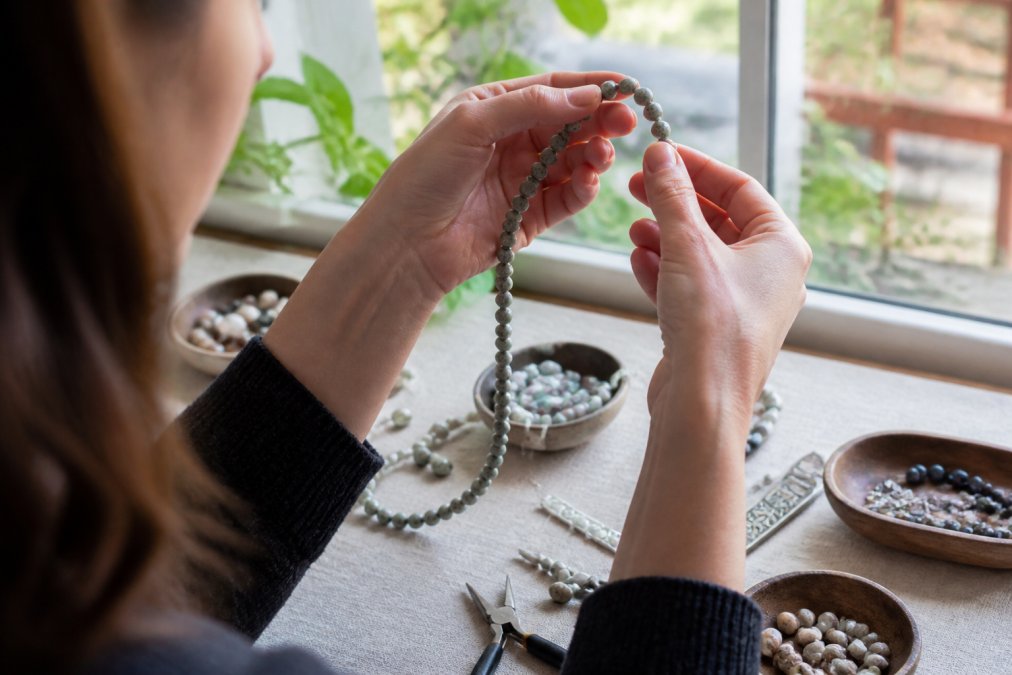
Perform a scratch test on an inconspicuous bead. Glass and stone resist scratching from a steel needle, while plastic and resin mark easily. For dyed beads, rub firmly with a damp white cloth; if color transfers, the dye is unstable and will bleed when worn.
Check structural integrity by gently squeezing a bead between thumb and forefinger. Quality stone and glass feel solid and unyielding; beads that feel chalky, crumble, or show hairline fractures will not hold up. Finally, string the bead on wire and give it a sharp tug to confirm the hole does not crack.
Budgeting for Quality: Where to Spend and Save
A smart budget prioritizes structural integrity: clasps, crimps, and the beads themselves. Spend more on natural stone and quality glass beads, the visual centerpiece of your work. Save on filler beads, spacers, and accents where minor imperfections are less noticeable.
Buying in bulk from a single strand is more cost-effective than individual beads, but only if the strand passes your quality checks. A cheap strand with inconsistent bead size will produce a disappointing project, making it a poor value regardless of price.
For beginners, buy one quality strand of the bead type you want to learn with, plus good findings, rather than several cheap options. This lets you focus on technique without fighting inferior materials. Craft Living Artistry curates a focused selection of kits, cords, beads, and maker tools to bring your creative ideas to life.
Final Checklist for Your Next Bead Purchase
Before you buy, run through this checklist to ensure you are getting quality jewelry beads that will perform well in your project.
| Checkpoint | What to Look For | Red Flag |
|---|---|---|
| Surface finish | Smooth, even texture with consistent luster | Rough spots, chips, visible bubbles |
| Bead size | Consistent diameter across the strand | Obvious size jumps between beads |
| Hole alignment | Centered, straight drill with clean edges | Angled holes, rough or chipped rims |
| Color consistency | Natural variation for stone, uniform for glass | Bleeding dye, patchy color |
| Weight | Feels dense and solid for its size | Feather-light or hollow feeling |
| Durability | Resists scratching and squeezing | Chalky texture, hairline cracks |
The time you spend evaluating beads before purchase pays off in pieces that drape beautifully, wear comfortably, and last. Whether stringing your first bracelet or restocking for a professional line, apply these checks consistently. For curated options, explore the bead selection at Craft Living Artistry.
Frequently Asked Questions
How can I tell if beads are high quality?
High-quality beads show consistent size, shape, and color across a strand. Check that holes are centered and drilled cleanly without chips. Natural stone beads should feel cool to the touch initially and have slight color variations. Glass beads should be free of bubbles. The surface finish should be smooth and even, with a consistent luster, indicating good bead quality and proper bead calibration.
What factors should I consider when choosing beads for durability?
For jewelry durability, consider the bead material and its hardness. Harder stones like quartz resist scratches better than softer materials like turquoise. The bead hole diameter matters for the stringing wire you plan to use. Look for a smooth surface finish without cracks or fractures, which are weak points. Bead weight is also a factor; heavier beads require stronger findings and cord.
How do I identify fake gemstone beads?
Start with the temperature test: real natural stone feels cool to the touch, while glass and plastic warm up quickly. Examine the surface for tiny pits or irregularities that indicate natural formation; perfect uniformity often signals synthetic beads or dyed stones. Look closely at the bead hole for paint bleeding, which is a sign of color treatment. Glass imitations may have tiny air bubbles visible under magnification.
Are there specific bead types recommended for beginners?
Beginners should start with glass beads, ceramic beads, or affordable semi-precious stones like howlite and dyed agate. These types of jewelry beads for beginners offer a good balance of consistent size and durability without a high cost. They are forgiving to work with and ideal for practicing basic beading techniques. Look for pre-calibrated strands to simplify your first jewelry design projects.


0 Comments