
Table of Contents
- What Sensory Play Actually Does for a Toddler’s Brain
- Cognitive Growth: Problem-Solving, Cause and Effect, and Early Brain Development
- Motor Skills and Language: Fine Motor, Gross Motor, and Talking
- Emotional Regulation and the Calming Effect of Tactile Play
- Sensory Bin Ideas for Toddlers That Use What You Already Own
- How to Set Up Sensory Play at Home Without a Big Budget
- Sensory Play Activities for 2 Year Olds: A Simple Starter List
- Safety, Supervision, and the Caregiver’s Role During Play
- Frequently Asked Questions
Last Updated: September 30, 2026
What Sensory Play Actually Does for a Toddler’s Brain
Sensory play is any activity that engages a toddler’s senses, touch, sight, hearing, smell, taste, and body movement, to spark learning through hands-on exploration. A bin of rice and a wooden spoon can teach more than a stack of flashcards.
The brain builds itself through repetition. Every time a toddler squeezes wet sand or hears a rattle shake, neurons fire and connect, forming the neural pathways that support thinking, moving, and talking later on. That’s the real benefit: not entertainment, but early brain development you can see happening in real time.
Cognitive Growth: Problem-Solving, Cause and Effect, and Early Brain Development
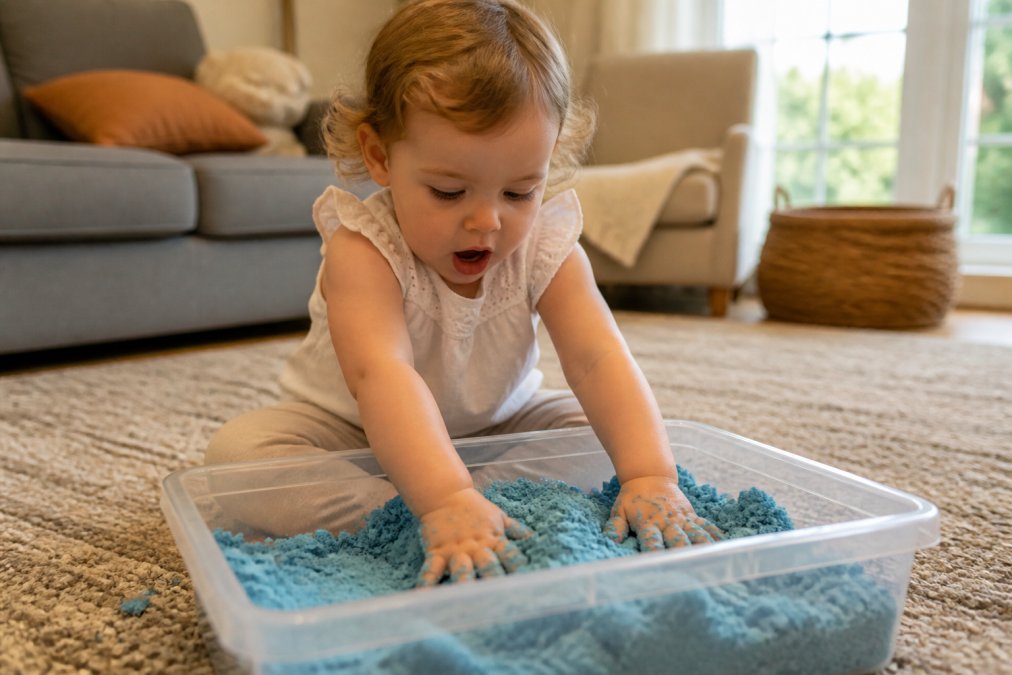
Cognitive growth happens fastest when a toddler’s hands are busy, because the brain learns concepts through the body before it can hold them as words. Pour water into a funnel and watch them learn that cause and effect is real: my action made that happen. That single discovery is the foundation of problem-solving and independent thinking.
Here is the mechanism underneath it. Toddlers build mental models, sometimes called schemas, by repeating an action and tracking what changes. When a child scoops rice, dumps it, and scoops again, they are running a small experiment: same action, same result, every time. That repetition is what moves a skill from something they do into something they know. The brain strengthens the neural pathway each time the pattern repeats, which is why the tenth scoop teaches more than the first.
Tactile exploration also teaches concepts that words can’t yet carry. A toddler who sorts smooth stones from rough ones is practicing categorization. One who stacks cups in order is learning size and sequence. One who hides a toy under a cloth and finds it again is rehearsing object permanence, the understanding that things exist even when out of sight. These are the same thinking skills that later support abstract thinking and preschool readiness.
Watch for these concrete markers as your toddler plays:
- Cause and effect (roughly 9-18 months): deliberately drops or throws items to see what happens, repeats an action that got a reaction
- Object permanence (roughly 8-12 months and solidifying after): searches for a toy you hid under a cup or blanket
- Categorization (roughly 18-24 months): groups similar items, like all the round lids together, even without being told
- Simple problem-solving (roughly 18-36 months): stacks, nests, or turns an object to make it fit, tries a second approach after the first fails
- Working memory (roughly 24-36 months): follows a two-step direction, like “pick up the cup and put it in the bin”
A common mistake is stepping in too fast when a toddler gets stuck. Give them thirty seconds of struggle before you help. That pause is where the learning lives. The productive struggle is the point, not a problem to solve for them.
Rotate sensory materials every two to three weeks, not every day. Novelty drives exploration, but familiarity builds mastery. Toddlers need repeated exposure to the same texture before they truly understand it.
Sensory play builds cognition by letting toddlers run the same small experiment over and over. Repetition, not novelty, is what turns an action into understanding.
Motor Skills and Language: Fine Motor, Gross Motor, and Talking
Fine motor skills and gross motor skills develop together during sensory play, and so does language. Pinching a single bead builds the same finger strength needed for holding a crayon later. Scooping, pouring, and reaching across a bin develops motor coordination and the vestibular system, which governs balance and spatial awareness.
Language acquisition rides along for free. Narrate what you see: “You’re squeezing the sponge, water is dripping out.” Toddlers pick up vocabulary faster when words attach to a physical sensation they’re feeling at that exact moment. Research from Zero to Three on early language development confirms that responsive back-and-forth interaction, not passive exposure, drives language growth.
Keep the narration simple and specific. “Squishy” beats “nice” every time.
Emotional Regulation and the Calming Effect of Tactile Play
Tactile play has a calming effect that many parents underestimate. Repetitive motions, kneading dough, running fingers through dry lentils, sifting sand, activate the same soothing response as a favorite blanket. For a toddler mid-meltdown, a sensory bin can be the reset button.
Self-regulation isn’t taught through lectures. It’s practiced. When a child calms their own body using a texture they find comforting, they’re building the internal toolkit they’ll use for years. Proprioception, the sense of where your body is in space, plays a big role here; heavy work like pushing, pulling, and squeezing is especially regulating.
Some toddlers need high-energy input. Others need quiet, low-stimulation textures. Watch which one your child gravitates toward and lean into it.
Sensory Bin Ideas for Toddlers That Use What You Already Own
The best sensory bin ideas for toddlers don’t require a shopping trip. Check your kitchen and pantry first: dry rice, dry beans, uncooked pasta, oatmeal, and flour all work beautifully. Add measuring cups, spoons, funnels, and small containers you already own.
A few reliable combinations:
- Dry rice + scoops + muffin tin
- Dry beans + toy trucks + small bowls
- Water + sponges + squeeze bottles (outdoors or on a towel)
- Shredded paper + tongs + ice cube tray
- Cooked spaghetti + colander (cooled, supervised)
Theme bins keep interest high without new purchases. A “farm bin” is just dry cornmeal, toy animals, and a scoop.
How to Set Up Sensory Play at Home Without a Big Budget
Setting up sensory play at home takes about five minutes and almost no money. The formula is simple: one base material, two or three tools, one container. That’s it.
Here’s a starter checklist you can run through before every setup:
- Base material chosen (rice, beans, water, sand, dough)
- Container with raised sides (plastic tub, roasting pan, storage bin)
- Two or three scooping or pouring tools
- Towel or mat underneath
- Clear space for the bin on floor or table
- Adult within arm’s reach
A shallow plastic storage bin works better than a deep one. Toddlers need to see and reach everything without climbing in. If you’re using water, set up on a hard floor or outside.
Never use dry beans, uncooked rice, or small beads with a toddler who still mouths objects. Choking risk is real and serious. Stick to taste-safe options like cooked pasta, yogurt, or homemade play dough until mouthing stops.
Sensory Play Activities for 2 Year Olds: A Simple Starter List
Sensory play activities for 2 year olds should be short, simple, and repeatable. Attention spans at this age run five to ten minutes per activity, so plan for several short sessions rather than one long one.
Try these:
- Water transfer with a sponge and two bowls
- Play dough with a plastic knife and cookie cutter
- Dry rice scooping into a muffin tin
- Finger painting with yogurt and food coloring
- Bubble wrap stomping on the floor
- Ice cube exploration in a shallow tray
- Fabric swatch sorting by texture
Safety, Supervision, and the Caregiver’s Role During Play
Safety and supervision come first, always. The caregiver’s role isn’t to direct play, it’s to stay close, watch for hazards, and narrate what’s happening without taking over. That balance is where the best learning happens.
Safety is a checklist, not a vibe: check for choking-size parts, choose non-toxic materials, and stay within arm’s reach. Then step back and let your child lead the play.
Frequently Asked Questions
What are five benefits of sensory play for toddlers?
Sensory play supports five main areas of toddler development: cognitive growth through cause-and-effect exploration, fine and gross motor skills through scooping, pouring, and reaching, language acquisition as caregivers name textures and actions, emotional self-regulation through calming tactile input, and social cooperation when children play alongside peers or siblings. Each benefit builds on the others, which is why repeated, open-ended sensory play tends to produce stronger developmental gains than a single activity done once.
At what age should you start sensory play with your child?
You can introduce simple sensory play in the first year, but toddlers between 12 and 36 months get the most from it because they can sit, grasp, and follow basic directions. For 2 year olds, start with taste-safe materials like cooked pasta, water, or plain yogurt, and keep sessions short, around 10 to 15 minutes. Watch for mouthing, since toddlers still explore by tasting, and choose bin fillers accordingly.
How do you know if your 2 year old has sensory processing issues?
Occasional resistance to mess is normal. Signs worth discussing with your pediatrician include extreme distress at ordinary textures like grass or sand, repeated gagging at common food textures, covering ears at everyday sounds, or seeking intense crashing and spinning far beyond peers. A pediatric occupational therapist can assess sensory processing, but a diagnosis is not required to start gentle sensory play at home. Many children simply need gradual, low-pressure exposure.
How does sensory play support cognitive development in toddlers?
When a toddler pours water between two cups, they are testing cause and effect, building early brain connections, and practicing problem-solving in real time. Tactile exploration of different materials also strengthens abstract thinking later, because children who have handled rough, smooth, wet, and dry objects have concrete reference points for describing and comparing them. These small experiments lay groundwork for preschool readiness in math and science.
Toddlers learn best when their hands are busy and an adult is nearby, and that’s exactly the setup Craft Living Artistry is built to support. Our kids’ craft kits bring the materials, tools, and ideas together in one convenient box, so you can spend less time hunting for supplies and more time watching your child explore. Browse the collection and find a kit that fits your child’s stage, from taste-safe first textures to scooping, sorting, and building activities that grow with them.



0 Comments