
Last Updated: November 6, 2026
Quick Summary
Essential studio safety equipment starts with engineering controls that remove dust and fumes at the source, then adds personal protective equipment for what remains. Set up local exhaust ventilation, a kiln vent, wet cleaning supplies, and sealed storage for dry materials before buying a respirator. PPE is your last line of defense, not your first.
- A fitted particulate respirator rated N95 or higher is needed for clay and silica dust.
- Wet wiping surfaces with a damp cloth captures dust instead of launching it into the air.
- Choose an air purifier with true HEPA filtration matched to your room’s cubic footage.
- Use gloves rated for the temperatures you actually handle, not ordinary oven mitts.
- Check your first aid kit monthly and restock expired supplies after any use.
Table of Contents
- Start With Engineering Controls, Not Just Gear
- Respiratory Protection: Respirators and Dust Masks
- Silica Dust Control for Pottery Studios
- Choosing the Best Air Purifier for Pottery Studio Work
- Eye Protection, Gloves, and Protective Clothing
- Kiln Safety Equipment and Heat Protection
- Building a Pottery Studio First Aid Kit
- Stock Your Studio Safely With Craft Living Artistry
- Frequently Asked Questions
Start With Engineering Controls, Not Just Gear
Most potters buy a respirator first and a ventilation fan last, if they buy one at all. That order is backwards.
Engineering controls are physical changes to the workspace that reduce exposure before it reaches your lungs: local exhaust ventilation, a kiln vent, wet cleaning, and closed storage for dry materials.
Here’s the throughline for this guide: PPE is your last line of defense, not your first.
A practical order to follow:
- Decide where dry clay and glaze mixing happens, ideally away from living space.
- Add local exhaust or a kiln vent before you fire the first load.
- Set up wet cleaning supplies at every station.
- Then buy PPE sized to the hazards that remain.
If you’re laying out a new space, our step-by-step guide on how to organize a home pottery studio covers where ventilation and controls belong. See how a professional pottery studio organizes its space for airflow and safety layout.
Respiratory Protection: Respirators and Dust Masks
A dust mask is not a respirator, and a surgical mask is neither. For pottery work, you need a fitted particulate respirator rated N95 or higher for clay and silica dust, and cartridge respirators when you handle glazes or fire kilns in enclosed spaces. The distinction matters because a loose paper mask lets air leak around the edges, so dust bypasses the filter entirely.
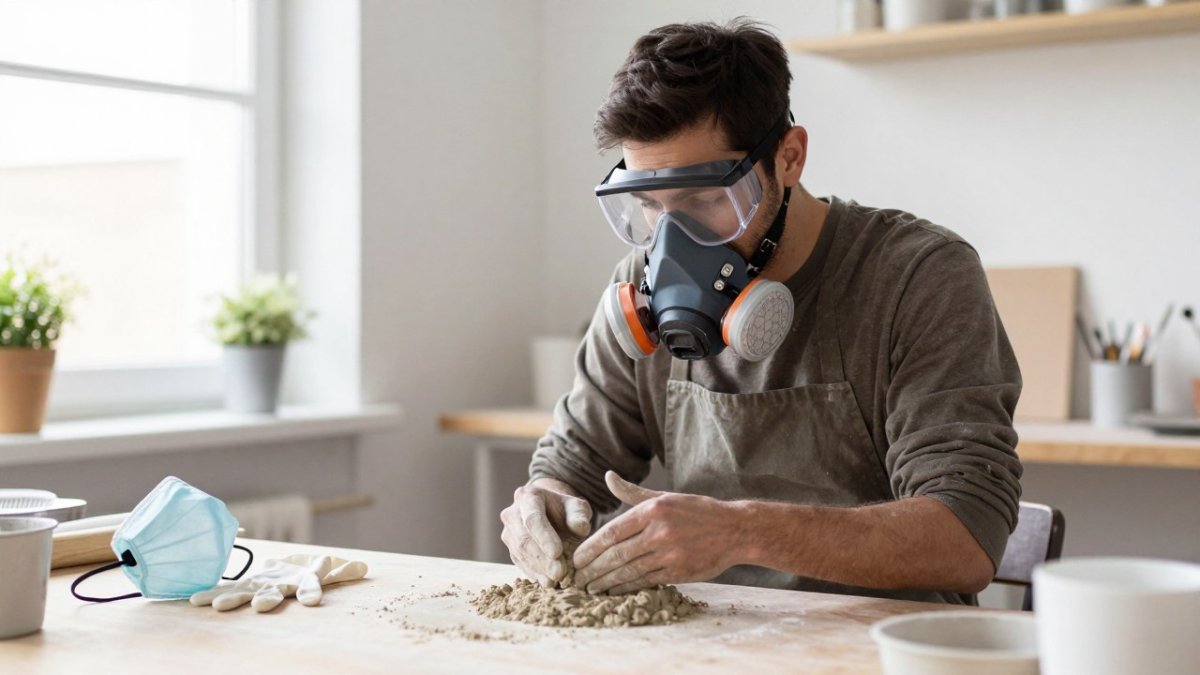
Match the respirator to the hazard and the task
Respirator selection should follow the task, not the other way around. Use this task-to-respirator map as a starting point, then confirm against the product’s instructions and the safety data sheet for any chemical you handle.
| Task | Typical respirator | Why |
|---|---|---|
| Mixing dry clay, reclaiming scraps, sanding bisque | N95 or higher particulate respirator | Captures fine silica and clay dust at the source |
| Mixing dry glaze materials, spraying glaze | Particulate respirator plus adequate ventilation; cartridge respirator with particulate prefilter if spraying | Glaze powders include silica and metal oxides; spraying creates fine aerosol |
| Kiln loading, unloading, and peephole checks during firing | Cartridge respirator with acid-gas or multi-gas cartridges if fumes are present; otherwise particulate protection for dust | Kiln fumes include sulfur oxides and other gases depending on clay and glaze chemistry |
| Cleaning with a HEPA vacuum or wet methods | N95 or higher if dust is disturbed | Cleaning can resuspend settled dust |
A common mistake is wearing the same respirator for glaze chemicals and clay dust without swapping cartridges. Particulate filters capture dust; chemical cartridges capture gases and vapors.
Fit testing and seal checks
A respirator only protects you if it seals. A seal check before every use helps catch fit problems.
- User seal check every time. Cover the filter inlets and exhale gently; a leak means refit.
- Formal fit testing matters if you wear a respirator regularly, especially with facial hair that breaks the seal. OSHA’s respiratory protection guidance describes qualitative and quantitative fit tests; even hobbyists can use the qualitative saccharin or Bitrex methods with a fit-test kit.
- Facial hair and eyewear interfere with the seal. A clean-shaven face and eyewear straps routed outside the respirator mask improve fit. Prescription glasses can be worn with most half-face respirators, but the temples must not break the seal.
- Sizing matters. Respirators come in small, medium, and large; a poor size choice causes leaks and discomfort. Try more than one size if you are between sizes.
Filters, cartridges, and replacement intervals
Replace particulate filters according to the manufacturer’s schedule. Chemical cartridges have a limited service life and should be replaced when you first notice breakthrough odor or taste, or on the manufacturer’s recommended interval, whichever comes first.
The OSHA respiratory protection guidance is a solid reference for seal checks, fit testing, and filter schedules, even for hobbyists. If you fire indoors, pair respiratory protection with a kiln vent and local exhaust so the respirator is handling only what remains.
Silica Dust Control for Pottery Studios
Silica dust control is the practice of keeping fine clay and glaze particles out of the air and off surfaces, using wet methods, ventilation, and filtration instead of dry sweeping.
Wet cleaning is the single highest-value habit. A damp sponge or mop captures dust instead of launching it into the air. Dry sweeping does the opposite.
Practical dust control steps:
- Wipe surfaces with a damp cloth rather than sweeping or dry vacuuming.
- Use a dust-control vacuum with HEPA filtration if you must vacuum.
- Keep dry clay and glaze powders in sealed containers.
- Clean sink traps and never pour clay slurry down a drain.
The Ceramic Arts Network’s studio safety guidelines recommend wet-wiping surfaces rather than sweeping or vacuuming, which matches what we’d tell any beginner. For more detail on the hazards of crystalline silica, the CDC’s silica exposure overview explains why the smallest particles pose the biggest risk.
Choosing the Best Air Purifier for Pottery Studio Work
The best air purifier for a pottery studio is a unit with true HEPA filtration and enough clean-air delivery to cycle your room’s air several times per hour.
Air purifiers are a backup, not a substitute for source control. They clean what’s already airborne. Local exhaust removes dust and fumes before they spread. Use both.
What to look for:
- True HEPA filtration, not “HEPA-like” marketing language.
- A clean air delivery rate matched to your room size.
- Replaceable filters with affordable replacement costs.
- A carbon stage if you fire or glaze indoors.
Watch out: an undersized purifier running in a large studio gives a false sense of safety.
Eye Protection, Gloves, and Protective Clothing
Safety glasses or goggles protect against flying clay, glaze splashes, and kiln debris. Nitrile gloves handle glaze materials and chemical additives. An apron and closed-toe footwear round out the basics.
Which gear for which task:
| Task | Eye Protection | Hand Protection | Clothing |
|---|---|---|---|
| Throwing on the wheel | Safety glasses | Optional | Apron |
| Mixing dry clay or glaze | Goggles | Nitrile or chemical-resistant gloves | Apron, closed-toe shoes |
| Loading and unloading kiln | Face shield or glasses | Heat-resistant gloves | Apron, closed-toe shoes |
| Cleaning the studio | Safety glasses | Nitrile gloves | Apron |
For glaze chemicals, check the safety data sheet and match your gloves to the material; nitrile works for many, but not all. The NIOSH eye safety guidance covers selection basics for protective eyewear.
Kiln Safety Equipment and Heat Protection
Kiln safety equipment includes a kiln vent, heat-resistant gloves, a fire extinguisher rated for electrical fires, and clear clearance around the unit.
A kiln vent pulls fumes and heat out of the firing area, which protects both your lungs and your indoor air quality.
For work surfaces near hot tools and kiln-adjacent repairs, a heat-resistant mat protects the bench from scorch damage. Our silicone soldering work mat handles heat up to 932°F, which makes it a useful addition to a station where hot tools and small repairs happen.
Watch out: ordinary oven mitts are not kiln gloves. Use gloves rated for the temperatures you actually handle, and let pieces cool fully before bare-hand contact.
Building a Pottery Studio First Aid Kit
A pottery studio first aid kit should cover cuts, burns, eye splashes, and dust irritation, plus a way to rinse chemicals off skin fast. Off-the-shelf kits get you partway; you’ll want to add a few studio-specific items and a written emergency plan. A written plan matters as much as the supplies, because injuries can happen when hands are wet, tools are sharp, and the kiln is hot.
What to include
- Adhesive bandages and gauze for cuts from tools and clay edges
- Burn gel and sterile dressings for kiln and hot-tool burns
- An eyewash station or sterile saline rinse
- Nitrile gloves for treating wounds
An eyewash station earns its place if you handle glaze chemicals. Rinsing fast matters more than rinsing fancy. Keep the kit where you can reach it with wet or injured hands, not buried under a shelf of bats.
Emergency readiness beyond the kit
A first aid kit is only one part of emergency readiness. The rest is access, information, and a plan you have actually practiced.
- Eyewash access. If you use glaze chemicals, a plumbed eyewash or a gravity-fed portable eyewash should be within a few seconds’ reach of the mixing area. A bottle of sterile saline is a backup, not a substitute. Flush eyes for at least 15 minutes and seek medical care.
- Burn response. For a minor kiln or hot-tool burn, cool the area under cool running water, cover with a sterile nonstick dressing, and do not apply ice or butter. For a large, deep, or facial burn, or a burn that looks white or charred, seek medical care immediately.
- Chemical splash on skin. Remove contaminated clothing, rinse with plenty of water, and check the safety data sheet for the specific chemical. Some glaze materials require medical attention even for small exposures.
- Emergency contacts. Post the local poison control number, your physician, and the nearest urgent care or emergency department. Note your kiln’s shutoff location and the location of your main electrical panel.
Inspection and restocking schedule
Check the kit monthly and after any use. Replace expired supplies, restock bandages and gloves, and confirm the eyewash is clean and within its expiration date. A simple checklist taped inside the kit lid makes the monthly check a two-minute task rather than a forgotten one.
Stock Your Studio Safely With Craft Living Artistry
Safety gear is only useful if it fits your actual workflow. Buy the controls first, the PPE second, and skip nothing that matches a hazard you genuinely face.
If you’re deciding what to buy first, our comparison of beginner pottery kits versus buying tools separately helps you weigh a starter kit against piece-by-piece shopping. See our list of essential beginner pottery clay tools to fill the gaps your safety gear doesn’t cover.
At Craft Living Artistry, we curate a focused selection of kits, cords, beads, and maker tools so you can build a safe, workable studio without hunting across a dozen stores.
Setting up a studio safely takes planning, but it doesn’t have to be complicated.
Frequently Asked Questions
What safety equipment do I need for a pottery studio?
At minimum, you need a fitted respirator for mixing dry clay and glaze materials, safety glasses, nitrile gloves, and a protective apron. Add a dust-control vacuum or wet cleaning supplies for silica dust, plus a first-aid kit and eyewash station. Kiln safety equipment matters too if you fire on site. Start with engineering controls like ventilation and wet cleaning, then layer personal protective equipment on top of those habits.
How can I control silica dust in a pottery studio?
Wet cleaning beats dry sweeping every time. Wipe surfaces with damp cloths and mop floors instead of sweeping, which sends crystalline silica into the air. Use a dust-control vacuum with HEPA filtration rather than a shop vac, keep clay scraps damp, and avoid sanding dry pieces indoors. A sink trap keeps clay sediment out of wastewater. Good silica dust control for pottery studios starts with these habits before it ever reaches a respirator.
What type of air purifier is best for a pottery studio?
Look for a unit with true HEPA filtration rated for fine particles, sized for your room’s square footage and air changes per hour. HEPA captures the tiny crystalline silica particles that matter most. Place it near your work area but not so close that it pulls dust across your breathing zone. An air purifier supports your ventilation and dust control efforts, but it does not replace a respirator during dry mixing or glaze work.
What should be in a pottery studio first aid kit?
Beyond standard bandages and antiseptic, add an eyewash station for glaze splashes, burn gel for kiln and heat contact, and nitrile gloves for treating cuts without clay contamination. Include tweezers for clay or glaze splinters and a small mirror for eye checks. Store the kit away from dust and check expiration dates twice a year. A pottery studio first aid kit should sit within reach of both your wheel and your kiln.







0 Comments