Table of Contents
- Why Creative Alternatives Matter in Art Education
- Alternative Art Projects for Kids Beyond Paint and Pencil
- Low-Mess Art Projects for Kids That Still Inspire
- Collaborative Art Projects for the Classroom That Build Community
- Process Art Activities for Elementary Students
- Supplementing School Art Education at Home
- Making Creative Art Accessible and Affordable
- Frequently Asked Questions
Last Updated: October 10, 2026
Why Creative Alternatives Matter in Art Education
Traditional art class relies on paintbrushes, watercolors, and pencils. Creative alternatives to traditional school art open doors to techniques that engage different learners and spark genuine excitement.
Expanding the art toolkit transforms classroom dynamics. Students who felt stuck become problem-solvers. Process art activities for elementary students emphasize exploration over perfection, reducing anxiety and increasing participation.
Creative alternatives address practical classroom needs: low-mess projects eliminate cleanup headaches, paint-free options work in tight spaces, and accommodations for sensory sensitivities remove barriers to engagement.
Alternative Art Projects for Kids Beyond Paint and Pencil
Alternative techniques develop different skills: sculpture builds spatial reasoning, printmaking teaches planning and precision, textile work develops fine motor control, and mixed media teaches composition. Each can be adapted for K-12 learners with clear instructions and realistic timelines.
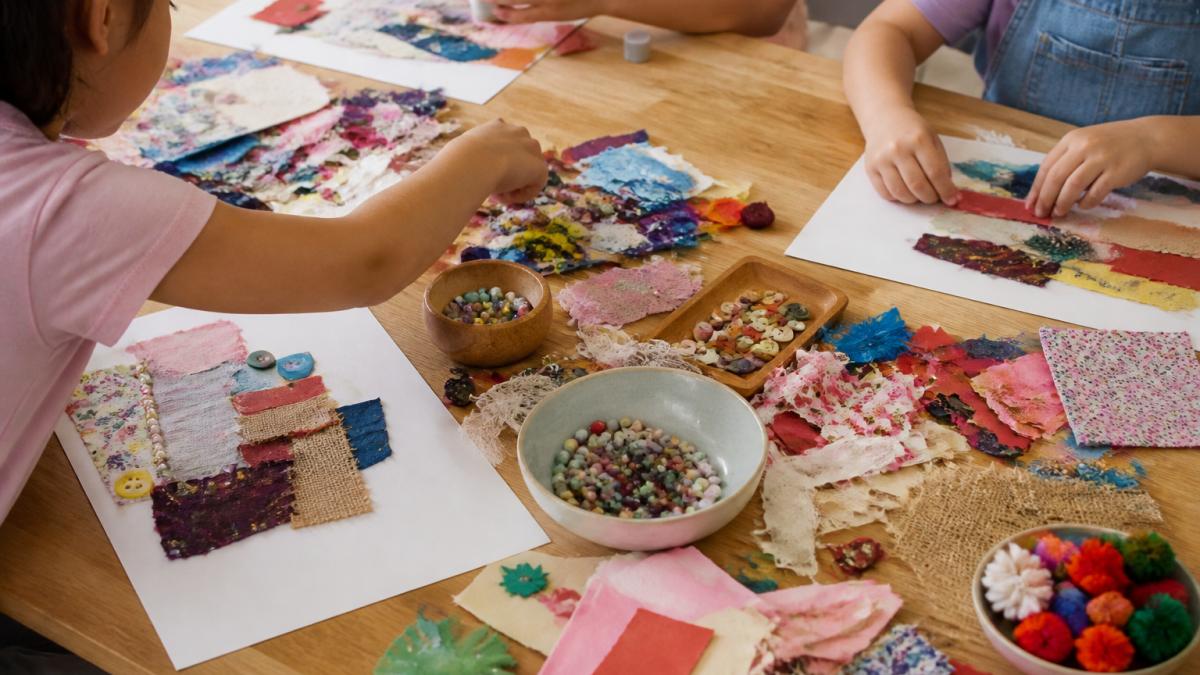
Mixed-Media Collage and Textile Work
Mixed-Media Collage
Grade levels: K-12 (adapt materials by age)
Learning objectives: Composition, color theory, texture exploration, spatial arrangement
Setup time: 10 minutes (gather and sort materials)
Project duration: 30-45 minutes
Cleanup time: 10 minutes
Steps:
- Prepare a base (8×10 cardboard or poster board).
- Cut or tear paper, fabric, and found materials into varied sizes.
- Arrange pieces on the base without gluing first (allows revision).
- Glue pieces down, layering for depth and visual interest.
- Add details (buttons, pasta) for texture.
Differentiation: Younger students (K-2) use pre-cut shapes; older students (3-12) cut their own materials.
Why students respond: Tactile engagement holds attention. Multiple materials provide entry points for different abilities.
Textile Work: Simple Cardboard Loom Weaving
Grade levels: 2-12
Learning objectives: Pattern, rhythm, fine motor control, over-under sequencing
Materials needed: Cardboard (cereal boxes work), yarn or fabric strips, scissors, tape
Setup time: 15 minutes (cut cardboard, create warp threads)
Project duration: 20-40 minutes
Cleanup time: 5 minutes
Steps:
- Cut a rectangular piece of cardboard (6×8 inches is manageable for younger students).
- Cut notches (½ inch apart) along the top and bottom edges.
- Wrap yarn through notches to create warp threads (the vertical base).
- Thread a needle or use a yarn needle to weave weft threads (horizontal) over and under the warp.
- Vary colors and textures; weave in fabric scraps or ribbon.
- Tie off the end and remove from the cardboard loom.
Differentiation: Younger students use thick yarn and wider spacing; older students use thinner yarn and tighter patterns.
Why students respond: Repetitive motion is calming. Students see immediate, tangible progress.
Sculpture and Three-Dimensional Building
Paper Sculpture
Grade levels: 1-12
Learning objectives: Spatial thinking, form, balance, structural design
Materials needed: Construction paper or cardstock, scissors, glue, tape, optional: markers or paint
Setup time: 5 minutes
Project duration: 25-40 minutes
Cleanup time: 5 minutes
Steps:
- Demonstrate rolling, folding, and curling paper to create three-dimensional forms.
- Students design a structure (animal, building, abstract form) by cutting and shaping paper pieces.
- Assemble pieces using glue and tape, building height and depth.
- Add details with markers or paint if desired.
Differentiation: Younger students use pre-cut shapes; older students design and cut their own forms.
Sculpture with Recycled Materials
Grade levels: K-12
Learning objectives: Creative problem-solving, resourcefulness, form, balance
Materials needed: Cardboard tubes, plastic containers, wood scraps, bottle caps, newspaper, tape, glue, paint or markers (optional)
Setup time: 10 minutes (collect and organize materials)
Project duration: 30-50 minutes
Cleanup time: 10 minutes
Steps:
- Gather recycled materials and sort by type.
- Students design a sculpture (robot, creature, abstract form) using found objects.
- Stack, tape, and glue pieces together.
- Paint or decorate if desired.
Differentiation: Younger students build freely; older students sketch designs first.
Why students respond: Three-dimensional work feels more “real” than drawing. Kinesthetic learners thrive. Recycled materials feel permission-giving.
Printmaking and Transfer Techniques
Foam Plate Printing
Grade levels: 1-12
Learning objectives: Planning, precision, cause and effect, image reversal
Setup time: 10 minutes (prepare ink station)
Project duration: 30-40 minutes
Cleanup time: 10 minutes
Steps:
- Students design an image on paper first (encourages planning).
- Transfer or draw the design onto the foam plate using a pencil (pressing creates indented lines).
- Roll or sponge ink onto the plate.
- Press the inked plate onto paper to transfer the image.
- Lift carefully to reveal the print.
- Repeat with different colors or papers.
Differentiation: Younger students use simple designs and teacher-prepared plates; older students create detailed, multi-color prints.
Stencil and Rubbing Techniques
Grade levels: K-12
Learning objectives: Negative space, texture, mark-making
Materials needed: Paper, pencils or crayons, textured objects (leaves, coins, tree bark), scissors, tape
Setup time: 5 minutes
Project duration: 15-30 minutes
Cleanup time: 2 minutes
Steps:
- Place paper over a textured surface (tree bark, manhole cover, leaf).
- Rub gently with the side of a crayon or pencil to reveal the texture.
- Alternatively, cut stencils from paper and use them as masks for crayon or marker work.
Differentiation: Younger students explore rubbings outdoors; older students create layered stencil compositions. Students with sensory sensitivities use pencil rubbings instead of crayon.
Why students respond: Printmaking teaches cause and effect. The surprise of what appears rewards careful planning.
Low-Mess Art Projects for Kids That Still Inspire
Mess concerns often limit what teachers attempt. Low-mess alternatives remove that barrier without sacrificing engagement or learning.
Dry Media and Paint-Free Options
Dry media (colored pencils, markers, oil pastels) create vibrant results without water or cleanup. Water-soluble oil pastels clean up with soap and water. Dry media projects include Zentangle designs, marker resist, colored pencil layering, and scratch art. Students see results immediately with no drying time or stained clothing.
Water-Based and Quick-Cleanup Materials
When water is necessary, use watercolor cakes (not liquids), spray bottles, and designated cleanup stations. Water-based projects include watercolor on wet paper, marker tie-dye on paper towels, water droppers with food coloring, and wet chalk. Contain materials, prepare surfaces, and establish cleanup routines.
Collaborative Art Projects for the Classroom That Build Community
Collaborative projects strengthen relationships and teach shared goals. Mural projects let entire classes contribute to one large artwork. Collaborative sculpture uses paper, clay, or found objects to create installations where each person’s work matters. Group printmaking teaches sequencing and planning. These projects build inclusion and celebrate every student’s contribution.
Process Art Activities for Elementary Students
Process art activities for elementary students prioritize exploration over product. Activities include sensory exploration with unusual tools, color mixing experiments, texture creation, and layering. These activities have no “right answer,” reducing performance anxiety and accommodating different learning speeds.
Supplementing School Art Education at Home
Parents can extend classroom learning using household materials: newspaper, magazines, fabric scraps, buttons, and dried pasta. Home projects include collage, painting with household objects, drawing, building with clay, and weaving. These projects cost nearly nothing and show students that art happens everywhere.
Making Creative Art Accessible and Affordable
Budget constraints limit what schools can offer, but strategic material choices and differentiated instruction make creative alternatives achievable on any budget, and accessible to all learners, regardless of ability or sensory profile.
Budget-Friendly Material Sourcing
Recycled and Household Materials
The most cost-effective approach is to use materials already available in classrooms, homes, and communities:
- Cardboard: Cereal boxes, shipping boxes, paper towel tubes, toilet paper tubes. Cost: free. Uses: looms, sculpture bases, printmaking blocks, structural building.
- Paper and cardstock: Newspaper, magazines, junk mail, paper bags, construction paper scraps. Cost: free to $0.02 per sheet if purchased. Uses: collage, papier-mâché, stencils, paper sculpture.
- Fabric scraps: Leftover fabric from sewing projects, worn clothing, thrift store finds. Cost: free to $0.50 per pound at fabric donation centers. Uses: collage, weaving, mixed media, textile projects.
Sourcing Strategy: Partner with local businesses to collect scraps, send home materials wish lists, visit thrift stores, and check community “Buy Nothing” groups for free donations.
Cost Comparison: Traditional vs. Alternative Projects
| Project Type | Traditional Approach | Alternative Approach | Cost Difference |
|---|---|---|---|
| Painting | Acrylic paint sets ($3-8 per student), brushes, canvas or paper | Dry media (markers, colored pencils already in classroom) or water-based markers | $0-2 per student vs. $5-10 |
| Drawing | Sketch pads ($2-4 per student), pencils, erasers | Newspaper, cardboard, charcoal sticks (free or $0.50) | $0-1 per student vs. $3-5 |
| Sculpture | Air-dry clay ($1-3 per student) | Cardboard, paper, found objects (free) | $0 per student vs. $1-3 |
| Printmaking | Linoleum blocks ($2-5 each), carving tools ($15-30 set), ink | Foam plates (free from grocers), pencil for carving, washable paint (already in classroom) | $0-2 per student vs. $5-10 |
| Weaving | Yarn ($1-2 per project), looms ($20-50 each) | Cardboard looms (free), yarn scraps (free or donated) | $0 per student vs. $3-5 |
Accessibility Beyond Cost: Differentiation for All Learners
Affordability is only one barrier. Sensory sensitivities, motor challenges, and learning differences also limit access. Thoughtful project design removes these barriers:
For Students with Sensory Sensitivities: Offer paint-free alternatives, gloves or barrier tools, unscented materials, quiet workspaces, and student choice in materials.
For Students with Fine Motor Challenges: Pre-cut materials, offer adaptive scissors or guillotine cutters, use tape instead of glue, provide thicker writing tools, use pre-threaded needles and larger yarn, and allow arrangement without gluing.
For Students with Visual Processing Differences: Use high-contrast colors, limit material choices, provide tactile materials, offer verbal descriptions, and allow extra processing time.
For Students with Attention or Executive Function Challenges: Break projects into smaller steps, use visual checklists, limit material choices, provide fidget-friendly materials, and set clear time limits.
For Students with Intellectual or Developmental Disabilities:
- Focus on process over product; celebrate exploration and effort.
- Use repetitive, calming activities (rubbing, stamping, layering) that build confidence.
- Offer hand-over-hand support or peer partnerships for complex steps.
- Adapt projects to match fine and gross motor abilities (larger materials, simpler assembly).
Building a Sustainable Materials Library
Schools can reduce ongoing costs by building a reusable materials collection:
- Establish a donation system: Send home a materials wish list each semester. Collect donations in labeled bins.
- Partner with local businesses: Ask print shops, frame shops, and fabric stores to donate scraps. Many are happy to avoid disposal costs.
- Create a materials exchange: Connect with other schools or homeschool groups to swap materials and supplies.
- Invest in durable tools: Buy quality scissors, rulers, and cutting tools once; they last years. Prioritize tools over consumables.
- Organize by project type: Label bins by project (“Collage Materials,” “Weaving Supplies,” “Printmaking”) so teachers can grab what they need.
- Rotate materials seasonally: Use fall leaves in autumn, evergreens in winter, flowers in spring. This keeps materials fresh and free.
Free and Low-Cost Resources
- Library books: Most public libraries have art instruction books, technique guides, and project idea collections. Borrow for free.
- Online tutorials: YouTube channels and educational websites offer free step-by-step project videos.
- Community art centers: Many offer free or sliding-scale classes, material access, and teacher workshops.
- Museum education programs: Many museums offer free or discounted field trips and provide teaching resources.
The real cost of art education is time and intention, not expensive materials. When teachers prioritize process over product, celebrate diverse materials, and differentiate for all learners, creative alternatives become accessible to every student, regardless of budget, ability, or sensory profile.
Frequently Asked Questions
What are some creative alternatives to painting and drawing for kids?
Beyond traditional paint and pencil, students can explore mixed-media collage using fabric and paper scraps, sculpture with clay or recycled materials, printmaking with stamps and stencils, weaving, and metal embossing. Water-soluble oil pastels, colored pencils, and markers offer different tactile experiences. Many of these alternatives engage different learning styles and help students discover unexpected creative strengths while keeping hands-on learning exciting and varied.
What are the best low-mess art projects for kids?
Low-mess alternatives include dry media like colored pencils, markers, and chalk pastels; collage with pre-cut paper; tracing and transfer techniques; weaving with yarn on cardboard looms; and sculpture using air-dry clay or found objects. Water-based materials like watercolors in sealed palettes and water-soluble markers also minimize cleanup. These options reduce stress for parents and teachers while keeping the focus on creativity and skill-building rather than managing supplies.
How can collaborative art projects strengthen student engagement in the classroom?
Collaborative art projects build community and allow students to learn from peers. Group murals, collective sculptures, and shared mixed-media installations encourage communication and problem-solving. Students develop social skills while contributing to something larger than themselves. These projects also accommodate different skill levels and interests, letting each child participate meaningfully. Process-focused collaboration, where the experience matters more than the final product, reduces pressure and increases genuine creative exploration.
What supplies do I need to get started with creative art alternatives at home?
Start with versatile basics: colored pencils, markers, construction paper, and scissors for collage work. Add modelling materials like air-dry clay, recycled materials (cardboard tubes, fabric scraps, buttons), and natural items (leaves, twigs). For mixed-media projects, gather glue, tape, and water for water-soluble materials. Curated starter kits from specialty retailers often bundle everything needed for specific projects.





0 Comments