
Table of Contents
- What Counts as a STEM Craft Project for Preschoolers?
- 8 Easy STEM Activities for Preschoolers That Use Household Materials
- Hands-On STEM Activities for Preschoolers: Building and Engineering Challenges
- Engineering Activities for Preschoolers: Problem-Solving Through Play
- Preschool STEM Materials: What to Keep on Hand
- Safety and Adaptations for Ages 3-5
- How to Choose the Right STEM Craft Project for Your Child
- Frequently Asked Questions
Last Updated: October 6, 2026
What Counts as a STEM Craft Project for Preschoolers?
STEM craft projects for preschoolers combine making something with science, technology, engineering, or math thinking.
STEM craft projects for preschoolers are projects where a 3- to 5-year-old asks a question, makes something with their hands, and sees what happens.
A pre-cut foam snowman teaches gluing; a ramp your child builds, tests, and rebuilds teaches cause and effect.
STEM vs. STEAM: What’s the Difference?
STEAM is STEM plus an arts component. At this age the line is blurry: decorating a weather chart with crayons is STEAM, counting the sunny days is math. The label matters far less than whether your child is observing, building, or testing.
8 Easy STEM Activities for Preschoolers That Use Household Materials
These eight easy STEM activities for preschoolers need nothing fancier than what’s already in your kitchen, recycling bin, or craft drawer. Each lists materials, steps, and a learning goal so you can start in ten minutes.
| Activity | Materials | Learning Goal | Mess Level |
|---|---|---|---|
| Sink or Float | Bin, water, household objects | Prediction and observation | Medium |
| Weather Chart | Paper, markers, window | Tracking and patterns | Low |
| Nature Scavenger Hunt | Bag, printed list, seeds | Sorting and plant growth | Low |
| Pattern Play | Buttons, cups, beads | Counting and patterns | Low |
| Stick and Cup Structures | Popsicle sticks, cups | Building and balance | Low |
| Ramps and Rolling | Cardboard, toy cars | Cause and effect | Low |
| Baking Soda Reactions | Baking soda, vinegar, ice | Experimentation | High |
| Five Senses Exploration | Small household items | Observation and language | Low |
1. Sink or Float: A First Science Experiment
Fill a clear plastic bin with water and set out objects: a metal spoon, plastic cup, cork, rock, paper towel square. Ask your child to guess which will sink before each drop, and record the guesses.
The learning happens in the surprise: a heavy-looking cork floats, a light-looking rock sinks. Encourage testing the same object twice, then trying a new one.
2. Weather Chart and Daily Tracking
Draw a grid with columns for sunny, cloudy, rainy, and windy. Each morning, your child looks out the window and marks the day.
After two weeks, count the marks together. Which weather showed up most? This turns weather tracking into early data work and builds number sense without feeling like a lesson.
3. Nature Scavenger Hunt and Seed Planting
Print or draw a short list: a smooth rock, a leaf with points, a stick longer than your hand, something brown, something green. Walk the yard or a park and check items off together.
Back inside, plant bean seeds in a clear cup with a damp paper towel and set it on a windowsill.
4. Sorting, Categorizing, and Pattern Play
Dump a mixed pile of buttons, beads, or plastic cups on a tray. Ask your child to sort them by color, then size, then shape.
Next, start a two-color pattern and ask your child to continue it. Sorting and categorizing are foundational math skills, and pattern play builds the thinking behind counting and simple algebra.
Hands-On STEM Activities for Preschoolers: Building and Engineering Challenges
Building challenges are where hands-on STEM activities for preschoolers get physical. Give a child materials and a goal, and engineering thinking starts immediately: what holds, what tips, what needs a wider base.
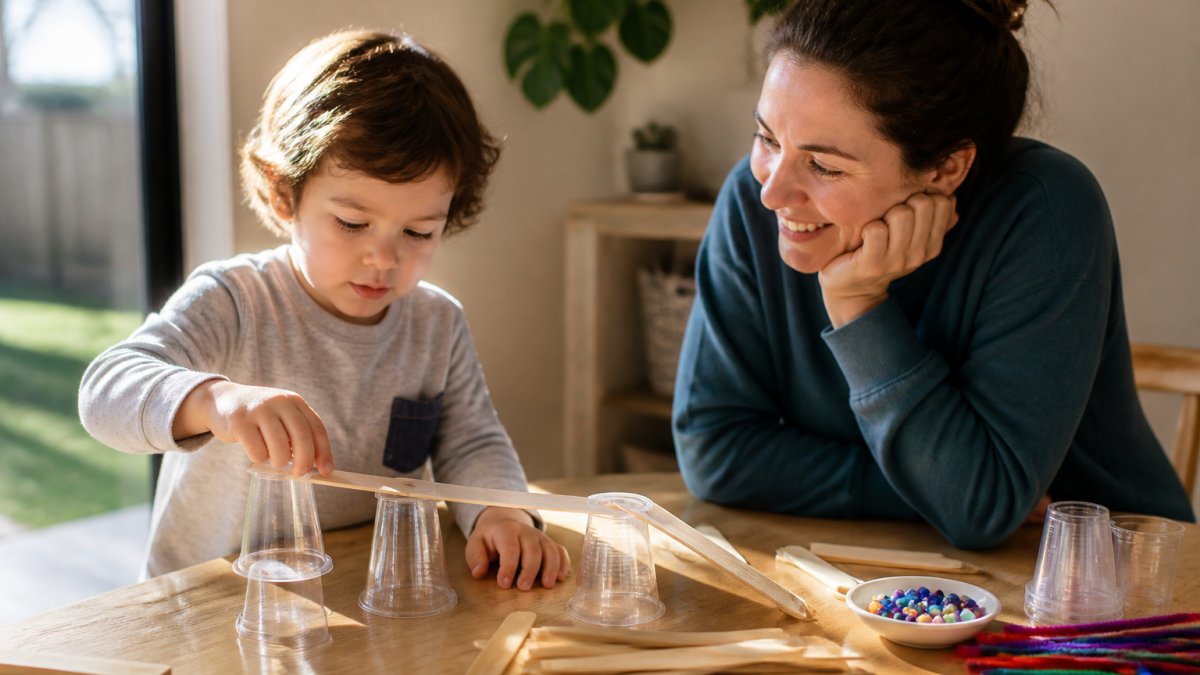
5. Popsicle Stick and Cup Structures
Hand your child popsicle sticks, plastic cups, and tape. Challenge them to build a tower taller than a stuffed animal or a bridge that holds a toy car.
Ask open questions as they work: “What would make it steadier?” or “What happens if we put a bigger cup at the bottom?” These prompts keep the inquiry going without taking over.
6. Ramps, Rolling, and Simple Machines
Lean cardboard against a couch cushion to make a ramp and send a toy car down it. Then change one thing: raise the ramp higher, or swap the car for a ball.
This is a simple machines lesson disguised as play. Ramps, wheels, and levers all show up, and repeated testing is how preschoolers learn cause and effect.
Engineering Activities for Preschoolers: Problem-Solving Through Play
The best engineering activities for preschoolers look like a mess and feel like a game. Both projects below put your child in charge of a problem: what happens when two materials meet, and how our senses help us figure things out.
7. Baking Soda Reactions and Ice Exploration
Set a spoonful of baking soda in a shallow dish and let your child drip vinegar on it with a dropper. Offer different amounts and watch them notice that more vinegar means more bubbles.
For ice exploration, freeze small toys in a block of ice and hand over warm water, salt, and a spoon.
8. Five Senses Sensory Exploration
Set out five items your child can explore one sense at a time: a soft cloth, a lemon, a bell, a cracker, a colorful picture.
This builds observation skills and vocabulary at once. A child who can say “rough,” “smooth,” “loud,” or “sweet” is learning to describe what they notice, the foundation of scientific observation.
Preschool STEM Materials: What to Keep on Hand
A well-stocked craft drawer turns a STEM project from a planned event into a two-minute decision. You need no formal kit, just a small rotating set of basics that work across every activity above.
The core supply list
These items cover sink-or-float, ramps, structures, sorting, and sensory play. Most are reusable and cost less than a single pre-made kit.
- Building and engineering: popsicle sticks, plastic cups (reusable, not disposable), paper towel and toilet paper tubes, cardboard scraps, masking tape, and a few small toy cars or balls.
- Science and chemistry: baking soda, white vinegar, a plastic dropper or turkey baster, a clear plastic bin, and a rimmed tray.
- Math and sorting: buttons, beads, plastic bottle caps, clothespins, and a muffin tin or ice cube tray for sorting compartments.
Where to get it cheaply
You do not need to buy anything new. Reliable sources:
- Recycling bin: tubes, cardboard, plastic tubs, bottle caps, egg cartons.
- Dollar store or big-box store: popsicle sticks, plastic cups, droppers, and sorting trays for a few dollars total.
- Hardware store: a small bag of corks and a roll of masking tape go a long way.
A common pattern is that families spend more on storage containers than on the supplies themselves. A single shoebox or a clear plastic bin with a lid is enough.
Storage that actually works
- One bin per category. Label them: building, chemistry, sorting, art. A preschooler can pull the right bin without help.
- Keep a “loose parts” jar on the counter. Corks, bottle caps, clothespins, and small cardboard pieces. Preschoolers reach for it constantly, and loose parts are the raw material of almost every building challenge.
- Rotate, don’t hoard. Keep the current favorites out and store the rest. Too many choices stalls a 4-year-old.
Substitutions when you are out of something
- No popsicle sticks? Use straws, rolled paper, or uncooked spaghetti.
- No plastic cups? Use paper cups, yogurt containers, or blocks.
- No dropper? Use a spoon, a straw, or a clean medicine syringe.
Low-mess and reusable options
If cleanup is the thing stopping you, choose projects by mess level:
- Low mess: sorting, pattern play, weather chart, nature scavenger hunt, five senses exploration.
- Medium mess: sink or float (water on a tray), ramps and rolling.
- High mess: baking soda reactions, ice exploration, anything with shaving cream or slime.
For high-mess projects, set a rimmed tray on a towel, keep a rinse bowl nearby, and have your child help wipe down when finished. The cleanup is part of the activity.
Keep a “loose parts” jar on the counter with corks, bottle caps, and clothespins. Preschoolers reach for it constantly, and loose parts are the raw material of almost every building challenge.
If you would rather skip the scavenging, our kids’ craft kits bundle the supplies for projects like these in one box, so nothing goes missing mid-activity.
Safety and Adaptations for Ages 3-5
Safety and adaptation are the two things that decide whether a STEM craft actually works at home or in a classroom. Most activity lists skip both. Here is the concrete version.
Safety rules that cover almost every project
- Supervise water and small parts at all times. The Consumer Product Safety Commission uses a small-parts test cylinder (about 1.25 inches wide by 2.25 inches long) to flag choking hazards for children under 3. If a button, bead, cork, or bottle cap fits inside that cylinder, keep it out of reach of any child still mouthing objects, and treat it as a supervised-only material for 3-year-olds.
- Choose non-toxic, washable supplies. Look for the AP (Approved Product) seal from the Art & Creative Materials Institute on markers, paints, and glues. That seal means the product has been reviewed for toxicity in children’s art materials.
- Keep the chemistry tame. Baking soda and vinegar is safe and edible-adjacent, but it still belongs on a rimmed tray. Never substitute bleach, ammonia, or drain cleaner for a preschool experiment, and never mix vinegar with bleach.
A simple rule of thumb: if you would not be comfortable with your child putting the material in their mouth, it does not go in an unsupervised bin.
Adaptations for different abilities and stages
The same project can stretch from a 3-year-old to a 5-year-old, or from a child with limited fine-motor control to one who needs a challenge. Adjust the task, not the topic.
For younger or less dexterous children:
- Swap small beads for large plastic buttons, chunky foam shapes, or jumbo tweezers.
- Pre-cut tape strips and pre-tear paper so the child focuses on building, not tearing.
- Use a wide-mouth cup instead of a narrow one for pouring and scooping.
For older or advanced children:
- Add a constraint: build a bridge that holds a small book, or a tower that survives a gentle fan.
- Ask them to sort by two traits at once (color and size), then explain their rule.
- Introduce measurement: how many cups tall is the tower? How many seconds until the ice melts?
For mixed-age groups:
- Pair a younger child with an older one and give each a role: the younger child predicts, the older child records.
- Set up one station with big materials and one with small materials so both ages work on the same idea at different difficulty levels.
For children with sensory sensitivities:
- Offer tools instead of bare hands: a spoon for the sensory bin, a paintbrush for the glue.
- Keep a towel and a rinse bowl nearby so a child can clean up immediately.
- Start with dry materials (rice, beans, buttons) before wet ones (water, shaving cream, slime).
Never leave a preschooler alone with water, small parts, or any project involving a dropper and liquid. A 3-year-old can aspirate a small object in seconds, and drowning risk exists even in a shallow bin.
Quick safety check before you start
- Does anything fit the small-parts cylinder? Supervise it.
- Is every supply non-toxic and washable?
- Is the water warm, not hot?
- Are the tools age-appropriate (no cords, no blades)?
- Do you have a tray, a towel, and a clear exit if your child loses interest?
If you can answer yes to all five, you are ready to start. If not, adjust the project before you set it out.
How to Choose the Right STEM Craft Project for Your Child
Pick based on three things: your child’s attention span, your tolerance for mess, and the skill you want to practice. A child who loves water will dive into sink or float.
Match the project to the goal, not the other way around:
- Building and balance: popsicle stick and cup structures
- Observation and language: five senses exploration
- Early math: sorting, categorizing, and pattern play
Start with one activity, run it twice, and let your child lead the second round. Repetition is where the learning sticks.
The hardest part of preschool STEM is not the science. We curate kids’ craft kits, cords, beads, and maker tools so everything you need for a project arrives in one box, with nothing missing and nothing to hunt down.
Frequently Asked Questions
What are STEM craft projects for preschoolers?
STEM craft projects for preschoolers combine hands-on making with science, technology, engineering, or math concepts. Examples include building ramps with popsicle sticks, testing which objects sink or float, tracking weather on a chart, and sorting natural materials by size or color. The craft is the vehicle, and the learning happens through observation, experimentation, and problem-solving during play. These projects suit ages 3-5 and use simple household materials.
How do you explain STEM to a preschooler?
Skip the acronym and focus on what they are already doing. Tell them they are being a scientist when they test what floats, an engineer when they build a tower, and a mathematician when they sort buttons by color. Preschoolers learn through inquiry-based learning and exploration, so naming the action is more effective than defining the term. Ask open questions like ‘What do you think will happen if we add another block?’ to keep creative thinking active.
What materials do you need for preschool STEM crafts?
Most projects use items you already have: plastic cups, popsicle sticks, paper towels, baking soda, ice, cardboard, blocks, and toy cars. Nature-based activities add leaves, seeds, and stones. Keep a dedicated bin with these preschool STEM materials so you can start an activity without a shopping trip. For families who want a ready-made option, Craft Living Artistry carries kids’ craft kits that bundle the supplies for you.
How can I make STEM crafts safe for preschoolers?
Supervise all activities and choose materials sized to avoid choking hazards for children under 3. Avoid small beads, sharp tools, and anything toxic. Use child-safe scissors and keep baking soda reactions in a shallow tray to contain spills. For outdoor nature scavenger hunts, check for poisonous plants and wash hands afterward. If a project involves water play, place a towel underneath and never leave a child unattended near water, even a shallow bin.
What is the difference between STEM and STEAM activities?
STEM covers science, technology, engineering, and math. STEAM adds art, so a project that includes drawing, decorating, or design alongside the technical challenge counts as STEAM. A ramp-building activity becomes STEAM when a child decorates the ramp or designs a pattern on it. Both approaches build problem-solving and creative thinking. For preschoolers, the distinction matters less than whether the activity invites hands-on exploration and questions.



0 Comments