
Table of Contents
- Why Start a 3D Printing Hobby? The Creative Appeal
- Is 3D Printing Expensive for Beginners?
- 3D Printing Materials for Beginners: What You Need to Know
- Beginner 3D Printing Projects to Spark Your Creativity
- Learning 3D Modeling and Design: A Hands-On Education
- Combining 3D Printing with Other Hobbies
- Safety, Ventilation, and Responsible Use
- Conclusion: Your First Steps into 3D Printing
- Frequently Asked Questions
Last Updated: October 8, 2026
Why Start a 3D Printing Hobby? The Creative Appeal
A 3D printing hobby is the practice of designing and producing physical objects from digital files, layer by layer, using a desktop machine. It rewards curiosity with something you can hold in your hand, and that loop from idea to object is what keeps people printing for years. Beginners arrive curious about the machines and stay because of what they can make. Below, we’ll show you exactly what the hobby offers, what it really costs, and how to begin without wasting money on the wrong setup. But first, here’s what most guides get wrong: they sell the technology instead of the payoff.
From Imagination to Physical Object
The core appeal is simple: a thought becomes a thing. You sketch a bracket, model it, and hours later it sits in your palm. That feedback loop is genuinely addictive, and it teaches design thinking faster than any course. For a deeper look at how the process works, the American Society of Mechanical Engineers’ resources on additive manufacturing explain the fundamentals clearly.
Is 3D Printing Expensive for Beginners?
No, not if you start deliberately. The honest answer is that the printer is the smallest part of the long-run cost. A common beginner pattern is to spend most of the budget on the machine, then discover that filament, replacement nozzles, failed prints, and electricity quietly add up over the first year. Budget for five categories, not one.
The Real Costs: Printer, Filament, Tools, Failures, and Power
Here is the framework most experienced hobbyists use to judge the true commitment:
| Cost Category | What It Covers | How It Behaves Over Time |
|---|---|---|
| Printer | The machine, plus any enclosure or build-surface upgrade | One-time, largest single line item |
| Filament | PLA, PETG, TPU, resin | Recurring; scales with how much you print |
| Tools | Calipers, flush cutters, scraper, hex keys, spare nozzles | Small one-time, occasional replenishment |
| Failed prints | Wasted filament and time from warping, jams, adhesion loss | Highest in month one, drops as you learn |
| Electricity | The printer, plus any heated bed or enclosure heater | Modest but continuous during long prints |
Two mechanisms drive most of the surprise. First, failed prints are not free, every failed part consumes filament you already paid for, and beginners typically waste more material in their first month than in any month after. Second, maintenance is a real line item: nozzles wear, belts stretch, and lubricant runs out. Setting aside a small monthly amount for consumables prevents the hobby from feeling like a money pit.
We won’t quote specific prices here because they shift constantly and depend on your goals. Check current listings directly rather than trusting a year-old blog post. For current pricing on Craft Living Artistry’s products, please visit our website. The U.S. Consumer Product Safety Commission publishes general electrical safety guidance worth reading before you plug in any new machine.
How to Tell If Printing Actually Saves You Money
Broad claims that 3D printing “pays for itself” deserve scrutiny. A simple cost-per-part framework cuts through them:
- Material cost per part, weigh or estimate the filament used, then multiply by your spool’s cost per gram.
- Failure rate, if one in four prints fails, your effective material cost is roughly a third higher than the sticker price suggests.
- Design time, if you model the part yourself, count the hours. If a replacement costs a few dollars at a store, your time may be worth more than the savings.
- Printer wear, every print consumes nozzle life and machine hours that eventually require replacement parts.
A part is a genuine saving when it is hard to find, custom-fitted, or unavailable new. A part is a hobby expense when a mass-produced equivalent is cheap and sitting on a shelf. Both are fine reasons to print, just know which one you are doing.
The most common beginner mistake is buying a cheap printer with no community support. When it jams, you’re alone with a manual and a headache. Buy a model with an active user forum instead.
3D Printing Materials for Beginners: What You Need to Know
The best material for beginners is PLA, a plant-based filament that prints easily and forgives mistakes. Most newcomers should master PLA before touching anything else. Other common options include PETG for durability and TPU for flexible parts.
- PLA: easiest to print, great for models and prototypes
- PETG: tougher, slightly trickier, good for functional parts
- TPU: flexible, best saved for later
- Resin: detailed but requires ventilation and gloves
Filament quality matters more than most guides admit. Cheap, inconsistent spools cause jams and warping that beginners blame on the printer. You can browse our selection of filament when you’re ready.
Beginner 3D Printing Projects to Spark Your Creativity
The fastest way to stay motivated is to print things you actually want, in an order that builds skill instead of frustration. Most beginners who quit do so because they jumped straight to a complex functional part and hit a wall. A practical first-month roadmap avoids that.
A First-Month Roadmap
Week 1, Prove the machine works. Print a small calibration cube and a temperature tower. These are quick, use little filament, and reveal whether your bed is level, your first layer is squished correctly, and your temperatures are dialed in. Do not skip this step; every later print depends on it.
Week 2, Print something useful and simple. A phone stand, a cable clip, a bag hook, or a wall bracket. These are single-piece, no supports, and finish in under an hour. The goal is a completed object you actually keep.
Week 3, Print a part that must fit something real. Measure a cabinet knob, a drawer pull, or a missing bracket with calipers, then model a replacement. This is where tolerances stop being abstract.
Week 4, Design one original object. Even a simple one. Tinkercad is enough. The moment you print something that did not exist as a file before you made it is the moment the hobby clicks.
Useful Custom Parts and Household Fixes
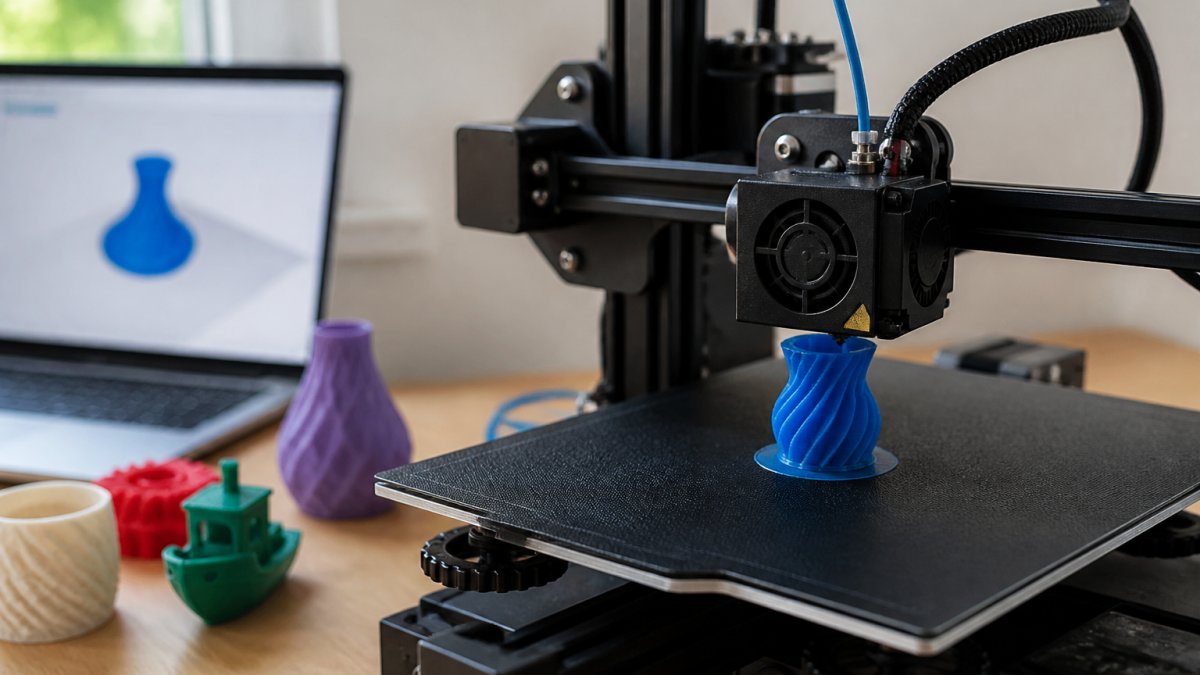
Custom parts are where the hobby pays you back. A replacement knob for a cabinet, a clip for a broken drawer, a phone stand sized exactly to your desk. Obsolete parts for old appliances are a favorite, since replacements often don’t exist anymore. The pattern to look for is anything discontinued, oddly sized, or specific to your setup.
Projects That Pair With Hobbies You Already Have
If you already make things, printing multiplies what you can do. Model railroaders print tiny buildings and rolling stock details. Jewelry makers print custom molds, ring sizers, and display stands. Board gamers print organizers, terrain, and replacement pieces. Gardeners print seed starters and plant labels. The easiest first project is almost always an accessory for a hobby you already love.
Measure twice with calipers, not a ruler. A millimeter of error on a functional part means a reprint, and reprints add up in both time and filament.
Learning 3D Modeling and Design: A Hands-On Education
Design skills grow faster through small projects than through tutorials. Free tools like Tinkercad suit absolute beginners, while Fusion 360 and Blender reward more serious learners. The hobby doubles as an education in geometry, tolerances, and problem-solving.
Combining 3D Printing with Other Hobbies
This is where the hobby gets genuinely fun. Model railroaders print tiny buildings. Jewelry makers print custom molds and display stands. Rocketry enthusiasts print fins and nose cones. If you already craft, you’ll find a hundred uses. Our jewelry-making essentials pair naturally with printed organizers and display pieces.
Safety, Ventilation, and Responsible Use
Print in a ventilated space, away from where you sleep. Some filaments release fumes when heated, and resin printing demands gloves and airflow. Keep the machine on a stable surface, supervise long prints, and follow the manufacturer’s electrical guidance.
Safety isn’t optional. A cheap enclosure and an open window solve most beginner concerns, and they cost far less than a doctor’s visit.
Conclusion: Your First Steps into 3D Printing
The hardest part is choosing a starting point, and that’s exactly where we can help. Craft Living Artistry curates kits, filaments, and maker tools so you’re not piecing together a setup from five different stores. Our focused selection means fewer wrong turns. Get started with Craft Living Artistry and turn your first idea into something you can hold.
Frequently Asked Questions
Is 3D printing a good hobby for beginners?
Yes, 3D printing is very accessible for beginners. Many modern printers are designed for ease of use, with auto-leveling and simple software. You don’t need to know how to code; you can start by downloading free designs and printing them. The learning curve is mostly about understanding your printer and materials, which is part of the fun. It’s a hands-on hobby that rewards curiosity and experimentation, making it great for creative people.
How much does it cost to start a 3D printing hobby?
The cost to start a 3D printing hobby varies based on the printer and materials you choose. Entry-level printers are available, and filament spools are sold. You’ll also need to account for tools and potential upgrades. For a realistic breakdown, check Craft Living Artistry’s website for current pricing on printers and filament. Many beginners start with a budget-friendly setup and expand as they learn.
What can you actually make with a 3D printer at home?
You can make a wide variety of items: custom parts for repairs, household organizers, toys, jewelry, art pieces, and even prototypes for inventions. The possibilities are nearly endless. Beginners often start with simple projects like phone stands, planters, or replacement knobs. As you learn 3D modeling, you can design your own creations. Combining 3D printing with other hobbies, like rocketry or cosplay, opens up even more project ideas.
Is 3D printing safe for home use?
3D printing is generally safe for home use when you follow proper precautions. The main considerations are ventilation and material choice. Printing with PLA, a common beginner material, produces minimal odors, but some filaments require better ventilation. Always operate your printer in a well-ventilated area, avoid touching hot parts, and keep small prints away from pets and children. Following the manufacturer’s safety guidelines and using common sense will help you enjoy the hobby responsibly.



0 Comments