
Quick Summary
Gemstone bead quality combines how a bead looks, how it is made, and whether it will hold up in your piece. Professionals check material identity, color evenness, surface polish, shape and size uniformity, drill hole cleanliness, and durability together rather than judging color alone.
- Confirm the bead is the stone named, since glass, resin, and dyed stone can look similar.
- Ask ssellers directly whether beads are natural, dyed, or heat-treated, and expect a plain answer.
- Inspect each bead under good light with a loupe, checking color, cracks, chips, and polish.
- Measure diameter with digital calipers and judge the spread between minimum and maximum, not the average.
- Check drill holes for centering, clean rims, and internal cracks, since poor holes cause early failure.
Table of Contents
- What Gemstone Bead Quality Actually Means
- Natural, Dyed, and Heat-Treated Gemstone Beads Compared
- How to Identify Real Gemstone Beads Before You Buy
- Color, Clarity, Cut, and Polish: A Bead-by-Bead Inspection Checklist
- Checking Size and Shape Consistency Across a Strand
- Drill Holes, Durability, and Quality Trade-Offs by Jewelry Use
- Certification, Verification Limits, and Your Next Bead Purchase
- Frequently Asked Questions
What Gemstone Bead Quality Actually Means
Last Updated: November 16, 2026
Gemstone bead quality combines how a bead looks, how it’s made, and whether it will hold up in your piece. For a broader guide to choosing quality jewelry beads, see choosing quality jewelry beads.
Small differences in bead quality can change how a finished piece looks, and the same stone can look flawless in a photo yet show uneven color or chipped drill holes in hand.
Here is what professionals usually look at:
- Material identity: Is the bead the stone it claims to be, or glass, resin, or dyed stone?
- Color: Is it even across the bead, and consistent across the whole strand?
- Surface and polish: Is the finish smooth, free of pits, scratches, or dull patches?
Many buyers focus mainly on color, but a strong bead should pass all of these checks.
Natural, Dyed, and Heat-Treated Gemstone Beads Compared
Many beads sold as gemstone are not untreated natural stone. Some are dyed to add or intensify color; some are heat-treated to change appearance. Neither practice is automatically bad, but each affects what you’re paying for and how the bead behaves.
- Natural (untreated): Color and inclusions come from the stone itself. These usually cost more and vary more from bead to bead.
- Heat-treated: Heat is commonly used to improve color in some stones. Disclosure is the key question.
- Dyed: Color is added to porous stones like some agates and jaspers. Dye can fade with light, heat, or wear.
Ask the seller directly whether beads are natural, dyed, or treated. Good sellers answer plainly. You can also browse the best beads for professional jewelry making to compare options.
Spotting Dye and Treatment Signs
Look for signs that color sits on the surface instead of running through the stone:
- Color that pools in cracks or drill holes
- Unnaturally uniform color with no banding that matches the stone type
- Dye residue on your fingers after rubbing a bead with a damp cloth
Some treatments are hard to detect without lab testing, so visual checks have limits.
How to Identify Real Gemstone Beads Before You Buy
Online, you can’t handle the beads, so read the listing carefully. Look for the exact stone name, not a general term like “healing stone” or “crystal.”
Use this quick process:
- Check the material name. “Amethyst” is more specific than “purple gemstone.”
- Look for treatment disclosure. A seller should say if beads are dyed or heat-treated.
- Compare weight and feel. Glass is often lighter than natural stone of the same size.
- Look for consistency across photos. Multiple close-ups should show the same color and pattern.
- Ask for a clear photo of several beads together. This shows how well the batch matches.
Imitations often look too perfect. Natural stone usually shows small variations in color, banding, or texture.
Color, Clarity, Cut, and Polish: A Bead-by-Bead Inspection Checklist
When beads arrive, inspect them one at a time under good light. A simple loupe or magnifier helps. Use this checklist:
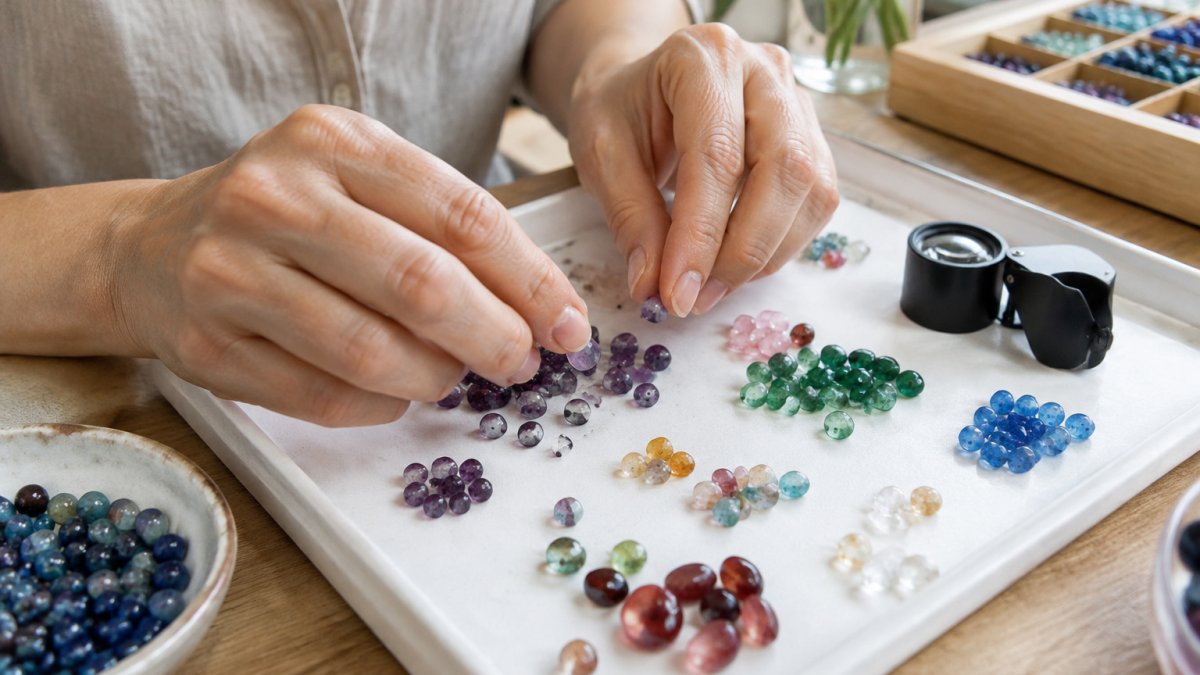
- Color: Is it even, without patchy spots or unexplained lighter areas?
- Clarity: Are inclusions natural and expected for the stone type, or do they look like flaws?
- Cut: Are facets crisp and evenly spaced on faceted beads?
Machine-faceted beads tend to be more uniform; hand-cut beads may show more character. Neither is wrong, but know which you’re buying.
!Close-up of hands in a bright craft studio sorting loose gemstone beads on a white tray with a magnifying loupe beside them
Checking Size and Shape Consistency Across a Strand
Consistency separates a strand that reads as a set from one that looks assembled from leftovers. Work on a flat, neutral tray under daylight or a daylight-balanced lamp, and lay the full strand out in a single line before judging.
Measure diameter, don’t eyeball it
Digital calipers give a more precise measurement than estimating by eye, so measure a sample of beads spread across the strand and record the minimum and maximum.
- Nominal size vs. actual: A strand sold as 8 mm rarely measures exactly 8.00 mm on every bead. What matters is the spread: a tight spread holds a design together; a wide spread shows as a lumpy line.
- Where variation hides: Measure across the widest point of each bead, not at the drill hole, and measure faceted beads across the same axis each time.
- Batch comparison: Compare spreads, not just averages. A strand averaging 8 mm with a 0.6 mm spread looks less uniform than one averaging 7.9 mm with a 0.2 mm spread.
Check shape, not just size
Two beads can measure the same diameter and still not match.
- Roundness: Roll round beads across a flat surface. A true round bead tracks straight; an oval or off-round bead curves or wobbles.
- Profile: Turn each bead and compare its silhouette against its neighbors. Coin, rondelle, faceted, and nugget shapes each have an expected profile that a strand should hold consistently.
- Facet alignment: On faceted beads, check that facet count and placement are consistent. Mixed facet patterns within a strand often signal mixed production runs.
Match color across the strand
Color matching is where photos mislead most. Judge the strand as a whole, then in pairs.
- View in daylight: Incandescent light warms color and hides cool tones; daylight or a daylight-balanced lamp shows the true range.
- Look for drift: Some strands shift gradually end to end, which is common in natural stone. Decide whether a gradual shift suits your design or whether you need a matched set.
- Check pattern, not just hue: Banding, mottling, and inclusions are part of the stone’s identity. The question is whether pattern density is consistent enough for your piece.
Count defects, don’t just notice them
Defect frequency is the most useful number for comparing batches, and almost no listing gives it to you.
- Tally per strand: Count chips, cracks, dull patches, and off-color beads across the full strand. A strand with two or three outliers can often be sorted; one with a dozen is a different product.
- Sort before you commit: For a large order, ask the supplier how many beads per strand typically fall outside spec, and whether they will replace or credit outliers.
- Photograph the outliers: Keep a photo of the worst beads next to the listing photo as evidence if received quality does not match the description.
Watch out: a single close-up photo can make a strand look more uniform than it is, because the camera compresses color and hides size drift.
Compare strands and batches like a buyer
When choosing between suppliers or planning a multi-strand piece, compare on the same criteria every time: measured diameter spread, shape consistency, color range, and defect count per strand. Ask for a photo of several beads side by side with a ruler or caliper in frame, and request the same view from each supplier.
The article’s measurement guidance can be scanned quickly, so here is a summary of the key checks.
| Check | How to do it | What to look for |
|---|---|---|
| Diameter | Measure a sample with digital calipers | Tight spread between min and max |
| Roundness | Roll each bead across a flat surface | Track straight, no wobble |
| Profile | Compare silhouettes across neighbors | Consistent shape for the type |
| Color | View in daylight or daylight-balanced lamp | Gradual shift vs. matched set |
| Defects | Tally chips, cracks, dull or off-color beads | Two or three outliers per strand |
Drill Holes, Durability, and Quality Trade-Offs by Jewelry Use
Drill holes are the most under-inspected part of a bead and the most common cause of early failure. A rough, off-center, or undersized hole can fray thread, abrade wire, crack under tension, or keep a bead from sitting straight on the strand. General gemstone grading rarely addresses this, so treat hole quality as its own pass-or-fail check.
What to check at the drill hole
Work bead by bead under a loupe or a 10x magnifier with a bright, diffused light. Rotate each bead so the hole opening faces you, then tilt it to see into the channel. To match hole durability to your project, you can shop a natural stone beads jewelry kit suited to that use.
- Centering: On a round bead, the hole should enter and exit near the poles. Roll the bead on a flat surface; an off-center hole wobbles or drifts instead of tracking straight, making a finished strand look kinked.
- Diameter consistency: Pass your actual stringing material through a sample of beads. The hole should clear the cord or wire without forcing, but not so much that the bead slops. Hole diameter often varies within a single strand, changing how the piece drapes.
- Edge condition: Look at the rim where the hole meets the surface. Chipped or flared edges act like a rasp on thread and can saw through it under repeated movement. A cleanly drilled hole has a crisp, unchipped rim on both sides.
Watch out: a bead that looks flawless on the outside can still have a hole that is chipped on the exit side.
Stringing compatibility
Hole size and stringing material have to be matched deliberately, not by guesswork.
- Thread and cord: For knotted silk or nylon, the hole must pass the cord twice where knots sit between beads. If too tight, knots bunch and the strand loses spacing.
- Wire and beading cable: Wire’s stiffness amplifies any rough edge inside the hole. Nylon-coated beading cable is more forgiving, but a chipped hole can still cut the coating and expose the core.
- Headpins and eye pins: For drop earrings, the hole must clear the pin gauge with a little room; a press-fit hole can crack a brittle stone when the pin is bent.
Durability trade-offs by jewelry use
Acceptable inclusions, hardness, polish, and drilling all shift with how the piece will be worn. Match the bead to the job rather than applying one standard everywhere.
- Earrings: Weight and comfort matter more than abrasion resistance because earrings see less contact. Lighter beads with clean, centered holes usually suffice. For drops, check that the hole isn’t so close to the edge that the stone chips at the drill point.
- Bracelets: Bracelets rub against skin, clothing, and surfaces all day, so hardness and edge condition carry more weight. Choose scratch-resistant stones and beads with smooth, unchipped hole rims, since the strand flexes constantly at each hole.
- Necklaces: Larger beads concentrate load at each hole. Check that holes are centered and crack-free, and match stringing material to weight. A heavy statement necklace on thin cord puts the most stress exactly where the drill hole is weakest.
Trade-offs are normal and not automatically defects. A softer stone may look beautiful but scratch; a dyed bead may be affordable but fade; a hand-drilled bead may show slight hole variation that a machine-drilled bead would not.
Certification, Verification Limits, and Your Next Bead Purchase
Some sellers mention certificates or grading reports. These can help, but they don’t guarantee every bead on a strand. Certification often covers a specific stone rather than an entire batch, and it is not always clear what was tested.
Keep these points in mind:
- Ask what a certificate actually covers.
- Save listings, photos, and receipts for returns or disputes.
- Check the seller’s return terms if beads don’t match their description.
Good quality is a practical decision, not a single checkbox. Use the checklist above, compare beads carefully, and buy from sellers who describe their stones clearly.
Frequently Asked Questions
Where can I get quality gemstone beads?
Look for sellers who state whether each stone is natural, dyed, or heat-treated, and who show close photos of individual beads rather than only a stock image of a full strand. Good sources also describe drill-hole finish and list strand lengths and bead counts. Craft Living Artistry carries a curated selection of beads for jewelry making; for current availability and details on any specific strand, check the product page on the Craft Living Artistry website or contact the team directly.
How can you tell if gemstone beads are real?
Start with the seller’s disclosure, then inspect the beads yourself. Real stones usually show natural irregularities, varied internal patterns, and color that is not perfectly uniform from bead to bead. Glass and resin imitations often look unnaturally identical and can feel lighter or warmer to the touch. Dye tends to collect in drill holes and cracks, so a magnifier is useful. A simple test cannot prove identity with certainty, so treat the seller’s written disclosure and any lab documentation as the stronger evidence.
What is the most trusted gem certification?
Reports from established gemological laboratories are generally the most respected, because they examine stones with standardized equipment and describe identity, origin where possible, and treatments. Certificates from the seller alone carry less weight unless they name the lab and the report number. Keep in mind that most laboratory reports are issued for individual gemstones rather than bead strands, so a full certificate is rarely practical for a typical bead purchase. For most hobby and jewelry-making needs, a clear written disclosure of treatment and material is the practical standard to look for.
How do gemstone treatments affect bead quality?
Heat treatment and dyeing can improve color and appearance, but they can also make a bead more fragile or change how it looks over time. Dyed beads may fade with light exposure or bleed color when wet, and surface coatings can wear off with handling. Treated beads are not automatically lower quality, but their value and durability differ from untreated ones. Ask whether a strand is treated, and choose undyed or lightly treated beads for projects that will see frequent wear or moisture.




0 Comments