
Quick Summary
Sterling silver wire is the standard choice for silver wire pendants because it holds its shape and keeps its color. Most makers use 20 gauge half-hard wire for the frame and 24 gauge dead-soft wire for binding wraps. Sterling is marked .925, meaning 92.5 percent pure silver.
- Sterling silver is an alloy of 92.5 percent pure silver, usually marked .925.
- 20 gauge is the safest starting point for a first pendant.
- Use half-hard wire for the frame and dead-soft wire for decorative wraps.
- Cut roughly 10 to 12 inches of frame wire plus 6 to 8 inches of binding wire for a simple pendant.
- Store finished pieces in an airtight bag with a tarnish-inhibiting strip.
Table of Contents
- Why Sterling Silver Wire Works Well for Pendants
- Sterling Silver Wire Gauges for Jewelry Making
- Dead-Soft vs. Half-Hard Sterling Silver Wire
- Step-by-Step: Making a Wire-Wrapped Pendant
- Sterling Silver Wire for Ring Making
- Where to Buy Sterling Silver Wire for Jewelry Making
- Start Your Next Pendant With the Right Wire
- Frequently Asked Questions
Last Updated: November 11, 2026
Sterling silver wire is the material most jewelry makers reach for when they want silver wire pendants that look finished and hold their shape. For guidance on picking quality jewelry wire to buy, see how to choose high quality jewelry wire.
Sterling silver is an alloy of 92.5 percent pure silver, usually marked .925 on the wire or the finished piece. The added copper gives it enough strength to hold a wrapped loop or a bail without bending out of shape. Pure silver is too soft for most wire wrapping, so the alloy is the standard choice for pendant work.
This article walks through the decisions that matter most: gauge, temper, a step-by-step wrapping method, and where to buy. Each section answers one practical question, so you can read straight to the part you need.
Why Sterling Silver Wire Works Well for Pendants
Sterling silver combines workability with durability. It bends cleanly around a stone or bead, it springs back a little when you release tension, and it takes a polish that looks bright for years with normal wear.
Many makers also prefer sterling over craft-grade copper or plated wire for silver wire pendants that will be worn against skin or given as gifts.
Sterling Silver Wire Gauges for Jewelry Making
Gauge describes wire thickness. In the American Wire Gauge system, a higher number means a thinner wire. For pendant work, most makers choose between roughly 18 and 22 gauge for the main framework and 24 to 28 gauge for fine wrapping and binding.
- 18 gauge: Sturdy enough for bold pendants, bails, and frames around larger stones. It is harder to bend by hand, so it usually requires pliers.
- 20 gauge: A common all-purpose choice. It wraps easily, holds its shape, and suits most beginner pendants.
- 22 gauge: Delicate and easy to manipulate. Good for fine wrapping, dainty designs, and smaller stones, but it can look flimsy on a heavy pendant.
- 24 to 28 gauge: Best reserved for the fine binding wraps that lash a stone to a frame, not for the frame itself. These sizes kink easily, so feed them slowly and keep tension even.
If you are unsure, 20 gauge is the safest starting point for a first pendant.
Matching Gauge to Pendant Design
The stone or bead you plan to wrap should drive the gauge decision. A heavy, large stone needs a thicker frame, or it will look unbalanced hanging from a thin wire. A small or lightweight bead works well with 22 gauge and looks refined.
Use these starting combinations as a practical guide:
- Wrapping a cabochon or flat stone: 20 or 21 gauge half-hard for the frame, 24 or 26 gauge dead-soft for the binding wraps. The frame carries the weight; the thin wire holds the stone against it.
- Forming a simple bail: 18 or 20 gauge half-hard. A bail takes the full weight of the pendant on the chain, so it needs stiffness more than flexibility.
- Building a wire frame or outline: 18 gauge half-hard for larger frames, 20 gauge half-hard for smaller ones. Frames that will be hammered for texture can start in dead-soft and be work-hardened after shaping.
- Making a dainty, minimalist pendant: 22 gauge half-hard for the structure and 26 gauge dead-soft for accents. Keep the stone small so the proportions stay balanced.
- Wrapping a bead or drop: 20 or 22 gauge half-hard for the loop and 24 gauge dead-soft for the wrap. Beads are lighter than most stones, so thinner wire holds up.
Consider the design too. Open, sculptural pendants with long wire tails need a stiffer gauge to keep their shape. Tight, wrapped designs can use a thinner wire because the wraps add strength.
Planning Wire Length and Cost Before You Cut
Sterling is sold by the foot or in spools, and mistakes waste expensive material. A workable rule of thumb for a simple wrapped pendant is 10 to 12 inches of frame wire plus 6 to 8 inches of binding wire; larger stones and elaborate wraps need more. Before cutting, run the wire around the stone once, add the length needed for the bail and the finishing wraps, then add a 2-inch buffer.
Dead-Soft vs. Half-Hard Sterling Silver Wire
Temper describes how hard the wire is. The three common options are dead-soft, half-hard, and hard.
Dead-soft wire bends and wraps easily with your fingers and light tools. It suits intricate wrapping and forming tight curves.
Half-hard wire holds its shape better.
Many experienced makers combine both. They use half-hard wire for the structural frame and dead-soft wire for the decorative wraps that hold the stone.
The article’s temper comparison can be scanned at a glance:
| Temper | Best for | Key difference |
|---|---|---|
| Dead-soft | Intricate wrapping and tight curves | Bends easily but can sag under weight |
| Half-hard | Outer frames and bails | Holds its shape but needs pliers |
| Combined use | Frame plus decorative wraps | Strength from half-hard, easy shaping from dead-soft |
Step-by-Step: Making a Wire-Wrapped Pendant
This walkthrough uses a single stone or bead, 20 gauge half-hard sterling silver wire for the frame, 24 gauge dead-soft wire for the binding wraps, and basic pliers.
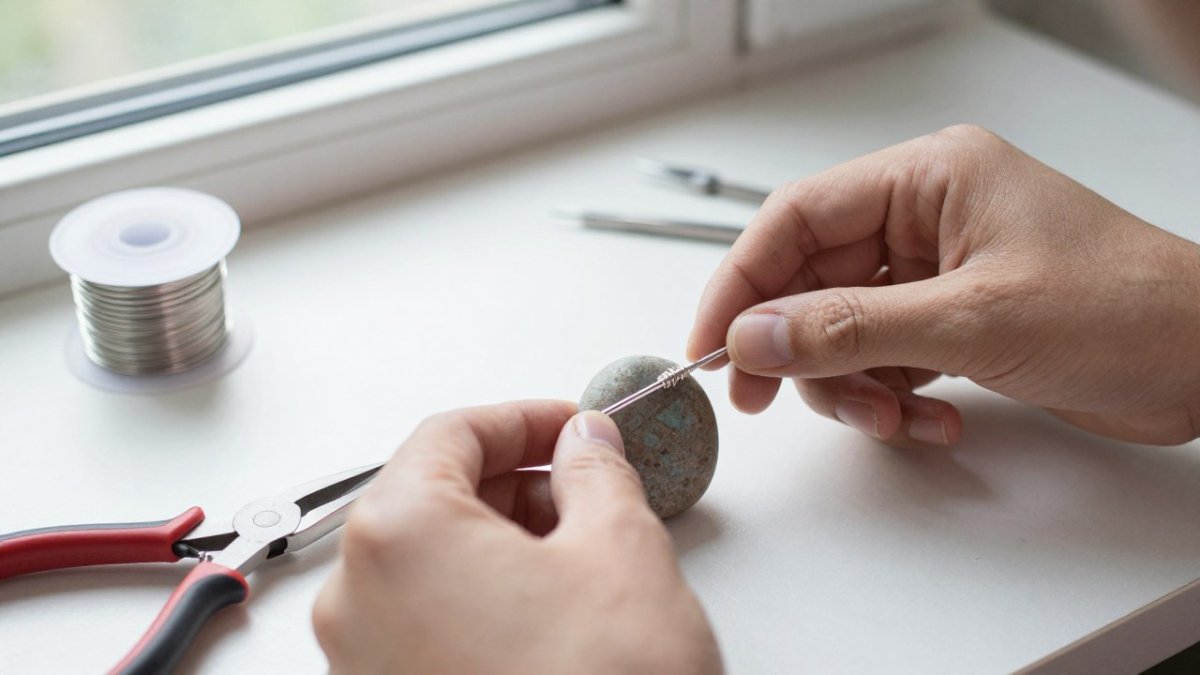
- Cut your wire. Cut roughly 10 to 12 inches of frame wire for a simple pendant, plus 6 to 8 inches of binding wire. Measuring a little long gives you room to correct mistakes.
- Create the bail. Use round-nose pliers to form a loop at the midpoint of the frame wire. This loop is where the pendant chain or cord will pass through. Leave the loop slightly open until the stone is set, then close it flush.
- Position the stone. Place your stone or bead against the wire so it sits centered under the loop.
- Wrap the frame. Bring the frame wire around the stone, crossing it at the top and bottom. For a deeper walkthrough of simple wire-wrapped pendant techniques, see simple wire wrapped pendant techniques. Keep the two sides even so the stone sits centered.
- Bind the stone. Use the thinner dead-soft wire to wrap over the frame wires at several points, pulling each wrap snug against the stone. Keep the wraps tight and evenly spaced.
- Secure the wrap. Once the stone is held firmly, wrap the remaining binding wire several times around the base of the frame, then trim the tail and tuck the end flat with flush cutters and chain-nose pliers.
- Finish the bail and check balance. Close the bail loop, hang the pendant, and make sure it hangs straight. Adjust the bail if it tilts.
A quick note on the common mistake: beginners often pull the wire too tight before the stone is fully held, which pops the stone out of its frame. Snug the wire gradually, checking the stone after each wrap.
Troubleshooting Common Pendant Problems
- Loose wraps: If a binding wrap slides, add one more wrap beside it and press it flat with chain-nose pliers rather than pulling the existing wrap tighter, which can distort the frame.
- Uneven coils: Space wraps by eye against the previous wrap, not against the stone. If a gap appears, unwind that section and rewrap rather than stacking a correction on top.
- A weak or tilted bail: A bail that leans usually means the loop was formed off-center. Reform it around the round-nose pliers and close it with parallel-jaw pliers so the opening stays round.
- Kinked frame wire: Kinks cannot be fully removed from half-hard wire. If a kink appears, cut back to before the kink and restart that section; forcing it straight weakens the wire.
- Tool marks: Wrap the jaws of pliers with tape or use nylon-jaw pliers on visible surfaces. Marks left by serrated jaws are difficult to polish out of thin wire.
Finishing, Polishing, and Tarnish Care
After assembly, smooth every cut end with a fine file or a flush cutter held flat, because a sharp tail can catch on clothing or scratch skin. Polish the finished pendant with a soft cloth and a silver polishing cloth; avoid abrasive pastes on fine binding wire, which can wear the thin wraps. Sterling tarnishes as it reacts with sulfur in the air, so store finished pieces in an airtight bag with a tarnish-inhibiting strip, and clean with mild soap and water rather than harsh dips that can dull the surface.
Tools and Setup You Need
You do not need a large studio to start. A basic kit includes round-nose pliers, chain-nose pliers, flush cutters, a bench block, a fine file, and a soft cloth for polishing. To decide whether you need pliers or wire cutters first, read jewelry pliers vs wire cutters for beginners.
Watch out: cut wire ends are sharp and can fly when trimmed. Cut toward a container or hold the wire low, and wear safety glasses when clipping thin wire.
Sterling Silver Wire for Ring Making
Rings use the same metal but ask for more strength. A ring band is worn daily and bent often, so most makers choose 14 to 16 gauge sterling for the band and a half-hard temper so it keeps its round shape. Sizing matters as well. Wire rings are formed around a ring mandrel, and you should measure your finger or use an existing ring as a guide before cutting.
Where to Buy Sterling Silver Wire for Jewelry Making
When comparing sterling silver wire options, check three things: the .925 stamp or stated purity, the gauge and temper listed, and the length included. Pricing depends on quantity and current market conditions, so visit the Craft Living Artistry website for current prices and availability.
Start Your Next Pendant With the Right Wire
Choosing sterling silver wire comes down to three decisions: gauge for the frame, temper for the shape you want, and purity so you know what you are buying. Start with 20 gauge, use half-hard wire for structure and dead-soft for wraps, and work slowly as you learn. Craft Living Artistry aims to make crafting accessible and enjoyable for everyone. Pick one stone, cut a short length of wire, and wrap your first piece this week.
Frequently Asked Questions
What is the best sterling silver wire for pendants?
For most pendants, 20 to 22 gauge sterling silver wire offers a good balance of strength and workability. Round wire in .925 sterling silver is the most common choice for wrapping and framing stones. Thicker 18 gauge wire suits bold, sculptural designs, while 24 gauge works for delicate bails and fine wrapping. Choose based on the weight of your pendant element and the look you want. Check that the wire is stamped .925 so you know it is genuine sterling silver.
Should I use dead-soft or half-hard wire for a pendant?
Dead-soft wire is easy to bend and wrap around a stone or shape into a bail, but it can deform under stress. Half-hard wire holds its shape better once formed, which makes it a strong choice for a finished pendant that will be worn daily. Many makers wrap with dead-soft wire for flexibility and use half-hard for frames or bails that need to keep their form. Work-hardening during forming also stiffens soft wire, so plan your bends accordingly.
Where can I buy sterling silver wire for pendants?
Craft Living Artistry carries jewelry-making essentials, and you can visit the website for current availability and product details. Specialty bead and jewelry supply shops also stock sterling silver wire in multiple gauges and hardness levels. When buying, check that the listing states .925 composition, gauge, hardness, and length so you know exactly what you are getting before you order.
Can I use sterling silver wire to make a bail for a pendant?
Yes. A bail is the loop that connects a pendant to a chain, and sterling silver wire is a common material for it. Use 18 to 20 gauge half-hard wire for a sturdy bail that holds its shape, or dead-soft wire if you want to form it more easily and then harden it by hand. Wrap the loop tightly and trim the ends neatly so the bail sits flat against the pendant.





0 Comments