
Table of Contents
- What Is the Difference Between Clay Types
- Earthenware vs Stoneware vs Porcelain: Core Properties
- Best Clay for Beginners: Making Your First Choice
- Pottery Clay Firing Temperatures and Cone Systems
- Specialized Clay Types: Fire Clay, Ball Clay, and Air-Dry Options
- Choosing Clay for Hand-Building vs. Wheel Throwing
- Cost, Storage, and Troubleshooting Common Clay Failures
- Frequently Asked Questions
Last Updated: September 25, 2026
What Is the Difference Between Clay Types
Understanding clay types is essential before you commit time and money to a pottery project. Different clays fire at different temperatures, demand different skill levels, and produce vastly different results. The difference between earthenware, stoneware, and porcelain isn’t just academic, it determines whether your finished piece will hold water, survive thermal shock, or shatter in your kiln.
At Craft Living Artistry, we help beginners and experienced potters navigate these choices by breaking down the practical differences that actually matter. Whether you’re hand-building a decorative bowl or throwing functional dinnerware, selecting the right clay type is your first critical decision. Below, we’ll show you exactly how each clay type behaves, what equipment you’ll need, and which one matches your skill level and project goals.
Earthenware vs Stoneware vs Porcelain: Core Properties
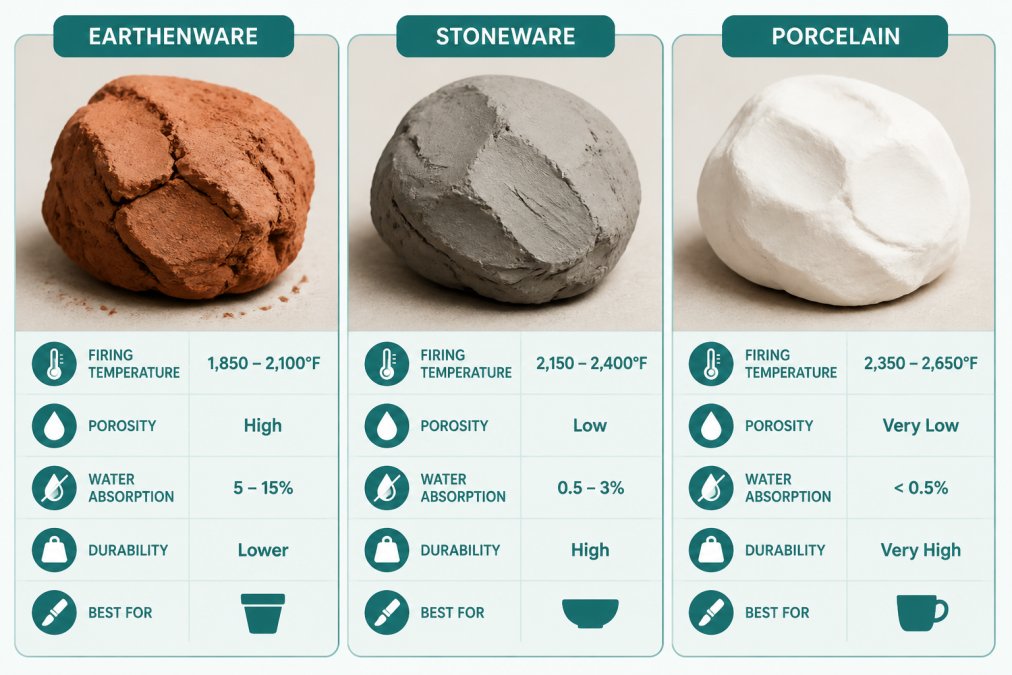
These three clay types represent the spectrum from beginner-friendly to advanced, and their differences run deep. Each fires at a different temperature range, exhibits different workability, and produces different durability and appearance in the finished piece.
Earthenware: Low-Fire, High Plasticity
Earthenware is the most forgiving clay for beginners. It fires at low temperatures (typically Cone 06-04, around 1,828-1,945°F), making it accessible if you don’t have access to a high-temperature kiln. The clay body remains porous even after firing unless glazed, which means it won’t hold liquids without a waterproof glaze coating.
What makes earthenware popular is its plasticity, it’s responsive to your hands and forgiving of mistakes. The clay is soft and easy to shape, making it ideal for hand-building techniques like pinch pots, coil building, and sculpting. Earthenware comes in warm terracotta reds, whites, and earth tones. The texture is relatively smooth compared to heavily grogged stoneware.
The trade-off: earthenware pieces are fragile. They chip easily and can’t withstand thermal shock, sudden temperature changes will crack them. If you’re making decorative pieces or learning the fundamentals, earthenware is your best starting point. For functional dinnerware that needs to survive daily use and dishwashers, earthenware falls short.
Stoneware: Mid-Fire Durability
Stoneware fires at mid-range temperatures (typically Cone 5-6, around 2,167-2,232°F) and becomes significantly more durable than earthenware. The clay vitrifies partially, meaning the particles fuse together, creating a denser body that’s stronger and more chip-resistant. Stoneware is the workhorse of functional pottery.
This clay type handles daily use. Mugs, bowls, plates, and serving dishes made from stoneware survive dishwashers, thermal shock from hot liquids, and years of handling. The clay body is typically gray or buff-colored, and it often contains grog, particles of pre-fired clay added to reduce shrinkage and improve structural integrity. Grog gives stoneware a slightly rougher texture than earthenware, which some potters love for its rustic aesthetic.
Stoneware demands more skill than earthenware. The clay is stiffer and less plastic, making it harder to hand-build with. Wheel throwing stoneware is more challenging because the clay resists your hands. You’ll need access to a kiln capable of mid-range firing, which is more common than high-fire equipment but still requires planning.
The real advantage: stoneware is the sweet spot for most potters. It’s durable enough for functional work, forgiving enough for developing technique, and achievable without industrial equipment.
Porcelain: High-Fire Refinement
Porcelain is the premium clay type. It fires at high temperatures (typically Cone 10, around 2,345°F), and the clay fully vitrifies, becoming non-porous, glass-like, and translucent at thin edges. Porcelain pieces are food-safe without glaze and can withstand extreme thermal shock.
The visual appeal is undeniable. Porcelain has an extremely fine, smooth particle size that allows for delicate details and thin-walled vessels. The finished pieces feel refined and have a subtle white or off-white color. Professional potters and ceramic artists favor porcelain for its aesthetic qualities and durability.
Here’s the catch: porcelain is difficult to work with. The clay has low plasticity, meaning it resists your hands and cracks easily during hand-building. Wheel throwing porcelain requires significant experience, the clay is unforgiving of technique errors. Porcelain also shrinks dramatically during drying and firing (up to 15%), which means pieces crack if dried too quickly or fired in the wrong conditions.
Porcelain demands high-fire kiln access, which limits your options. The clay is more expensive than earthenware or stoneware. If you’re a beginner, porcelain will frustrate you. If you’re an experienced potter with proper equipment, it opens possibilities that other clays can’t match.
Porcelain’s high shrinkage rate is its biggest challenge. Experienced potters account for this by building thicker walls during hand-building and adjusting wheel-thrown forms to compensate for the final size reduction.
Best Clay for Beginners: Making Your First Choice
Your first clay choice should prioritize workability and access to firing equipment. Earthenware wins on both counts.
Start with earthenware if you’re learning hand-building techniques, don’t have kiln access, or want to experiment without high financial commitment. The clay responds to your touch, forgives pressure inconsistencies, and fires in community studio kilns that accept low-fire work. Your early pieces may not be functional, but they’ll teach you how clay behaves.
Move to stoneware once you’ve mastered basic hand-building and want to create pieces that actually work. If you’re interested in wheel throwing, stoneware is a better learning clay than porcelain because it’s more plastic and forgiving of technique errors. Stoneware also opens functional possibilities, you can make mugs that hold coffee without leaking.
Skip porcelain until you’ve spent at least a year working with other clays. Porcelain’s low plasticity and high shrinkage will defeat you if you’re still learning pressure control and drying techniques. The frustration isn’t worth it at the beginner stage.
Earthenware for learning, stoneware for function, porcelain for refinement. This progression matches skill development with material capability.
Pottery Clay Firing Temperatures and Cone Systems
Firing temperature is the single most important variable that separates clay types. Temperature determines whether clay particles fuse (vitrify), how strong the final piece becomes, and what glazes are compatible.
The cone system is the standard measurement for kiln temperature. Each cone number represents a specific temperature range and is designed to bend at that temperature, signaling that the kiln has reached the target. Cone 06 (the lowest common cone for earthenware) fires around 1,828°F. Cone 10 (high-fire porcelain) reaches 2,345°F. The difference matters enormously, a piece fired at Cone 06 will be porous and fragile; the same clay body fired at Cone 10 would vitrify completely.
Earthenware fires in the low range: Cone 06 through Cone 04 (1,828-1,945°F). At these temperatures, the clay particles soften and partially fuse, but the body remains porous. Glazes designed for low-fire are formulated to melt and seal at these lower temperatures.
Stoneware fires in the mid-range: Cone 5 through Cone 6 (2,167-2,232°F). At these temperatures, the clay vitrifies significantly. Glazes formulated for mid-fire melt and bond to the clay body, creating a sealed, waterproof surface.
Porcelain fires at high temperatures: Cone 10 (2,345°F) or sometimes Cone 9 (2,300°F). Full vitrification occurs, and the clay becomes non-porous even without glaze. High-fire glazes are engineered to melt at these extreme temperatures without running off the piece.
Firing temperature also affects workability during drying. Higher-fire clays shrink more and are more prone to cracking during the drying stage before firing. This is why porcelain requires careful drying protocols, any inconsistency in moisture content will cause cracks that appear before the kiln even opens.
Specialized Clay Types: Fire Clay, Ball Clay, and Air-Dry Options
Beyond the main three, several specialized clay types serve specific purposes.
Fire clay is a refractory clay designed to withstand extreme heat without melting.
Fire clay is extremely stiff and difficult to throw on a wheel. Using it for hand-building requires significant wedging and conditioning. Many beginners assume fire clay is just another clay type, it’s actually a specialty material for specific applications.
Choosing Clay for Hand-Building vs. Wheel Throwing
Hand-building and wheel throwing demand different clay properties, and your technique choice should influence your clay selection.
Cost, Storage, and Troubleshooting Common Clay Failures
Clay cost varies significantly by type and firing temperature. For current pricing and bulk options, visit Craft Living Artistry to explore clay selections and available quantities.
Common clay failures and fixes:
The most common beginner failure is choosing clay without considering firing access and equipment. Know your kiln’s maximum temperature before buying clay.
| Clay Type | Firing Temperature | Best For | Plasticity | Durability |
|---|---|---|---|---|
| Earthenware | Cone 06-04 (1,828-1,945°F) | Beginners, hand-building | High | Low |
| Stoneware | Cone 5-6 (2,167-2,232°F) | Functional pottery, wheel throwing | Medium | High |
| Porcelain | Cone 10 (2,345°F) | Advanced potters, refined work | Low | Very High |
| Air-Dry | No firing required | Sculptors, classrooms, decor | Variable | Low |
Frequently Asked Questions
What is the difference between earthenware, stoneware, and porcelain?
Earthenware fires at low temperatures (Cone 06-04) and remains porous even after firing, making it easy for beginners but less durable. Stoneware fires at mid-range temperatures (Cone 5-6) and vitrifies partially, creating functional, durable pieces ideal for dinnerware. Porcelain fires at high temperatures (Cone 10), vitrifies completely, and produces a non-porous, glass-like finish perfect for delicate work. Each has different plasticity, shrinkage rates, and workability characteristics.
Which clay type is best for beginners?
Earthenware is the best clay for beginners because it has high plasticity, forgiving handling, and fires at lower temperatures that consume less kiln energy. It’s easier to shape, less prone to cracking during drying, and doesn’t require advanced technique. Stoneware is a close second for those with access to mid-range kiln equipment. Air-dry clay is an excellent alternative if you don’t have kiln access at all.
Does clay type affect firing temperature?
Yes, clay type directly determines firing temperature. Earthenware fires at Cone 06-04 (roughly 1,800-1,900°F), stoneware at Cone 5-6 (roughly 2,200-2,300°F), and porcelain at Cone 10 (roughly 2,345°F). The particle size, mineral composition, and flux content of each clay body require specific heat to achieve proper vitrification and final properties. Firing at the wrong temperature can result in underfired, crumbly pieces or overfired, warped work.
What is the difference between air-dry clay and kiln-fired clay?
Air-dry clay hardens through water evaporation over 24-48 hours without kiln access, making it ideal for hobbyists and classrooms. It remains fragile and not waterproof or food-safe. Kiln-fired ceramic clay (earthenware, stoneware, or porcelain) undergoes chemical transformation through heat, creating durable, waterproof, food-safe pieces. Kiln firing requires equipment and knowledge but produces pieces suitable for functional use and long-term durability.


0 Comments