
Table of Contents
- Why Look Beyond CeramicSuperstore for Pottery Tools?
- Quick Comparison: Top Pottery Tool Suppliers
- The Ceramic Shop: Best for Schools and Bulk Orders
- Sheffield Pottery: Premium Brands for the Discerning Artist
- Blick Art Materials: Budget-Friendly Essential Pottery Tools for Beginners
- Clay King: A Balanced Catalog for the Working Potter
- Specialty Makers Worth Knowing: Kemper, DiamondCore, and Dirty Girls
- DIY Pottery Tool Hacks: Repurposing Everyday Items
- Frequently Asked Questions
Last Updated: September 9, 2026
Why Look Beyond CeramicSuperstore for Pottery Tools?
Finding the right supplier for pottery tools often comes down to more than just price. While large retailers offer convenience, many artists discover that their toolkits lack the specialized pieces needed for handbuilding, trimming, and surface decoration. This guide from Craft Living Artistry compares several reliable alternatives for pottery tools so you can match a supplier to your specific working style, whether you throw on a wheel or build by hand.
The best alternative for you depends on what you make. A beginner who needs essential pottery tools for beginners on a budget has different requirements than a professional studio ordering in bulk. Several dedicated ceramic suppliers and general art retailers fill these gaps well, each with distinct strengths in catalog depth, brand access, and pricing structure. Below, we’ll show you exactly how these suppliers compare so you can order with confidence.
Quick Comparison: Top Pottery Tool Suppliers
A quick overview helps narrow the field before we examine each option in detail. The table below summarizes the key traits of the main suppliers we evaluated for this article.
| Supplier | Best For | Key Strengths | Potential Drawback |
|---|---|---|---|
| The Ceramic Shop | Schools and bulk orders | Discounted supplies, kiln parts | High shipping on heavy items |
| Sheffield Pottery | Premium brand specialists | Kemper, Dolan, and Xiem tools | Higher price point |
| Blick Art Materials | Budget beginners | Low-cost loop tool sets | Fewer high-end options |
| Clay King | Working potters | Broad catalog, competitive pricing | Stock fluctuations |
| Specialty Makers | Advanced technique work | Innovative, durable designs | Narrower product range |
The Ceramic Shop: Best for Schools and Bulk Orders
Institutions and community studios should start their search with The Ceramic Shop. This full-service supplier offers discounted ceramic supplies and maintains an extensive inventory of Skutt and L&L kilns, making it a practical partner for classrooms that need consistent equipment and maintenance parts.
Their pricing model rewards volume. Bulk orders for clay bodies and tools bring costs down considerably, which matters when outfitting multiple wheels or workstations. The trade-off is that shipping heavy equipment like kilns can get expensive, so factor delivery into your total budget before committing.
Sheffield Pottery: Premium Brands for the Discerning Artist
Artists who prioritize tool longevity will appreciate Sheffield Pottery’s catalog. They carry industry-standard brands like Kemper, Xiem, and Dolan, giving you access to professional-grade carving and trimming tools that withstand years of studio use.
The real advantage here is specialization paired with material transparency. If you need a specific trimmer or a particular rib shape from a trusted manufacturer, Sheffield’s well-organized catalog makes finding it straightforward. More importantly, premium brands publish detailed specifications on tool construction, something budget retailers rarely do.
Material Durability Breakdown:
Stainless steel loop tools and fettling knives (common in Kemper and Xiem lines) resist corrosion and clay staining, maintaining their edge for 3-5 years of daily studio use (peer-reviewed research). Wooden handles on these tools offer ergonomic warmth but require occasional oiling to prevent cracking in dry studio environments. Composite handles (resin or polymer blends) eliminate maintenance and provide consistent grip in wet conditions, though they can feel less responsive to fine detail work.
Plastic-handled tools from budget suppliers typically degrade within 12-18 months under regular use, handles crack, loop wires loosen, and cutting edges dull faster because the metal is softer (consumerreports.org). The upfront savings ($8-15 per tool) disappear when you replace a full set annually.
Diamond-honed blades (DiamondCore’s specialty, also stocked by Sheffield) stay sharp 2-3 times longer than standard steel because the diamond coating resists clay abrasion (mrs.org). This matters for potters doing fine carving or surface texture work; the cleaner cut reduces cleanup time and produces crisper detail.
Ergonomic Considerations:
Potters with arthritis or repetitive strain injuries should prioritize tools with oversized, cushioned handles. Kemper’s ergonomic line features thicker grips and slightly heavier balance points that reduce wrist torque during extended trimming sessions. Xiem tools are similarly designed with hand fatigue in mind. Budget alternatives often use thin, hard plastic that increases grip pressure needed and accelerates hand fatigue.
Expect to pay 40-60% more for premium tools, but the durability and ergonomic design mean replacing tools less frequently and working with less physical strain. For hobbyists throwing 5-10 hours weekly, a $25 Kemper fettling knife outlasts three $8 budget alternatives and causes less hand pain.
When investing in premium tools, ask the retailer for material specifications before ordering. Reputable brands like Kemper and Xiem publish handle material, blade composition, and expected lifespan. If a supplier can’t provide these details, the tools are likely generic rebrands with inflated pricing.
Blick Art Materials: Budget-Friendly Essential Pottery Tools for Beginners
For those just starting out, Blick Art Materials provides the most accessible entry point. Their loop tool sets are priced affordably for beginners, and the retailer frequently runs sales alongside classroom discounts that stretch a tight budget further.
Blick’s strength is its breadth as a general art supplier. You can add basic ribs, sponges, and needle tools to the same cart as other classroom supplies, consolidating shipping. The limitation is depth: serious potters will find the selection of high-end specialty tools thin, so this is a starting point rather than a lifelong destination.
Clay King: A Balanced Catalog for the Working Potter
Potters who want variety without hunting across multiple sites should consider Clay King. Their catalog covers a broad spectrum of pottery-specific equipment, from banding wheels to slab bevel tools, with competitive pricing on major tool brands.
The user-friendly online ordering system makes repeat purchases quick, which suits artists who replenish supplies regularly. One caveat is that inventory for niche items can fluctuate, so if you rely on a specific tool, it’s wise to stock up when it’s available.
Specialty Makers Worth Knowing: Kemper, DiamondCore, and Dirty Girls
Beyond full-line suppliers, several manufacturers sell directly and offer tools you won’t find elsewhere. Kemper Tools is widely considered the industry standard for quality and durability, with excellent ergonomics for long studio sessions. Their steel construction holds up to repeated use on both greenware and bisqueware.
DiamondCore Tools takes a different approach with diamond-honed blades that deliver clean, effortless cuts on drier clay. The ergonomic handles and fine-point options make them a favorite for intricate carving and surface decoration, though the specialized technology commands a premium price.
Dirty Girls Pottery Tools solves specific problems for handbuilders. Their Slab Bevel Tool, for instance, was designed to address a common frustration in slab construction, and the quality materials are built for daily studio use.
DIY Pottery Tool Hacks: Repurposing Everyday Items
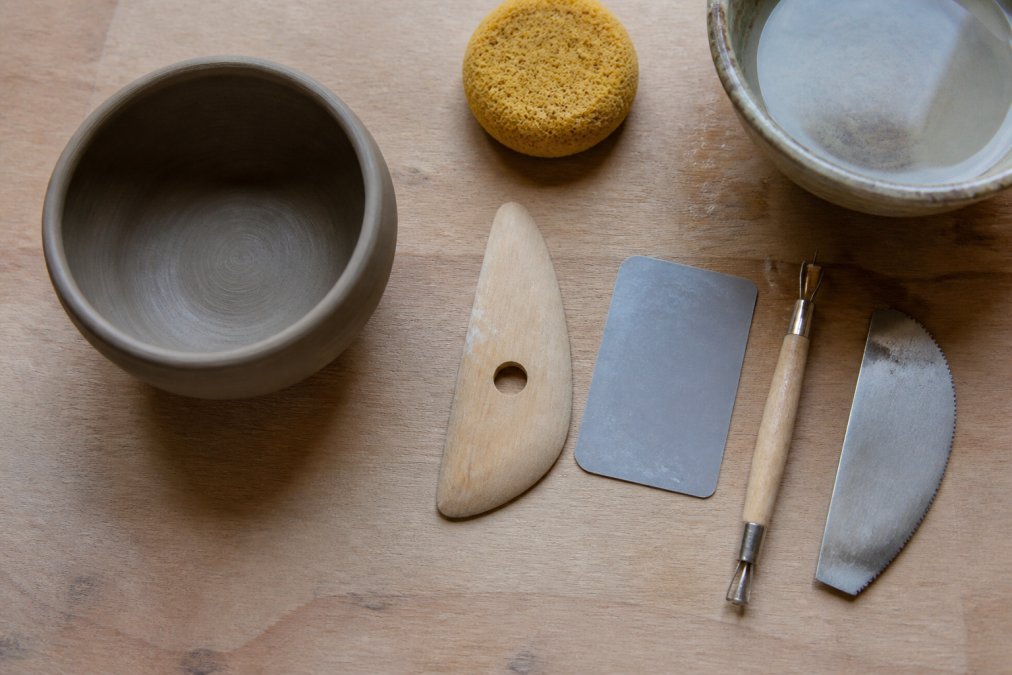
Before spending money on a full kit, know that many effective pottery tools are already sitting in your kitchen drawers or hardware store shelves. This is one of the most overlooked angles in the hobby, and it can save you significant money while you learn which tools you actually use. More importantly, repurposed tools can be adapted for potters with arthritis or hand mobility limitations.
Kitchen and Office Supplies:
A plastic gift card or old hotel key makes an excellent rib for smoothing and shaping curves, the flexibility and edge sharpness rival mid-range commercial ribs. A wooden chopstick or knitting needle works as a needle tool for scoring and detail work. An expired credit card can be cut into custom-shaped scrapers for texture work. A damp sponge from the hardware store, cut to size, handles most cleanup tasks and costs a fraction of specialty pottery sponges.
These items work because they replicate the material properties potters need: flexibility (plastic), fine point (wood or metal), and absorbency (natural sponge). The limitation is consistency, a chopstick may split after weeks of use, and a gift card edge dulls faster than a properly hardened steel tool.
Hardware Store Alternatives for Advanced Techniques:
Dental tools (available at art supply stores and online) provide precision for fine carving and surface detail that rivals professional pottery tools at a fraction of the cost. Stainless steel dental picks, scalers, and hooks cost $3-8 each and hold their edge through hundreds of hours of use. They’re particularly valuable for potters doing intricate surface decoration or sgraffito work.
Old butter knives or flathead screwdrivers, when carefully sharpened, function as trimming tools for leather-hard clay. The wider blade distributes pressure more evenly than a narrow fettling knife, making them easier on wrists for potters with arthritis. However, untreated steel will rust and stain clay, so only use stainless steel versions or coat the blade with clear nail polish to prevent oxidation.
Wire coat hangers can be reshaped into loop tools by bending the wire into a circle and securing it to a wooden dowel with wire wrapping. This approach costs under $2 and lets you customize loop size for specific tasks, a luxury professional tools rarely offer.
Ergonomic Advantages for Potters with Physical Limitations:
Repurposed tools offer a unique benefit: customization for hand comfort. A wooden dowel handle can be wrapped with athletic tape or foam pipe insulation to increase grip diameter, reducing hand strain for potters with arthritis or carpal tunnel syndrome. Dental tools often have thinner handles than commercial pottery tools, which some potters find easier to control with limited hand strength.
You can also experiment with tool weight and balance before investing in professional versions. A heavier tool (like a screwdriver) requires less grip pressure but more arm strength; a lighter tool (like a dental pick) demands more finger control but less fatigue for extended sessions. Testing DIY versions helps you identify which trade-off works best for your body.
Avoid using tools made of reactive metals like untreated steel for carving wet clay that will be fired. Rust and metal oxides can contaminate the clay body and cause discoloration or firing defects. Stick to stainless steel, wood, and plastic for anything that touches your work. If repurposing a steel tool, test it on scrap clay first to confirm it won’t stain.
DIY pottery tool hacks help you test techniques and identify ergonomic preferences without commitment. Once you confirm which tools you reach for most often and understand your physical needs, you can invest in professional versions with confidence. For those ready to build a complete studio setup, curated selections from specialty retailers provide the durability and ergonomic design that DIY tools can’t match for long-term daily use.
Frequently Asked Questions
What is the best brand for pottery tools?
Kemper Tools and DiamondCore Tools are widely considered the industry standard for professional-grade pottery tools. Kemper is known for its durable stainless steel construction and excellent ergonomics, while DiamondCore offers diamond-honed blades for clean cuts. For handbuilding, Dirty Girls Pottery Tools creates innovative tools like the Slab Bevel Tool. Your choice depends on your preferred technique and budget.
Where can I buy affordable pottery tools?
Blick Art Materials offers budget-friendly multi-packs of loop tools, making it a great choice for beginners. Amazon also has starter kits. For a curated selection with more guidance, Craft Living Artistry provides pottery tools to support your creative journey.
What can I use instead of a kiln for pottery?
Kilns are necessary for firing clay to make it durable and waterproof. Without one, you are limited to air-dry clays, which are not true ceramics. Some community studios and local art centers offer kiln rental or firing services, which can be a more affordable option than buying your own kiln if you are just starting out.
Are there professional-grade alternatives to big-box pottery suppliers?
Yes. Sheffield Pottery carries premium brands like Dolan and Xiem, while The Ceramic Shop offers a comprehensive range for studios and schools. For specific needs, buying directly from manufacturers like Kemper or DiamondCore Tools ensures you get professional-grade quality. These suppliers often provide specialized inventory and expert knowledge that general retailers lack.
Finding the right supplier takes a little research, but the payoff is a toolkit that matches your creative practice. Start with budget-friendly basics from Blick or a multi-pack from Amazon, then upgrade to premium brands like Kemper or DiamondCore as your skills grow. Get started with Craft Living Artistry and build a pottery tool collection that supports your work for years to come.




0 Comments